Get Full Government Meeting Transcripts, Videos, & Alerts Forever!
Get email alerts on the Wildfire Management topic
No spam. Unsubscribe anytime.
Jefferson County officials outline $multi‑phase wildfire program, urge phased funding and staff hires
Summary
Jefferson County officials urged the Board of Commissioners to fund a multi‑phase wildfire program that would shift the county from primarily responding to wildland fires toward a broader approach that includes preparedness, mitigation, outreach and shared data platforms.
Jefferson County officials urged the Board of Commissioners to fund a multi‑phase wildfire program that would shift the county from primarily responding to wildland fires toward a broader approach that includes preparedness, mitigation, outreach and shared data platforms.
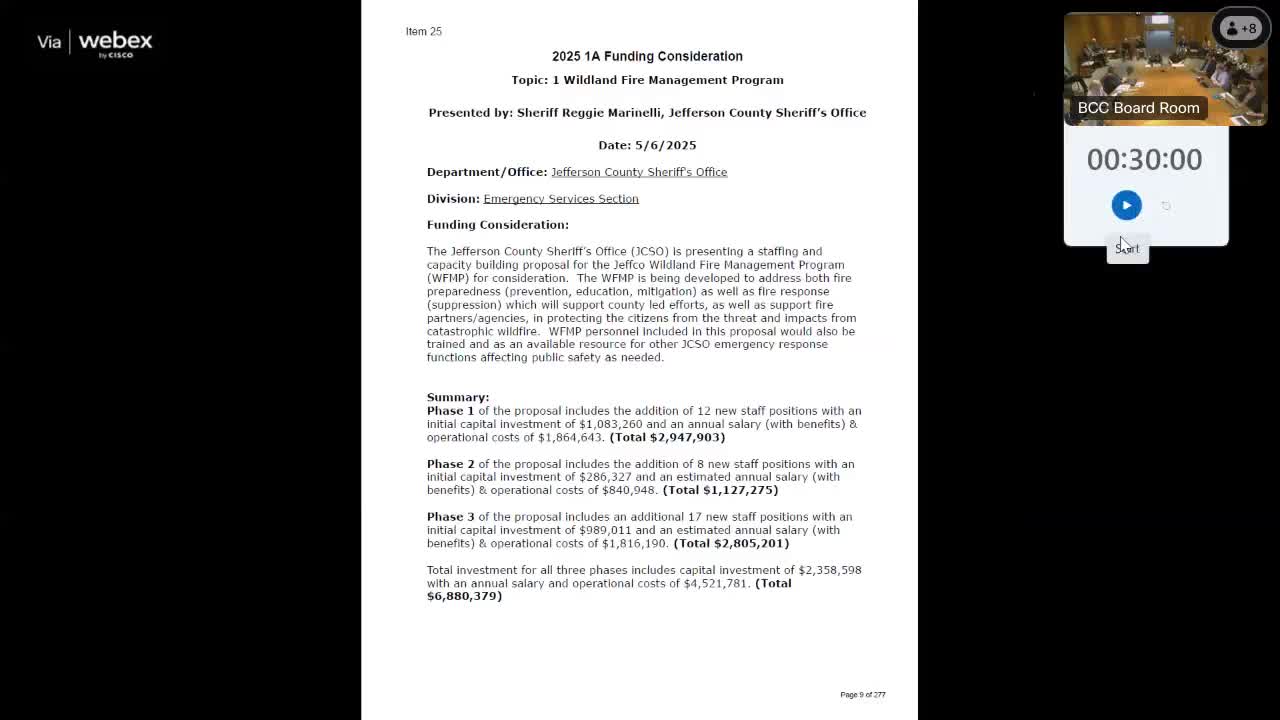
The sheriff's office presentation described a three‑phase proposal to hire leadership and field crews, set up a countywide home‑assessment program and expand community outreach. "This program would add capacity and build a program that includes preparedness, mitigation, education, outreach programs, as well as bolstering our response functions as well," the sheriff's office presenter said.
County Development & Transportation (D&T) staff described complementary regulatory and implementation work: updating building and defensible‑space requirements, integrating new state wildfire resiliency code provisions and expanding enforcement and permitting capacity. "We're going to need some additional assistance for the regulatory portion," the D&T presenter said, recommending $100,000 for a consultant to draft and coordinate regulations and $65,000 for permitting system changes.
Why it matters: Commissioners and staff said the proposal responds to the Community Wildfire Protection Plan that the county adopted last October. Presenters said a coordinated county program would reduce duplication among fire districts and partner agencies, improve competitiveness for grant matches and provide a consistent set of standards for residents.
What the proposal would do: The sheriff's office asked for three phases: - Phase 1: leadership hires (fire planner, GIS specialist, program manager) and one mitigation crew to begin planning and small‑scale implementation. - Phase 2: community outreach staff, a dedicated grants position and field staff for countywide home assessments. - Phase 3: additional staffing to scale implementation. The sheriff's office presentation noted the ask does not include homeowner micro‑grants; presenters said staff should first define the program before requesting grant dollars.
D&T staff said state rulemaking will expand the regulated Wildland‑Urban Interface (WUI) and that local code changes may require new planning, building and enforcement capacity. The D&T presenter summarized likely needs: two additional plans examiners, two additional building inspectors and additional code enforcement staff to meet anticipated workload from a larger WUI and a possible three‑year maintenance/certification cycle required by draft state rules.
Right‑of‑way and mitigation costs: D&T said roadside fuel‑break work and associated survey costs are not covered in existing budgets. Staff estimated surveying the county right‑of‑way could cost roughly $2,000,000 and proposed a $2.5 million 1A request to seed right‑of‑way mitigation and related work; D&T later proposed reallocating part of that sum toward flood‑related needs identified in the packet (about $1.8 million) while leaving roughly $700,000 for wildfire right‑of‑way tasks.
Coordination and grants: Presenters said county investment would strengthen grant applications (for example BRIC and similar programs) by providing local match and by demonstrating a landscape‑scale, coordinated approach. The sheriff's office said recent federal grant programs they viewed as relevant have been reduced or canceled, increasing the county's need to seed local funding.
Points of caution raised by commissioners: Commissioners emphasized enforcement capacity, calls to reserve money for homeowner grants (micro‑grants), and the need to align the voluntary mitigation work and any new regulatory requirements so residents do not do redundant work. Several commissioners asked for a clearer breakdown of ongoing versus one‑time costs and for an explicit plan connecting staffing, enforcement, permitting systems and funding.
Where things stand: Presenters asked the board to give direction on whether to proceed with all three phases now, only phases 1–2, or to phase the work over a longer period. Several commissioners said they supported a phased approach that would protect capacity ahead of the known 2027 budget dip in assessed valuation.
Ending: County staff said they will return with more detailed cost breakdowns, ordinance/regulatory drafts as the state code process concludes, and clearer proposals for homeowner grants once program design and staffing are in place.