Get Full Government Meeting Transcripts, Videos, & Alerts Forever!
Get email alerts on the Wildlife Management topic
No spam. Unsubscribe anytime.
Colorado Parks and Wildlife outlines wildlife trends and management challenges in Jefferson County
Summary
A Colorado Parks and Wildlife district manager told the Jefferson County Open Space Advisory Committee that deer and elk populations are generally healthy but unevenly distributed, chronic wasting disease remains a concern on the Front Range, and wolves introduced to Colorado are beginning to appear near county lines.
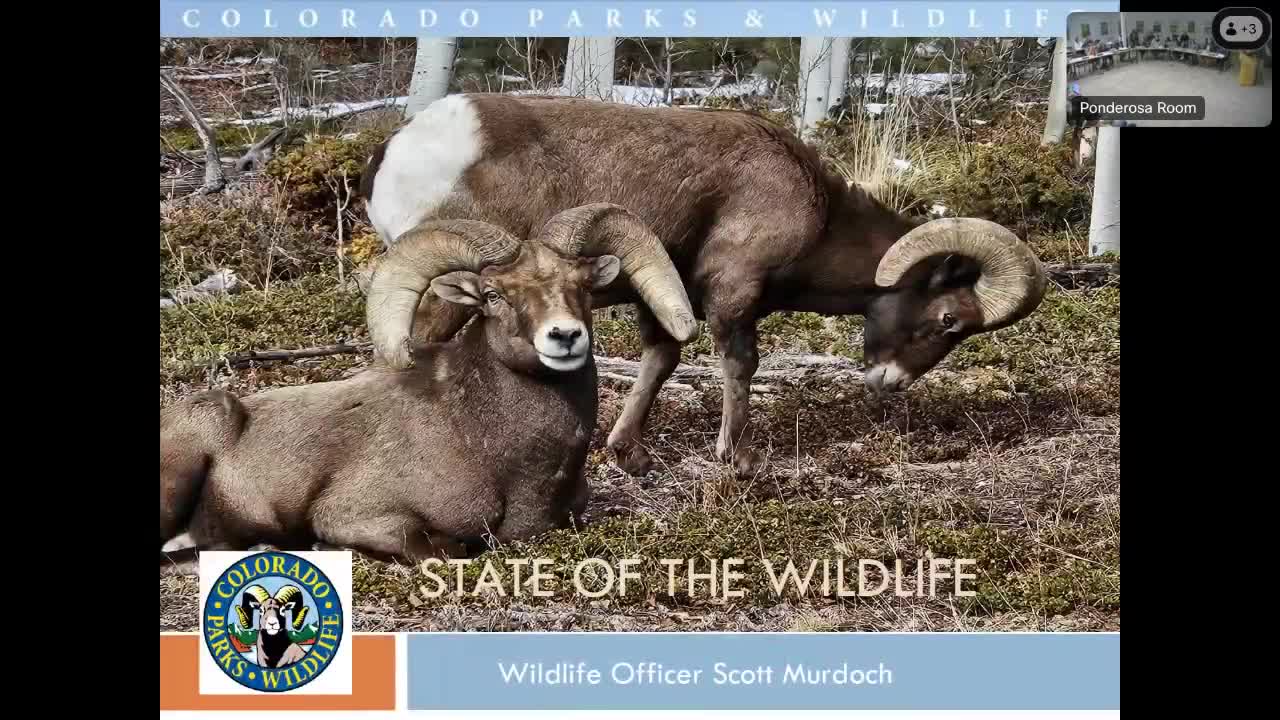
Scott Murdoch, district wildlife manager for Colorado Parks and Wildlife, told the Jefferson County Open Space Advisory Committee on the evening of the committee’s May meeting that the agency monitors many species in the county and uses hunting, surveys and other indices to guide management.
Murdoch said deer numbers in Jefferson County have been reduced in places "by design" and that managers are trying to move animals away from areas where they cause conflicts. He called chronic wasting disease (CWD) a continuing challenge along the Front Range and said recent data indicate maintaining harvest at about 40% in some herds helps lower prevalence. "Some new data suggests maintaining harvest at about 40% will help keep that prevalence rate low," Murdoch said.
The presentation covered large herbivores and predators. Murdoch said elk numbers are largely within management objectives but can concentrate near urban-suburban sites such as golf courses; moose are increasing after their introduction to Colorado in 1979 and are doing "excellently" in many high-elevation habitats; and bighorn sheep herds face disease-related recruitment problems in parts of Clear Creek and Jefferson counties. He described bears and mountain lions as "stable to increasing" in the county and said human–wildlife conflicts are often tied to food sources such as trash or seasonal crops.
Murdoch described hunting as the primary management tool for most species, supplemented by collaring, habitat surveys and conflict reporting. He said some predators and carnivores are difficult to assess with aerial or ground counts, so CPW uses multiple indices including conflict and harvest data.
On wolves, Murdoch told the committee that wolves released under Colorado’s 2020 ballot initiative are moving across parts of the state and that some have been detected near Clear Creek and Park counties. "We will be experiencing wolves here in Jefferson County at some point," he said, adding that federal endangered-species status affects management tools and that officers are working with livestock owners and game-damage staff to investigate depredation reports.
Committee members asked about the number and movement of released wolves and about hunter participation and license availability. Murdoch said the introduced wolves “have been all over the state,” described long-distance movements recorded by GPS collars and said license demand for species such as moose and sheep far exceeds supply.
The presentation closed with an offer to share contact information for local wildlife officers and to answer follow-up questions.
The committee did not take formal action on wildlife management at the meeting; the session was informational and intended to inform future advice to county commissioners.