Get Full Government Meeting Transcripts, Videos, & Alerts Forever!
Get email alerts on the Historic Preservation Planning topic
No spam. Unsubscribe anytime.
Boulder County advisory board narrows 2025 preservation funding to Latinx context study
Summary
Faced with a tight timeline and limited county funds, Boulder County’s Historic Preservation Advisory Board and Parks and Open Space staff agreed to prioritize a Latinx historic context study this year rather than a larger preservation plan, and elected new officers.
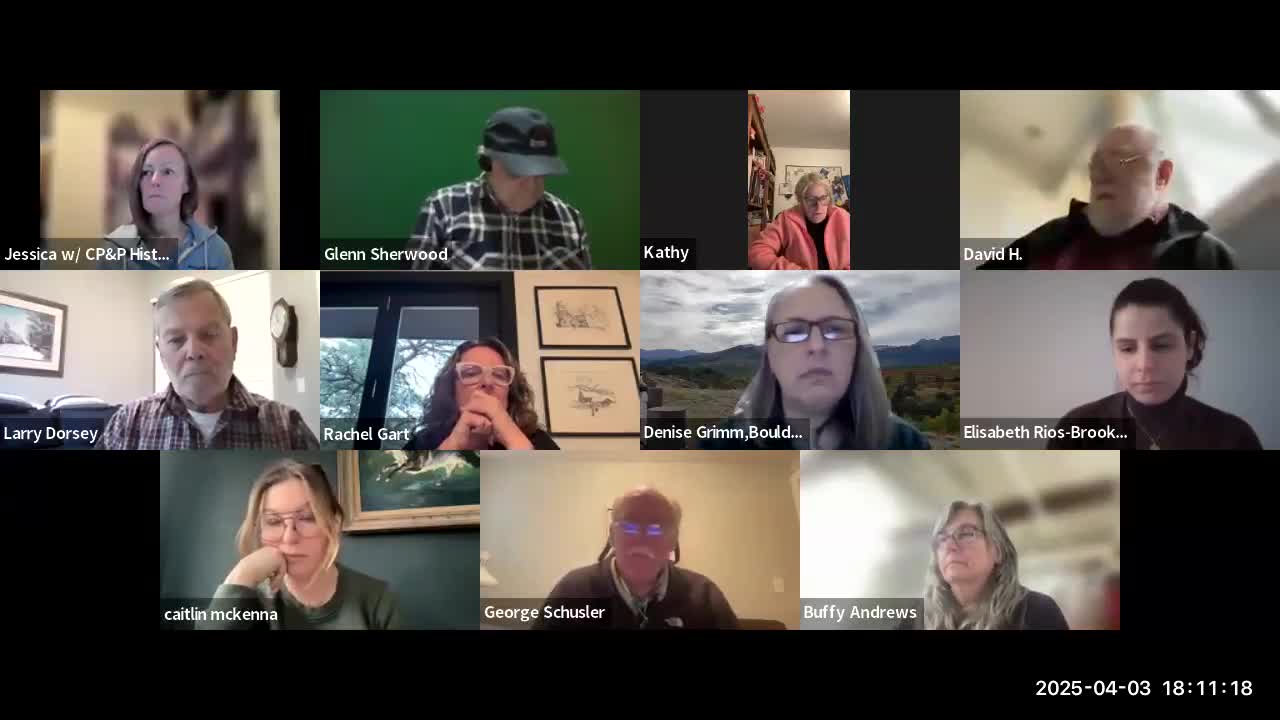
BOULDER COUNTY, Colo. — Boulder County Parks and Open Space staff and members of the county’s Historic Preservation Advisory Board decided April 3 to use limited 2025 county funds to complete a focused Latinx historic context study rather than a broader preservation plan, saying the narrower project is more feasible within the year and available budget.
The move aims to produce research and community-informed recommendations that staff can use in land-acquisition, stewardship and interpretation decisions. Denise Grimm, a Parks and Open Space staff member, told the board the department initially sought a comprehensive preservation plan but “we have to do this by the end of the year to be able to use this money,” and that staff judged a single context study would be more realistic given time and staffing limits.
Why it matters: A focused historic-context study can document underrepresented histories and give staff a clearer basis for evaluating properties and interpretation needs. Board members and staff emphasized the county’s history of limited funding and the practical need to produce a usable product on a compressed schedule.
Board and staff described the practical constraints driving the decision. Jessica Fasic, a Parks and Open Space staff member serving as the meeting secretary, explained staffing limits, noting her position generally is half-time but she has been performing additional duties since a prior staff departure. David Hawes, a board member, said the $50,000 county allocation reflected a step forward but was “not enough resources to do what you want,” and supported focusing on one context study to avoid producing a superficial product.
Members identified the Latinx context as the highest priority this year. Denise Grimm said staff chose the Latinx study rather than an Indigenous context because meaningful tribal consultation requires more time and sustained relationship-building; staff plan to coordinate Indigenous work with a separate county commissioner’s office hire who will advise on Indigenous issues. The board also mentioned other possible topics for future work, including Japanese farming families and a beet-storage building whose social history staff said is not yet known.
New cultural-resources staff member Elizabeth Rios Brooks, the county’s cultural resource program coordinator at Parks and Open Space, framed the chosen approach around community engagement. “The experts are the people that have lived and worked and shaped this land,” she said, adding that context research should be grounded in community voices and not rely only on existing written records.
Several board members urged that any study include a review of past county preservation efforts to create continuity with previous work. David Hawes suggested the Latinx context could summarize what the county and the Historic Preservation Advisory Board (HPEP) have done previously, and identify missed opportunities.
Board members and staff also discussed outreach strategies and potential partners. Caitlin McKenna, a board member, said preservation in Boulder County has “woefully underrepresented a lot of communities,” and urged that the project aim to broaden participation in preservation work. Members noted existing local resources, including the Chicano and Latino History Project in Boulder County and Longmont’s local histories, as possible starting points.
Next steps: Staff said they will prepare a scope of work and issue a consultant bid; the final scope will depend on bids and the funds available. Grimm and Fasic indicated the department must spend the allocated funds by the end of the county’s fiscal year and therefore prefer a project with a compact, deliverable scope rather than an over-ambitious plan that cannot be completed.
Votes at a glance
• Approval of minutes (Nov. 7, 2024): Motion to approve carried by roll call. Recorded roll-call responses during the meeting included Buffy Andrews (approve), Larry Dorsey (approve), Rachel Gard (approve), Elizabeth Gehring (approve), David Hawes (approve), Kathy Kaler (approve), Caitlin McKenna (approve), George Schuessler (approve), Glenn Sherwood (approve).
• Election of officers: The board approved a package nomination for new officers by roll call; recorded responses included Buffy Andrews (agree), Larry Dorsey (agree), Rachel Gard (agree), Kathy Kaler (agree), George Schuessler (agree), Glenn Sherwood (agree), Caitlin McKenna (agree), David Hawes (agree). The meeting record shows Caitlin McKenna accepted nomination for chair; a board member volunteered to serve as vice chair (name not specified in the roll-call summary).