
UCHealth presents strategic plan as budget tightens, highlights Medicaid, ambulatory access and partnerships
Get AI-powered insights, summaries, and transcripts
Subscribe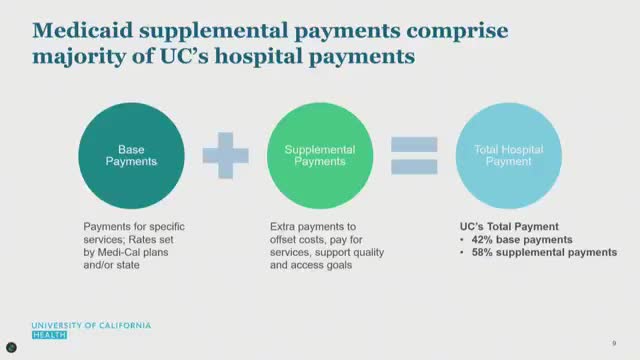
Summary
Executive Vice President David Rubin briefed the University of California Health Services Committee on a systemwide strategic plan that prioritizes federal/state engagement, ambulatory access, data-driven care and a new office of strategic partnerships while absorbing a budget reduction of about 6%.
Executive Vice President David Rubin told the University of California Health Services Committee that UCHealth is moving forward with a five‑pillar strategic plan while absorbing budget pressures and payment risks from Medicaid and Medicare.
Rubin, who introduced the plan at the committee meeting, said the strategy focuses on federal and state engagement, network development, ambulatory access and experience, population‑health data and innovation, and systemwide governance. "We submitted a budget that is down over 6% from last year," Rubin said, adding that the system is absorbing mandatory staff cost increases and reallocating funds to priority initiatives.
The plan, Rubin said, includes creating an office of strategic partnerships to coordinate Medi‑Cal and Medicare strategy and building systemwide governance for Medi‑Cal, along with a rapid response team for Medicaid. "We're actually going to build capability at UCHealth to support that," he said. Rubin also highlighted investments in ambulatory access, enterprise analytics and EPIC tools to standardize proactive care across campuses.
Regents pressed for details on the budget tradeoffs. Regent Bihari asked about a reported 62% reduction in “other designated funds” and which programs were affected. Rubin answered that some programs (for example, the anatomical donation program overseen by Brandy Schmidt) had their funding reclassified rather than cut and that campus assessment funds were adjusted to avoid double charging deans. "It was just moved into the campus assessment category," Rubin said.
Regent Grama asked how the hiring freeze and FTE reductions would be managed so essential positions are preserved. Rubin described a project management review that asked each direct report to prioritize positions aligned to the strategic framework and to work with campus CEOs and vice chancellors to protect roles that deliver systemwide value.
Rubin described the budget arithmetic: the plan covers about $1.6 million in mandatory increases for non‑represented staff, a workforce reduction line of about $3.8 million and a reserve of roughly $1.0 million for an office of strategic partnerships and enterprise analytics. He said the net reduction in the submitted budget was in the range of $2 million to $3 million but noted the figure folds in offsets and that natural growth would have been higher without cuts.
The strategic plan also highlights physician well‑being and representation for clinical faculty; Rubin said petitions by clinical faculty to join the Academic Senate were not successful but spurred conversations about alternate representation models.
Rubin told the committee the administration will return with additional work on employee benefit participation and student health programs later in the year. He said a comprehensive vision on student health is expected back in July or September.
Looking ahead, Rubin said UCHealth will continue targeted advocacy in Sacramento and Washington, D.C., to protect federal and state health financing that supports UC's safety‑net role.
The committee had no formal vote on the strategic plan at the meeting; the presentation was a discussion item and the administration identified follow‑up topics to return to the committee.