Get Full Government Meeting Transcripts, Videos, & Alerts Forever!
Get email alerts on the Transit Funding topic
No spam. Unsubscribe anytime.
Green Mountain Transit seeks special assessment as service reductions and Route 11 changes loom
Summary
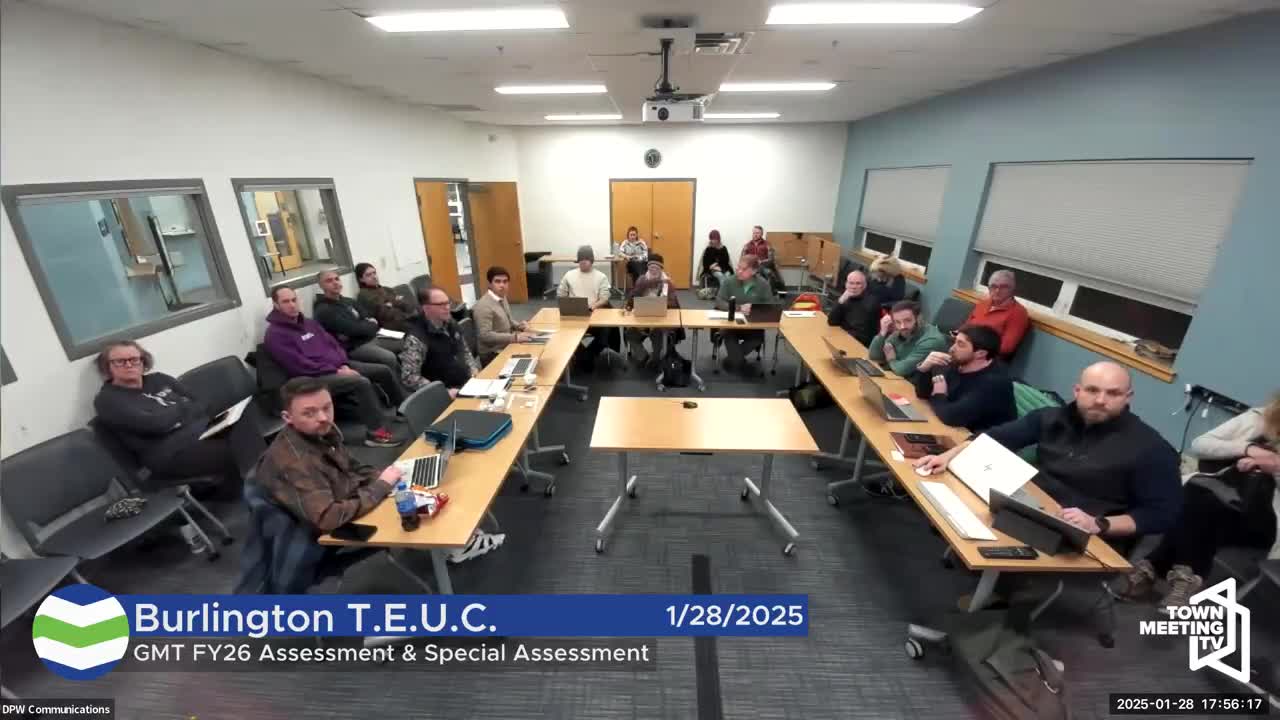
Green Mountain Transit officials told the Burlington City Council Transportation, Energy & Utilities Committee the agency is seeking a special assessment that would raise up to $308,000 across urban members, with Burlington’s share estimated at $170,000.
Green Mountain Transit officials told the Burlington City Council Transportation, Energy & Utilities Committee the agency is asking municipal partners to approve a special assessment that would raise up to $308,000 across GMT urban members, with Burlington’s share estimated at $170,000.
Clayton, a Green Mountain Transit staff member, said the special assessment is intended to fund three items: driver buyouts (about $240,000 in the initial estimate), payment to the Chittenden County Regional Planning Commission for assessment reform work (up to $50,000) and funds to support lobbying at the statehouse. “I’m not able to provide you with certainty right now about how much we will need from the special assessment,” Clayton told the committee, citing uncertainty about whether GMT and the Teamsters union will agree to buyouts or instead proceed with layoffs.
The request comes as GMT faces an estimated shortfall (staff cited roughly $1.2 million at the time of the meeting) and potential service reductions. GMT staff said any reduction in force would take effect in June 2025 if outside revenue is not secured. Clayton said preliminary votes from three of eight municipalities had approved the assessment; he also said the town of Essex approved it the prior night.
Why it matters: The special assessment would be legally binding only if all urban member municipalities approve it. The funding decision affects both labor outcomes for drivers and the scale of near-term service changes that could affect daily riders across the region.
Details from the committee meeting GMT staff presented four assessment options that differed in total cost to municipalities; the options produced about a $260,000 spread between highest and lowest scenarios. Committee members asked staff to translate those options into a per-tax-rate or per-household impact so local governing bodies could see how the assessment would affect taxpayers. Clayton said staff would provide that translation on future materials.
On driver buyouts and labor: Clayton said early signals from the Teamsters, which represent GMT’s urban drivers, indicate the union “would actually rather have a layoff than a buyout.” That uncertainty is one reason Clayton said the amount actually needed from the assessment could change and why the special assessment remains only partly defined.
Route 11 and fare policy: GMT staff also asked the committee to revisit a longstanding local practice: Burlington’s assessment pays for fare-free service on the portion of Route 11 that runs through the city. GMT recommended keeping Route 11 fare free for at least four more months while the agency evaluates likely service changes under a constrained budget. “What I’m proposing here is to proceed with the $2.43, which would be to continue with fare free service at least for the next 4 months while GMT determines whether or not Route 11 is going to be substantively reimagined,” Clayton said. (In committee discussion the $2.43 figure was presented as the combined cost estimate for the city’s contribution under the recommended option.)
Ridership and service priorities: GMT staff provided ridership context: the agency’s two busiest routes receive roughly 400,000–500,000 rides annually; by comparison, the number-11 route logged “a little over a hundred thousand rides” in the dataset cited by staff. GMT staff said roughly 40 percent of rides systemwide are covered by unlimited-access agreements with institutions (universities, large employers) and other contract arrangements.
Alternative service models and equity concerns: Committee members questioned whether microtransit or targeted service (for example, microtransit to Burlington International Airport) could replace lightly used segments of existing routes. Clint Clark, GMT general manager (referenced in the meeting), and Chris Damiani, GMT director of planning, said microtransit options are being studied and that combining ADA paratransit and microtransit services is a strategy other agencies have tried. Clayton warned that microtransit is “not cheap” and that there are labor-relations constraints if services currently provided by GMT union staff are contracted externally.
Next steps: GMT staff said they would continue to work with municipal finance offices (including Burlington’s CAO) to provide a clearer tax-rate translation of the assessment options and to update city leaders about the outlook from the governor’s budget and VTrans. Any formal special-assessment levy must be approved by each urban member municipality to be binding.
Ending note: Committee members expressed willingness to advocate for additional state support and urged GMT to provide more precise citizen-facing numbers (per-household or cents-per-thousand-dollar valuations) when the assessment returns to members for formal action.