Get Full Government Meeting Transcripts, Videos, & Alerts Forever!
Get email alerts on the Transportation Demand Management topic
No spam. Unsubscribe anytime.
Committee reviews citywide TDM action plan; public commenters press for stronger pedestrian, equity protections
Summary
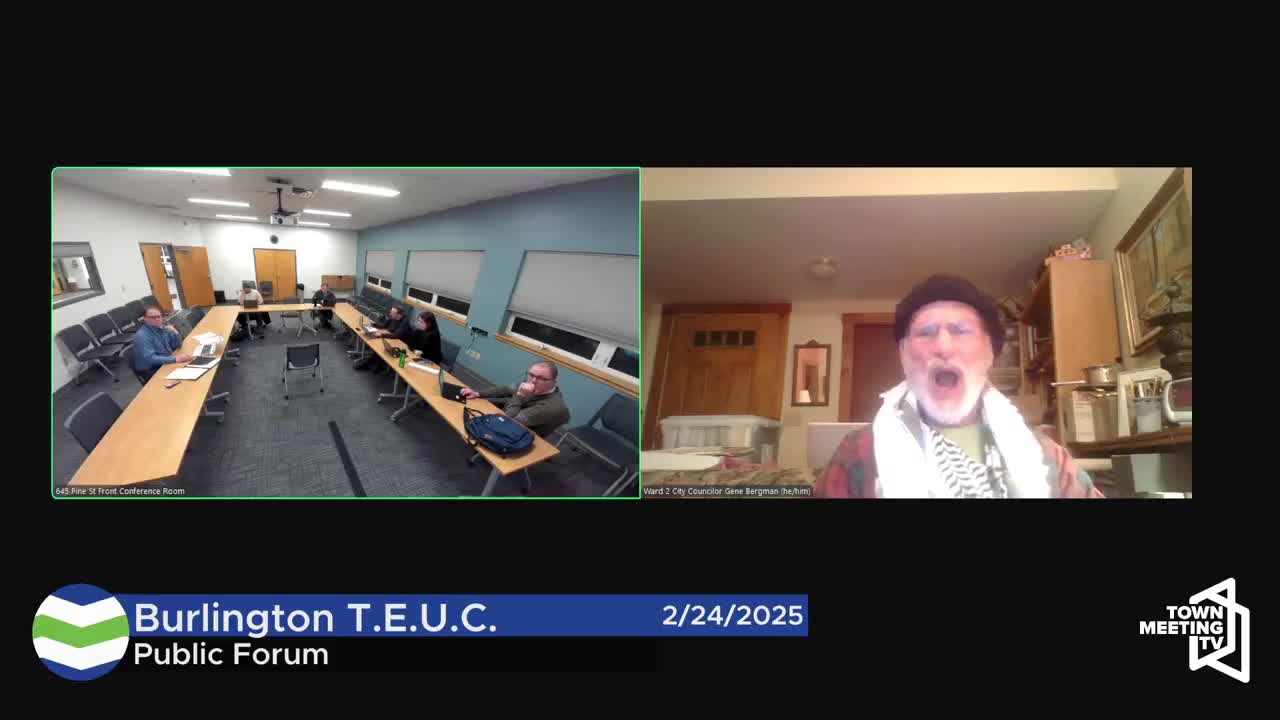
The Burlington City Council Transportation, Energy and Utilities Committee spent the meeting reviewing a draft Transportation Demand Management action plan and heard extended public comment urging more emphasis on walking, equity and the needs of people with disabilities.
The Burlington City Council Transportation, Energy and Utilities Committee spent the meeting reviewing a draft Transportation Demand Management action plan and heard extended public comment urging more emphasis on walking, equity and the needs of people with disabilities.
The plan — produced from a multi-year, citywide transportation options study — lays out a toolkit of regulations, funding and neighborhood strategies including a proposed points-based TDM ordinance amendment, carshare expansion, guaranteed-ride-home programs, ride-matching and possible microtransit pilots. Staff sought the committee’s recommendation to forward the plan to the full City Council for adoption so implementation could begin.
Why it matters: The plan is intended to reduce single-occupant vehicle trips, better coordinate private shuttle services and expand TDM beyond new development. It would guide future ordinances, neighborhood mobility hubs and possible staffing and funding priorities, and any changes could affect commuting options, downtown parking and projects that involve UVM, UVMMC and other large local employers.
Public commenters raised concerns that the plan underweights pedestrian needs and may disproportionately favor institutions and commuters who park on local streets. Sharon Buscher, a member of the public, told the committee: “I feel pedestrians do not have equal footing… I really feel that [TDM] falls short on that and I really feel that it's deserving of a lot more consideration of how to get people from one place to another by walking.”
Another public speaker, identified in the record as Barbara, urged the committee to evaluate every proposed metric against a single guiding question: will it increase or decrease pollution? Barbara criticized use of vehicle-miles-traveled (VMT) metrics and said some proposed multimodal hubs and parking strategies may shift traffic patterns without reducing total pollution. She recommended the city invest more in SSTA (the on-demand shared service) and urged safeguards so institutional fleet and shuttle changes do not shift maintenance costs onto city streets.
Staff presentation: Charles, the city planner leading the study, summarized the plan’s four components — transportation options (carshare, carpool, SSTA), regulations and ordinances (including the point system amendment to the City’s development code), management and funding, and neighborhood TDM strategies (mobility hubs, targeted outreach). He said consultants recommended hiring a full‑time TDM coordinator to advance the package and that the city has draft ordinance language and regional coordination conversations underway.
Council members and committee members broadly welcomed the plan’s direction but did not take formal action. Members asked for more outreach and explicit engagement with the city’s accessibility advisory committee, with one member saying: “slow and steady is my preference” and requesting that accessibility interests, older residents and lower-income residents be explicitly included in ordinance and program design. Staff agreed to return with prioritized near‑term actions and to pursue the ordinance amendment and neighborhood pilots in parallel with additional outreach.
The committee also flagged several implementation details that will need follow-up: how shared shuttle stops integrate with GMT routes; whether carshare parking requirements should be added to the ordinance; funding sources for piloted programs; and specific outreach strategies for neighborhoods with high numbers of new Americans or households without vehicles.
Next steps: Staff said they would refine the implementation priorities, continue outreach to accessibility and neighborhood groups, and return with a recommended timing for an ordinance amendment and possible pilot projects. The committee did not vote on the plan at this meeting.
Ending: Committee members asked staff to prioritize engagement with affected communities before the plan goes to the full council and to return with clearer near‑term actions and resource estimates.