Get Full Government Meeting Transcripts, Videos, & Alerts Forever!
Get email alerts on the City Finance Budget topic
No spam. Unsubscribe anytime.
Burlington rolls out 'ModernGov' reorganization as FY26 budget gap narrows; recycling privatization proposed
Summary
City officials presented a phased reorganization of finance and administrative services and an early FY26 budget update that showed a $2.5 million gap, while proposing the end of municipal curbside recycling collection — a step staff say would save roughly $200,000 annually but that councilors criticized as shifting costs to households.
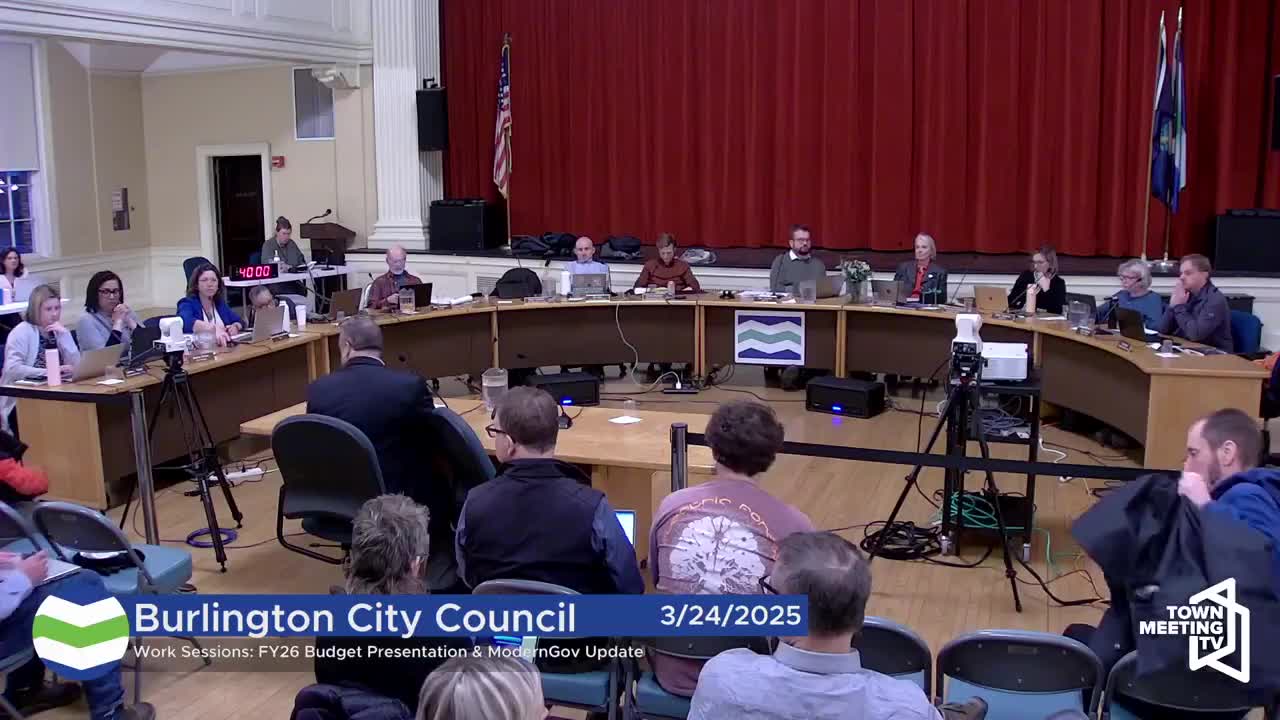
City officials presented a two-part modernization plan and an early look at next year's budget Monday, telling the City Council the effort aims to reduce duplication across city departments while preserving core services as the city addresses a roughly $2.5 million projected budget gap for fiscal 2026.
The immediate change staff proposed is creation of a Department of Finance and Administration to centralize the assessor, clerk/treasurer functions, human resources and IT and to centralize accounting expertise. Project lead Scott said the effort is intended to “value people and their work,” and reminded the council that “the city has grown by 98 people over the course of the last five years,” a trend he said the city needs to manage more strategically.
Why it matters: city leaders said consolidation could create multi-year, structural savings and fewer single-point failures in core financial and administrative work. But the package also includes a controversial proposal to end municipal curbside recycling collection and shift residents to private haulers — an idea councilors said would shift costs to households, risk inconsistent service and erode municipal control of a public good.
What officials told the council - Scott (project lead) described a phased timeline: parts 1 and 2 of the Finance & Administration reorganization are expected to be in place by the start of FY26; longer work on service inventories and additional reorganizations would run into FY27. - Director of Public Works Brad Spencer said the recycling proposal reflects changing market conditions: “We now pay over $200,000 a year to drop off recycling from the city,” he told councilors, and staff estimate eliminating municipal recycling would remove 3–4 full-time equivalent positions and “result[] in a net positive to the general fund of $200,000 a year.” (evidence excerpt: “Eliminating that re recycling results in a net positive to the general fund of $200,000 a year.”) - CAO Catherine (name in packet) and budget staff presented an early FY26 picture showing about $8 million in expense increases over FY25, driven largely by police and fire personnel costs; after identified revenues, one-time funds and proposed savings the council was shown a working gap of about $2.5 million.
Councillors’ reaction and next steps Councilors pressed staff for more detail on several points: what would happen to residents’ costs if recycling were privatized; how savings in the ModernGov plan were phased (staff said their budget figures assume full-year realization on July 1); and how large FY26 risks — notably police and fire contract negotiations and health insurance increases — might alter projections.
Multiple councilors opposed privatization of recycling on principle: Councilor Kane and Councilor Broderick argued the service is a public good and warned privatization would create regressive flat fees and weaker oversight. Councilor Bergman and others said modest additional municipal revenue could cover the shortfall if the city chose to retain collection.
Staff said the proposal to end municipal curbside recycling would not take effect immediately and would include discussions with haulers about continuing to use existing city bins, free drop-off options and possible neighborhood consolidation of collection days.
Where this goes from here Staff said the ModernGov changes and the FY26 budget are still evolving. They will return with more detailed budget presentations in May and with a higher-resolution service inventory in April. Any decision on recycling collection — and any related changes to the budget — would be subject to further review and public discussion.
Ending note: councilors and staff agreed on the need for more detail, including a high/medium/low scenario for gross receipts taxes (tourism-dependent receipts) and a clear public explanation of cost and service impacts if recycling collection changes.