Get Full Government Meeting Transcripts, Videos, & Alerts Forever!
Get email alerts on the Solid Waste Management topic
No spam. Unsubscribe anytime.
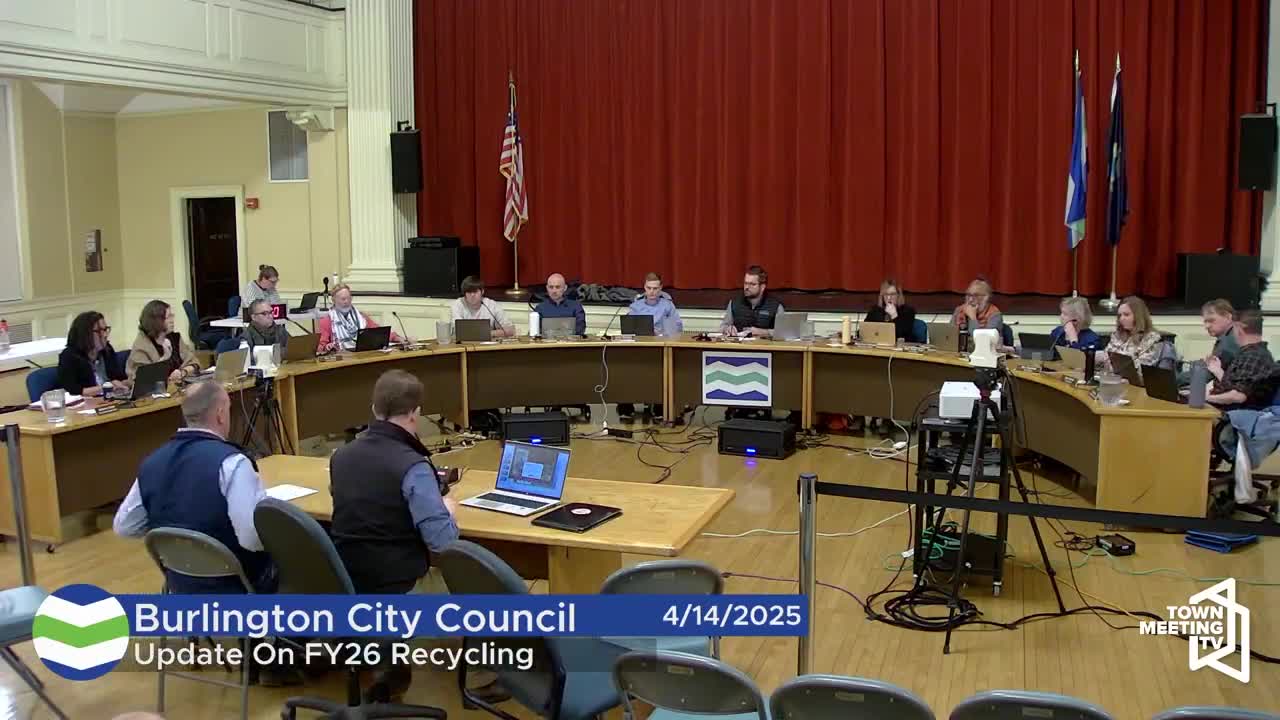
Council hears contentious update on FY26 recycling plan; staff proposes short‑term contracting, long‑term consolidation study
Summary
DPW briefed council on staffing, injury and vacancy problems in the city recycling program and proposed contracting out curbside recycling for 3–5 years as an interim step while evaluating a future consolidated collection model; speakers raised labor, service and cost concerns.
Department of Public Works Director Chapin Spencer and maintenance division staff briefed the council on April 14 about a proposed short‑term change to municipal curbside recycling collection and a medium‑term study of consolidated collection.
Spencer said Burlington’s recycling program faces persistent staffing shortages, high turnover (average tenure cited at about 11 months), injuries, and aging equipment; those constraints have made regular service difficult. The current system combines municipal pickup for 1–10 unit residential properties and subscription trash hauling by private firms; compost collection is mixed. A 2021 consultant study (GBB) found consolidated collection typically produces economies of scale; national data shows consolidated collection is common in many municipalities.
As a near‑term option, DPW proposed issuing an RFP this calendar year to contract with one or two private haulers to continue consolidated weekly recycling pickup for a 3–5 year pilot, paid from the city’s solid waste generation tax. The short‑term move would preserve curbside service while freeing DPW street maintenance staff for other infrastructure work, Spencer said. In the medium term the city would study a franchise or municipally‑run consolidated system for all three solid‑waste streams (trash, recycling, compost), examine zones, container sizes, opt‑outs and affordability protections, and return with specific policy choices.
Speakers at public forum, many of whom worked in DPW or represented labor, urged the council to preserve public collection. Clayton Dykstra and Brett Yates warned privatization could worsen labor conditions and reduce municipal accountability; they cited past city consolidation studies (2009, 2018, 2021) that showed savings from municipal consolidation. Michelle Sagleczyk and Gretchen Schissel urged the city to invest in improving public operations rather than privatize. Multiple DPW employees described difficult work patterns, snow season scheduling constraints and staffing losses; a DPW worker said recruitment of young workers is difficult because of the work‑life balance and injury risk.
DPW staff said the short‑term contracting option would preserve the weekly pickup pattern for residents and maintain most on‑street parking in the South End; it would also buy time for planning a consolidated system. Spencer said a quick decision is needed to meet budget timelines and possible Jan. 1 operational milestones. Councilors asked for a detailed cost runway, a publicly posted FAQ, and an explicit plan that includes union leaders. Councilor Neubieser and others said they supported exploring a municipal enterprise fund and a longer‑term consolidated municipal system but wanted any short‑term step to protect affected workers’ wages and job quality.
DPW scheduled two public forums and a DPW Commission discussion to gather more public input. The council did not vote on a change at this meeting; staff requested direction to continue public meetings and return with detailed budget lines and contractual language.