Get Full Government Meeting Transcripts, Videos, & Alerts Forever!
Get email alerts on the State Legislation topic
No spam. Unsubscribe anytime.
City representatives brief council on 2025 Vermont legislative session: guns-in-bars charter, housing, opioid funds and project-based TIFs
Summary
City representatives David Mickenberg and Virginia Renfrew briefed the Burlington City Council on April 28 about key 2025 legislative items, including a senate-cleared charter change to ban firearms in bars, proposed GA housing reforms (H91), FY26 opioid settlement allocations and a project-based TIF program (CHIP).
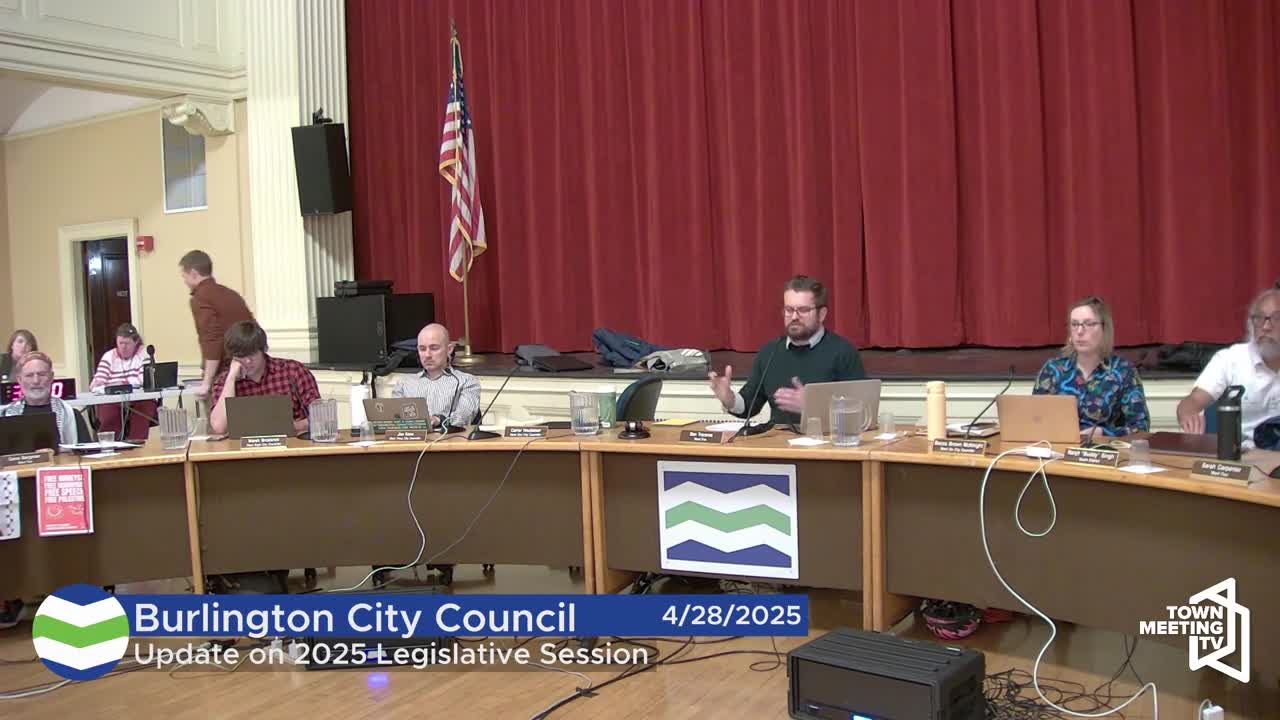
Burlington City Council received an update on state legislative activity from city representatives David Mickenberg and Virginia Renfrew during its April 28 meeting. The briefing covered multiple items with direct implications for the city including charter changes, homelessness funding, opioid settlement allocations and a project-based tax increment financing (TIF) program.
Charter changes and firearms in bars: Mickenberg reported that a charter change to ban firearms in bars passed the Vermont Senate Government Operations Committee and advanced through floor votes in the senate. The change carried on second and third readings and is now headed to the House Government Operations Committee for consideration, where city representatives said they will continue to advocate. The presenters said the measure was narrowed to focus on firearms in establishments serving alcohol to align with constitutional precedent discussed in recent federal court decisions.
Housing and General Assistance (H91): The presenters described H91 as a legislative effort to reimagine the General Assistance (GA) housing program, including shifting administration to community action agencies and building a different administrative structure. The presenters said a compromise was not reached in the budget-adjustment process and the legislature is continuing debate on administration and services; if enacted changes would not be implemented until FY27 and many implementation details remain unresolved.
Opioid settlement funds and FY26 priorities: Virginia Renfrew summarized work on the opioid settlement bill and stated that funding in FY26 includes an allocation for OPCs (reported in council discussion as $1,100,000 for an OPC implementation project in FY26) and other community harm-reduction and recovery supports. She noted year-to-year settlement amounts will decline and recommended planning to preserve longer-term staffing and program continuity.
Project-based TIF (CHIP program): The project-based TIF program (sometimes referenced as CHIP) passed the Senate within the housing bill and was under consideration in House committees. Presenters said the House Commerce and Ways & Means committees will review scope, affordability criteria and program oversight; local officials were advised to watch the bill and engage as members of the House consider the program design.
Community resource center funding: Mickenberg and Renfrew reported advocacy to restore $500,000 in state funding to support the Community Resource Center, a local resource the presenters said the legislature’s current deliberations are trying to protect as the budget is reconciled.
Other items: Presenters touched on charter changes tied to notice to tenants and district-drawing provisions, pretrial monitoring expansions, and a legislative package of public safety and housing items. They said the end of the session was several weeks away and urged councilors and residents to watch key committee calendars and contact representatives when the council asks for advocacy.
How councilors can help: Mickenberg and Renfrew recommended targeted advocacy on charter changes (particularly the guns-in-bars item), engagement with the governor’s office and state representatives, and mobilizing Burlington residents to contact legislators on priority items. They noted charter votes are an area where councilors’ outreach can be especially influential.
No council votes were taken during the briefing. The presenters said they would return to the council in June for a session debrief after the legislature adjourns.