Get Full Government Meeting Transcripts, Videos, & Alerts Forever!
Get email alerts on the Tdm topic
No spam. Unsubscribe anytime.
Committee hears plan to revise Burlington TDM rules, staff flags enforcement and staffing gaps
Summary
Planning staff outlined updates to Burlington's transportation demand management (TDM) rules and described enforcement and reporting challenges; committee members and residents pressed for clarity on residential parking-permit language, timelines and whether changes will be regulatory or administrative.
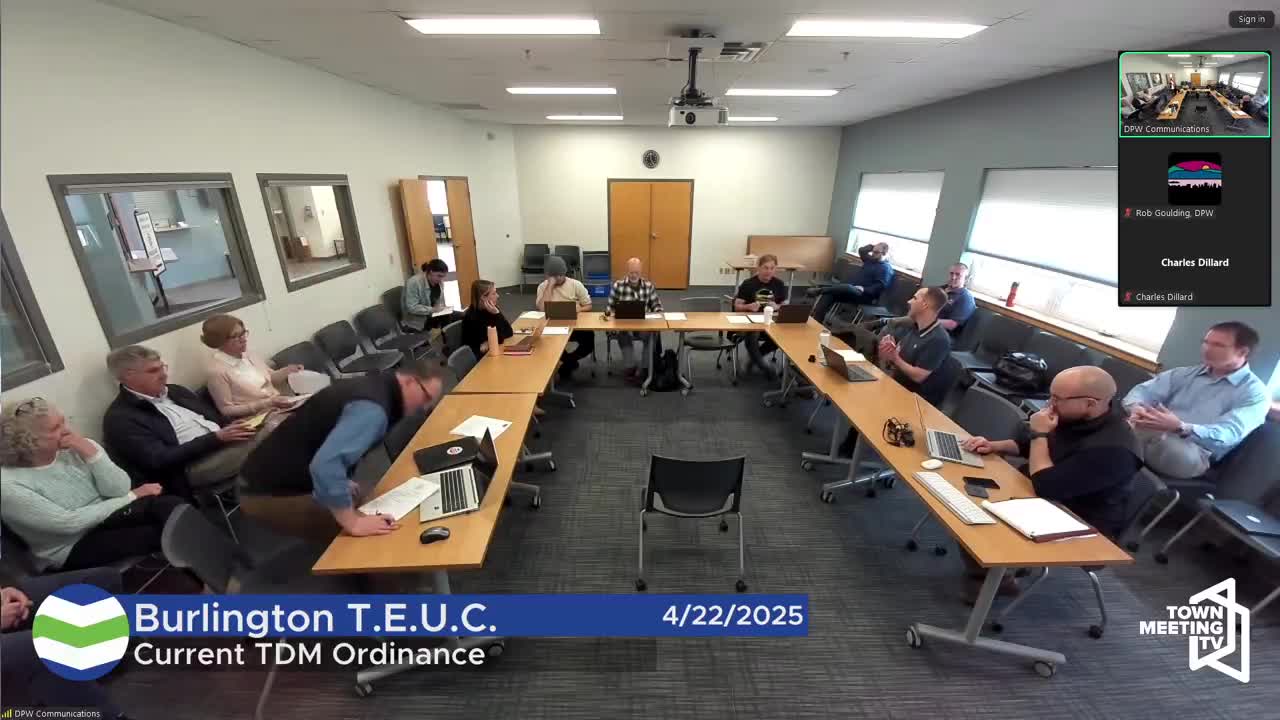
BURLINGTON, Vt. — Planning staff on the Burlington City Council Transportation, Energy & Utilities Committee presented an overview of the city’s Transportation Demand Management (TDM) rules and outlined a proposed path to amend the ordinance, while enforcement staff described operational gaps that make current monitoring difficult.
The presentation, delivered by Planning Director Charles Dillard and enforcement lead Scott Guston, covered existing TDM requirements in Article 8 (section 8.10.16) and described the city’s plan to draft a points-based ordinance and accompanying program guidelines. “What we are here tonight to talk about is updating and expanding Burlington’s TDM requirements,” Dillard said, adding that a draft amendment could come to the committee within the next two meetings.
The nut graf: committee members, regional partners and developers have asked for clearer guidance after a small number of projects began reporting under current requirements. Staff said the ordinance contains the broad rules but lacks the detailed implementation language that would make annual monitoring and enforcement consistent.
Under current rules, applicable projects (generally developments of 10 or more units and larger nonresidential projects) must designate a transportation coordinator, conduct travel surveys, provide outreach and implement at least two TDM strategies such as membership in a Transportation Management Association (TMA), subsidized transit passes or car‑share support. Scott Guston told the committee that Burlington currently tracks 17 TDM projects; only a handful have reached occupancy and still fewer are producing the required annual reports.
Guston said reporting gaps and unclear contractual relationships create practical enforcement issues: “We need a little more guidance — whether it’s in the ordinance or a guidance sheet — on how many parking counts we want to see, what seasons or times of day to measure, and what proof that providers must supply that services are being continued.” He also noted that some providers have changed or withdrawn products (for example, a previously available bike‑share) and the ordinance does not spell out how to document substitutions.
Several councilors pressed staff on where implementation rules should live. Councilor Jean Burkin said changes that materially alter requirements (for example, moving from annual to quarterly reporting) may cross the line into a substantive change that belongs in the zoning ordinance rather than an administrative guidance document. Dillard agreed: staff will try to keep operational details in guidance where possible but will bring ordinance text forward where the rule is substantive.
Residents used the public‑comment period to press a related concern: whether the report’s recommendation to study selling residential parking permits to non‑residents would be implemented. Catherine (Ward 6 resident) and others were explicit that that item is not moving forward now. Dillard reiterated that action step 3 of strategy R5 — a study of the residential parking permit program and the possibility of selling permits to nearby commuters — “is not being considered at this time” and would only move forward following separate, broader community engagement.
Staff also discussed the longer‑term recommendation from the regional plan that Burlington and neighboring municipalities develop regional TDM coordination or a full‑time TDM coordinator. Dillard said the city is exploring regional options with the Chittenden County Regional Planning Commission and neighboring municipalities, and that a regional coordinator could be an eventual medium‑term objective but was not a prerequisite to drafting clearer city rules and guidelines.
Ending: staff said the next step is drafting a points-based TDM ordinance and program guidance, meeting with regional partners and service providers, and returning to the committee with a draft amendment (staff estimated a summer or late‑summer timeline for the draft). Committee members asked staff to include clearer examples of measurement protocols and to flag any parts of a proposed draft that would require ordinance text rather than guidance.