Get Full Government Meeting Transcripts, Videos, & Alerts Forever!
Get email alerts on the Real Estate Development topic
No spam. Unsubscribe anytime.
Developer team outlines workforce-housing plan for 595 South Exchange Street; council and staff discuss process and risks
Summary
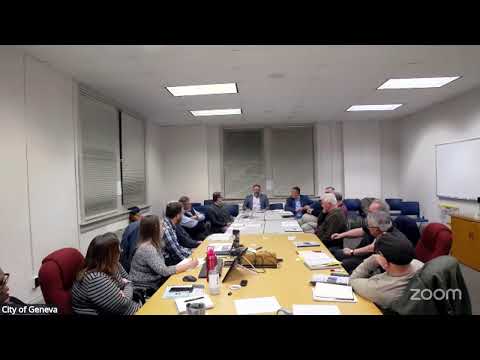
A development team responding to the city's RFQ for 595 South Exchange Street told the Geneva City Council at a work session that it seeks a "partnership and collaboration" with the city to deliver workforce housing and related resident services while preserving the corridor's historic character.
A development team that answered the city's request for qualifications for 595 South Exchange Street told the Geneva City Council in a work session that it seeks a "partnership and collaboration" with the city to create workforce housing and related community services.
The presentation, led by a developer representative who said the team prefers to work as a city partner rather than as a simple buyer, introduced the group's experience, project planning approach and likely program elements. The team said a project on the parcel would likely prioritize workforce and senior housing, could include ground-floor resident services and a small number of street-level uses, and would be designed to respect the downtown's historic context.
Why it matters: The property at 595 South Exchange has drawn multiple unsuccessful proposals in prior years. Councilors said they want a project that will actually be built and that protects the character of the Exchange Street corridor. The city is using an RFQ and the idea of a "preferred developer" to create a process that pairs the municipality and the development team on economics, design and a schedule for closing and construction.
The developer team emphasized three points repeatedly: (1) management and long-term stewardship, (2) transparency and regular communication with council and neighbors, and (3) a willingness to pursue grants and public incentives to close financing gaps. A representative from Pivotal, one of the team's operating partners, described the company as having built and managed housing since 1994 and said the team handles both development and long-term property management.
Councilors and staff focused questions on: potential unit counts and program mix, the presence or relocation of the existing day care on the site, whether commercial storefronts will be viable at street level, stormwater and foundation constraints on the site, the need for environmental testing, and ways the city and the team might coordinate on grants and infrastructure funding.
On design and context, developer Carl Schuler said he "got involved with that property pre COVID" and recalled prior student-housing proposals. The team's architect and designers said they plan to fit height, scale and materials to the adjacent four-story brick buildings and to avoid a monolithic appearance by creating a street-facing design that reads as multiple smaller elements.
On the daycare and programming: the team said the site can accommodate the existing day care or be designed to integrate a new space. The developer representative said the presence of a daycare would be seen as a community benefit and could be included in different design scenarios.
On site constraints and environmental issues, the team said earlier borings indicate the site will require piled foundations. The developer said it will perform a Phase I environmental review and move to further testing if needed; "we will do a phase 1 evaluation," the team said. The team also said excavation and material hauling should be limited because much of the parcel is already a depression.
On financing and timing, the team described a typical mixed capital stack and said the project could move fastest if the city and partners provided timely support. A senior team member estimated an optimistic construction-to-opening timeline of roughly "2 to 2—2' years" if approvals and financing align; in broader comments the group said the realistic horizon is "2 to 4 years," depending on funding and permitting.
On public incentives and grants, the team urged the city to pursue programs such as Restore New York and other state infrastructure grants, and to be pragmatic and targeted in requests. The team said payment-in-lieu-of-taxes (PILOT) structures and pilot programs can shift near-term tax revenue but typically yield greater revenue over time than a vacant site.
On management and resident services, the operator said the building would have an on-site manager and at least one maintenance technician hired locally; the team also proposed integrating supportive services on site, such as job-search assistance or a partner to help residents with benefits and other needs.
Council discussion also covered process. City staff and the developers described the RFQ approach as selecting a preferred developer and then working through a coordinated schedule that includes planning, engineering, finance and regular biweekly check-ins. Staff said it envisions a small working group of staff and a subset of councilors, with broader community outreach as project plans develop.
No formal decision to designate a preferred developer was recorded in the meeting. The council did not vote on any agreements; the only formal motion recorded in the transcript was to adjourn the work session.
Votes at a glance: - Motion to adjourn the work session: mover Councilman Johnson; second Councilor Lavin. The transcript records a voice vote of "Aye" with no roll-call tally provided and no recorded opposition.
What comes next: The city and the team discussed moving from RFQ selection toward an agreed schedule, environmental testing (Phase I), grant coordination and development of a detailed capital stack. Councilors repeatedly emphasized transparency with neighbors and the importance of tying infrastructure improvements to any project approval.
Ending note: Developers and city leaders framed the project as catalytic for Exchange Street, with repeated references to workforce housing as a way to increase downtown residency and broaden the local tax base. The group asked for a streamlined working relationship if the city names a preferred developer, and both sides said they would continue public outreach and regular updates.