Get Full Government Meeting Transcripts, Videos, & Alerts Forever!
Get email alerts on the Corporate Liability topic
No spam. Unsubscribe anytime.
Senate Judiciary Committee hears proponent testimony on bill to codify veil‑piercing limits
Summary
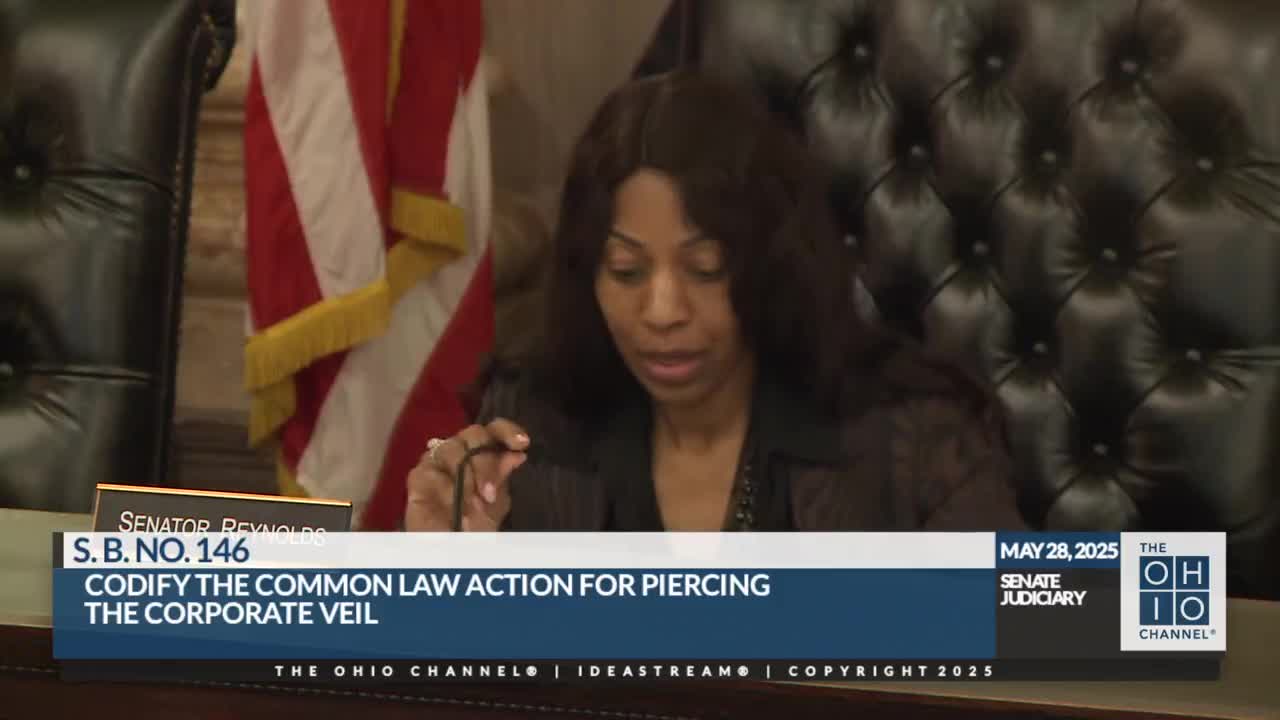
Senate Judiciary Committee members heard proponent testimony on substitute Senate Bill 146, which would codify Ohio common‑law standards for piercing the corporate veil and limit when individuals may be held personally liable for corporate actions.
Senate Judiciary Committee members heard proponent testimony on substitute Senate Bill 146, which would codify Ohio common‑law standards for piercing the corporate veil and limit when individuals may be held personally liable for corporate actions.
Supporters told the committee the bill is intended to preserve the traditional judicial balance that treats corporations and similar business entities as separate legal persons while keeping personal liability available only in cases of fraud or other exceptional circumstances.
Greg Russell, partner at the law firm Voorhees, Saylor, Seymour and Peace and general counsel for the Ohio Oil and Gas Association, said the state’s recent enforcement efforts have sought to impose personal liability on individuals by alleging they “knew about or should have known” about violations and had the authority to prevent them. Russell warned that, “the process can be the punishment,” citing an example in which the state has sought to impose liability on the owner of a small operator, Blaze Oil, after the company failed to plug three wells and the owner had no order personally issued to him.
Anne Marie Spera, partner at the Bricker Gradin law firm, testifying for the Ohio Alliance for Civil Justice, told the committee that Ohio courts have long treated shareholders, officers and directors as generally not liable for corporate debts and pointed to the state constitution in that context. “To be clear, nothing in this bill prevents prosecution for those who commit crimes,” Spera said, and she said the bill clarifies the standard courts should apply when veil piercing is sought.
Kevin Shemp, an associate attorney at Dickinson Wright testifying for the Ohio Chamber of Commerce, said the bill would bring predictability to civil and administrative enforcement by adopting factors courts already use: that veil piercing requires a showing of complete control by an individual and fraudulent or illegal conduct that results in harm. “By creating a statutory framework for piercing the corporate veil, Senate Bill 146 will also bolster the state’s legal climate by bringing greater predictability to our civil justice system,” Shemp said.
Witnesses described the state’s recent enforcement approach as a “participation” theory of liability that could, they said, be applied broadly and deter investment. Russell and others gave examples of pending enforcement matters, including a case referenced in testimony as State v. Northwood Oil and Gas Company, where prosecutors allege an officer could have required compliance and did not.
Vice Chair Reynolds moved to adopt the substitute version of the bill; the committee adopted the substitute without objection. The committee then received proponent testimony; the hearing record stands as the committee’s hearing on Senate Bill 146.
Details cited by witnesses at the hearing included that the Ohio Oil and Gas Association is a 75‑year statewide trade association; the Ohio Chamber represents more than 8,000 companies; and the Blaze Oil example involved three wells the company was ordered to plug and for which the owner was later the target of liability claims. Several witnesses said civil‑penalty regimes can include minimum and maximum daily amounts, which, depending on the statute, can reach into the tens of millions of dollars over time.
No formal committee vote to report Senate Bill 146 to rules was recorded in the hearing; the substitute was adopted and the committee heard testimony.
The committee did not take additional action on the bill at this meeting and concluded the public hearing.