Get Full Government Meeting Transcripts, Videos, & Alerts Forever!
Get email alerts on the Corporate Liability Piercing Veil topic
No spam. Unsubscribe anytime.
Senate Judiciary Committee adopts substitute to codify standard for piercing corporate veil
Summary
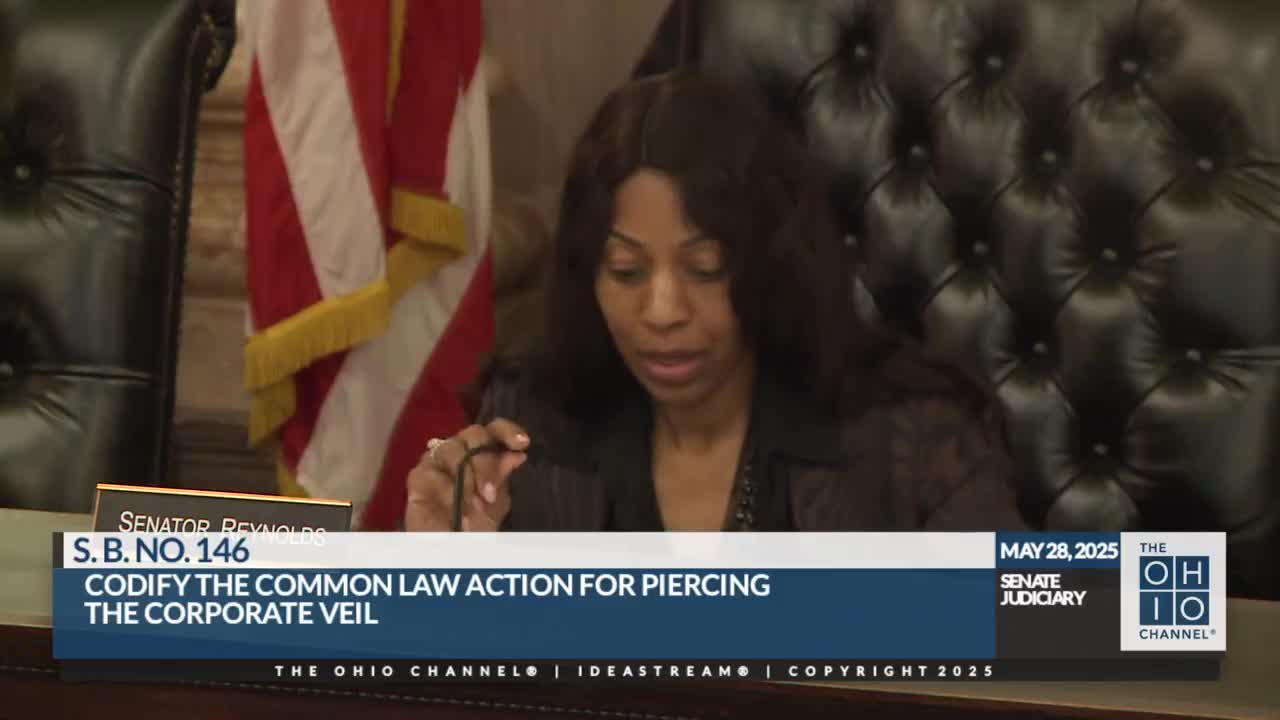
At a meeting of the Ohio Senate Judiciary Committee, members adopted a substitute version of Senate Bill 146, which would codify Ohio's common-law standard for piercing the corporate veil and narrow circumstances when individuals may be held personally liable for corporate obligations.
At a meeting of the Ohio Senate Judiciary Committee, members adopted a substitute version of Senate Bill 146, which would codify Ohio's common-law standard for piercing the corporate veil and narrow circumstances when individuals may be held personally liable for corporate obligations.
The substitute was put forward by Vice Chair Reynolds when the bill was called for its second hearing and, after a brief question period and no objections, the committee adopted the amendment. Vice Chair Reynolds moved to adopt the substitute; the committee chair asked if there were objections and, "Seeing none, the substitute bill is adopted." The committee then heard proponent testimony.
Greg Russell, a partner at the law firm of Voorhees, Saylor, Seymour and Peace and general counsel for the Ohio Oil and Gas Association, told the committee that recent enforcement efforts have sought to impose personal liability without meeting traditional veil-piercing standards. Russell said those enforcement efforts "seek to avoid piercing the corporate veil" and warned of broad consequences for investors and officers, saying, "the process can be the punishment." He described cases in which the state has sued both the company and individuals after orders to plug wells were not appealed, citing a small operator he called Blaze Oil and the case of State v. Northwood Oil and Gas Corporation as examples he has seen in litigation.
Anne Marie Spera, a partner at the Bricker Gradin law firm testifying for the Ohio Alliance for Civil Justice, told the committee the substitute sets a statutory standard that reflects the limited, exceptional role that veil piercing plays in Ohio law. Spera cited the Ohio Constitution, saying the principle that corporate owners are not generally liable for entity debts is "included in the Ohio constitution in article 13, section 3," and said the bill allows veil piercing "for fraud or other exceptional circumstances" while clarifying acts that are insufficient to impose personal liability.
Kevin Shemp, an associate attorney at Dickinson Wright testifying on behalf of the Ohio Chamber of Commerce, said the change brings predictability for businesses and specifically extends the codified factors to administrative enforcement actions. The Ohio Chamber's testimony stated the organization represents more than 8,000 companies and urged the committee to favorably report the bill because it "will improve the business and legal climates" by reinforcing the divide between corporate liability and personal assets.
Committee members asked for examples and clarifications during testimony. Senator Blessing asked for concrete examples of recent enforcement actions; Russell cited the Blaze Oil matter and the Northwood case and said those matters are proceeding through the courts. Witnesses repeatedly said the bill would not prevent criminal prosecution where wrongdoing is proven but would raise the bar for imposing personal liability in civil or administrative enforcement absent fraud or equivalent exceptional conduct.
The committee's action was limited to adopting the substitute and receiving proponent testimony. No formal vote tally for adoption was recorded in the transcript, and committee members did not take additional public testimony in opposition during the session. The committee designated this appearance as the bill's second hearing.