Get Full Government Meeting Transcripts, Videos, & Alerts Forever!
Get email alerts on the Medicaid Expansion topic
No spam. Unsubscribe anytime.
Advocates urge Senate panel to drop automatic 'trigger' that would end Medicaid expansion
Summary
Disability, health and advocacy groups told the Senate Medicaid subcommittee that language in House Bill 96 that would automatically end Medicaid expansion if the federal FMAP falls below 90% would strip coverage from hundreds of thousands of Ohioans and destabilize health services across the state.
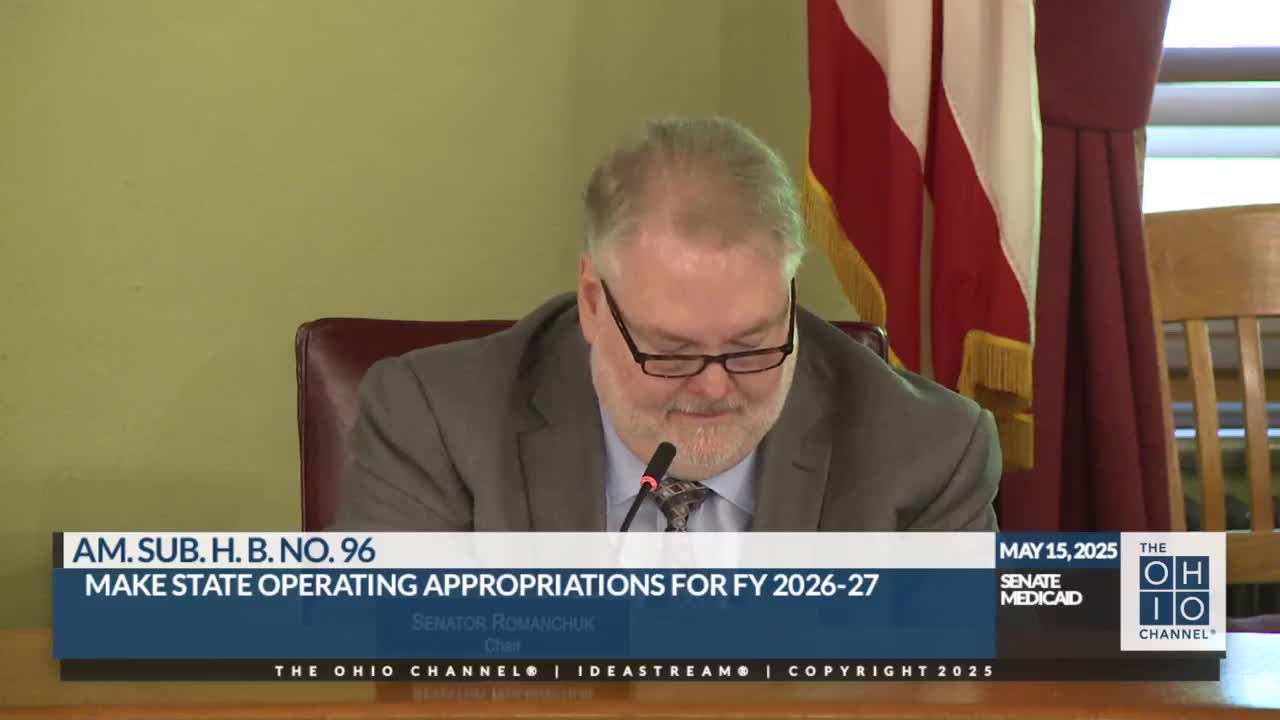
Chairman Romanchuk and members of the Senate Medicaid Subcommittee heard multiple witnesses Monday urging lawmakers to remove or soften language in House Bill 96 that would automatically terminate Ohio's Medicaid expansion if the federal matching rate (FMAP) dropped below 90%.
Disability advocates, reproductive health groups, social workers and local coalitions told the panel the measure — described in testimony as a "trigger" — would abruptly cut coverage for hundreds of thousands of people with little warning and cause service providers to collapse.
"Ending Medicaid expansion is nothing short of a work disincentive for hundreds of thousands," said Dr. Jules Padalita, disability rights advocate for the Ability Center of Greater Toledo. "This could mean that up to 2 out of every 5 direct care workers in Ohio would be affected by the trigger law in an industry where the term 'direct care crisis' has been used for decades."
The Planned Parenthood director Danielle Fierczyk told the committee that the expansion is "foundational to Ohio's economic success" and urged senators to vote against HB 96. She supplied district-level counts of people who would lose coverage under the trigger language, telling the committee the result would be immediate loss of benefits for constituents in each Senate district represented on the panel.
Matthew Tippett, state chapter director for the National Association of Social Workers–Ohio, asked the committee to change the word "shall" to "may" so future lawmakers would have discretion rather than an automatic termination. "We really view this as throwing out the milk before you open the bottle to smell if it's even spoiled," Tippett said, arguing the state might be able to absorb small FMAP changes.
Multiple parent, disability and senior witnesses described the human effects: loss of access to specialty care, medications, long‑term care and services that help people keep working. Northern Ohioans for Budget Legislation and Equality members and local nonprofit leaders called the provision particularly destabilizing for children and families and said it could also increase uncompensated hospital care and emergency department use.
Committee members did not take a vote during the informal hearing. Witnesses asked senators to restore or preserve other related provisions, including continuous eligibility for children from birth through age 3 and to retain existing reporting and oversight relationships.
The subcommittee received dozens of written statements on the topic, and several witnesses said they would submit additional data showing how a rollback of expansion would affect hospital usage, workforce stability and county-level services.