Get Full Government Meeting Transcripts, Videos, & Alerts Forever!
Get email alerts on the Medicaid Expansion Trigger topic
No spam. Unsubscribe anytime.
Witnesses urge lawmakers to remove 'trigger' that would end Medicaid expansion
Summary
Multiple providers, advocates and Medicaid beneficiaries told the Senate Medicaid subcommittee that proposed 'trigger' budget language would abruptly end Medicaid expansion if federal funding dipped, harming hundreds of thousands of Ohioans and local providers.
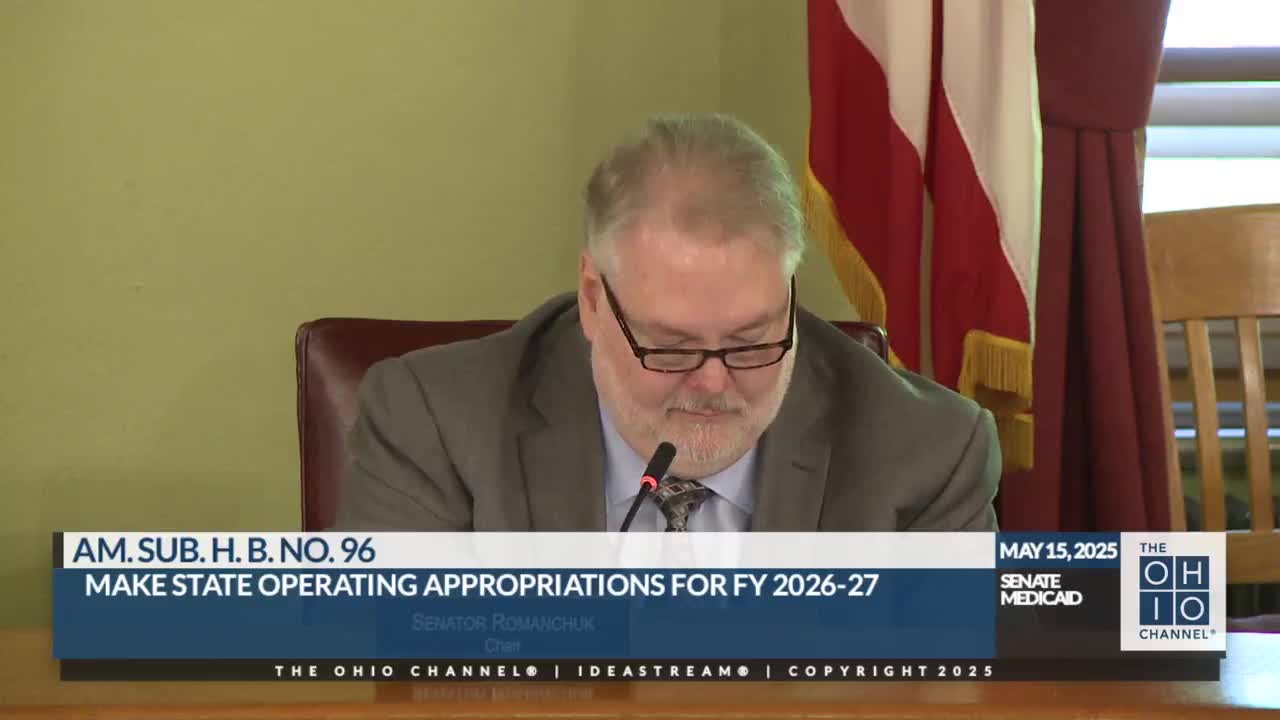
Chair Romanchuk convened the Senate Medicaid subcommittee hearing on House Bill 96, where dozens of witnesses urged the committee to change or remove language that would automatically end Ohio's Medicaid expansion if the federal matching rate falls below a specified threshold.
The testimony centered on the proposed "trigger" provision and its potential consequences. Danielle Fierczyk, director of public policy for Planned Parenthood Advocates of Ohio, warned that the trigger would “decimate Ohioans' Medicaid access,” saying it would immediately remove coverage for large numbers of people who rely on expansion. Matthew Tippett of the National Association of Social Workers, Ohio chapter, said the law would risk undoing gains made during the opioid crisis and observed that many community providers expanded services under Medicaid expansion and would lose funding if expansion were cut.
Speakers gave district-level estimates of impact. Fierczyk read figures showing tens of thousands in each senator's district would lose coverage if expansion were ended, and several witnesses noted that many people covered by expansion have no realistic private coverage option.
Individuals who rely on the coverage offered personal testimony. Cheryl Pritchard, a Medicaid expansion enrollee with chronic conditions, said the coverage has been a “lifesaver” that enabled her to work and afford disease-modifying therapies. Diane Howard, a Cuyahoga County official and Medicaid advocate, warned that cuts would strain adult protective services and long-term care staffing.
Experts and advocates recommended changing the budget language from a mandatory "shall" to a discretionary "may," enabling future lawmakers to respond to fiscal realities rather than forcing an immediate rollback. Dr. Jules Padalita, a disability-rights advocate, said the trigger would act as a "work disincentive" for hundreds of thousands of people and noted that even a short, unannounced loss of coverage could leave families unable to afford medications. The Ohio Poverty Law Center and multiple coalitions urged restoring or retaining protections such as continuous enrollment for children birth through age 3.
No formal committee votes or motions were taken during the informal hearing. Witnesses called on the committee to preserve Medicaid expansion, to retain continuous enrollment protections for young children, and to avoid language that would cause abrupt coverage loss without phased, predictable transition planning.
The hearing continued with other budget-related testimony after the block of speakers on the trigger language.