Get Full Government Meeting Transcripts, Videos, & Alerts Forever!
Get email alerts on the School Finance Referendum topic
No spam. Unsubscribe anytime.
Elkhorn Area School Board authorizes April referendum after budget retreat; outlines potential cuts if vote fails
Summary
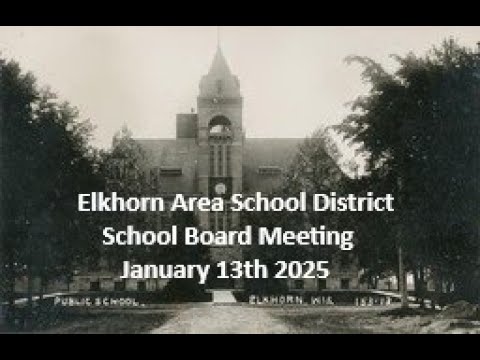
The Elkhorn Area School District Board of Education on Monday approved a resolution to seek voter approval for a four-year, nonrecurring operational referendum of $4 million per year and scheduled a referendum election for April.
The Elkhorn Area School District Board of Education on Monday approved a resolution authorizing the district to seek voter approval for a four-year, nonrecurring operational referendum of $4,000,000 per year and scheduled a referendum election to ask voters in April to allow the district to exceed its state revenue limit by that amount each year.
Board members said the request follows a recent budget retreat in which staff presented a five-year financial forecast showing growing deficits if revenues and expense assumptions hold. Business manager Bill (last name not specified in the meeting record) and district staff told the board the combination of low revenue-limit increases, rising costs and enrollment trends creates a projected operating shortfall that would require either new revenue or substantial reductions to avoid running out of fund balance over several years.
The board’s action authorizes a nonrecurring question covering four years and passed on roll-call votes. Board members also approved a separate resolution to provide for the referendum election itself; both measures passed with the recorded votes in the public meeting.
Why this matters: District staff presented a forecast showing modest state revenue-limit increases (the revenue cap increase used in the forecast is $3.25 per pupil per year under current law) while expenses were modeled with multi-year salary and benefit increases. Under the adopted scenario, the district would face growing deficits that staff said could be materially constrained by a successful referendum but would not entirely eliminate the need for other reductions. Board members emphasized they would continue to pursue internal savings regardless of the referendum outcome and that a failed referendum would trigger a district implementation plan of cuts developed during the budget retreat.
What the board and staff told the public: At the budget retreat and in the meeting, staff described assumptions used in the forecast (3% annual salary adjustments, 6% health-insurance increase in planning, utilities rising 5–10%, and a conservative view of state aid) and listed possible reductions that could be implemented if the referendum does not pass. Those options included a district hiring freeze, consolidating elementary grade bands into center schools, reorganizing custodial services, reductions at the middle-school model (moving toward a junior-high department model), reductions in central-office positions, and other attrition-based staffing reductions. Staff estimated those measures could equal roughly $1.2 million to $1.7 million in savings depending on scope and timing and—if fully pursued—would require converting many neighborhood-based structures and reassigning staff to maintain services.
Tax impact and timing: Using conservative property-assessment growth of 2.5%, staff presented a sample tax impact for the proposed $4 million ask: roughly $0.53 per $1,000 of assessed value. Staff translated that to $53 annually on a $100,000 home and about $159 annually (about $13.28 per month) on a $300,000 home under the assumptions in the presentation. The board highlighted statutory deadlines: because the April referendum calendar is compressed, the board must finalize the decision to place the question on the spring ballot in a short window in January to meet election deadlines.
Community response and outreach: Several parents and residents spoke during community participation asking the board to consider a shorter-term, nonrecurring ask and to make more detailed savings documents and town-hall opportunities available before a vote. Staff and trustees said they will publish a referendum web page that documents what has already been cut, what additional cuts would occur if the referendum fails, and how the district used community feedback to shape the proposal. Board members also invited groups and individuals to request meetings with staff and trustees to review details before the vote.
Votes at a glance (formal actions recorded in the meeting): - Approval of minutes for the Dec. 9, 2024 regular and closed school board meeting: motion moved and seconded; roll-call vote recorded with majority yes; two abstentions recorded for the closed-session portion (members recorded abstaining: Ms. Corpus and Mr. Jaime Serabia). (Transcript evidence: roll-call at ~1549–1570.) - Approval of minutes for the Jan. 6, 2025 closed-session meeting: motion moved and seconded; roll-call vote recorded as approved. (Transcript evidence: ~1577–1616.) - Approval of General and Other Fund Bills dated 01/13/2025 in the combined amount of $922,732.18: motion moved and approved by voice vote. (Transcript evidence: ~1620–1960.) - Resolution authorizing the district to exceed the state revenue limit by $4,000,000 per year for four years (nonrecurring): motion moved and approved by roll-call vote (recorded yes votes in the meeting transcript). (Transcript evidence: ~6063–6096.) - Resolution providing for a referendum election on that question: motion moved and approved by roll-call vote (recorded yes votes in the meeting transcript). (Transcript evidence: ~6127–6211.) - Designation of public depositories for the 2024–25 school year (adding BMO as a depository): motion moved and approved by voice vote. (Transcript evidence: ~6264–6415.) - Approval of personnel recommendation sheet (appointments/transfers, retirements noted): motion moved and approved by voice vote. (Transcript evidence: ~8593–8694.) - Acceptance of school gifts (donations to programs and Maker Fest): motion moved and approved by voice vote. (Transcript evidence: ~8732–8776.)
Discussion highlights staff asked the board to consider as part of the communications plan: clarifying what cuts would be implemented if the referendum fails; listing what the district has already deferred or held (technology purchases, building maintenance and roofing projects, and certain open positions); and offering additional public town halls before the April election so voters can ask specific questions. Staff also noted potential revenue upside through increased open-enrollment payments or state budget changes but said those could not be relied upon when preparing the forecast.
What’s next: The board approved both the authorizing resolution and the motion to set the referendum election, and staff will prepare public materials, additional town-hall dates and a referendum webpage with savings and scenario documents. If the referendum fails, staff said the district would implement the previously outlined reductions, phased by attrition where feasible, and the board would adopt the specific reduction plan.
Ending: Board members reiterated the tight calendar for placing a question on the April ballot, encouraged community members to attend forthcoming informational meetings, and said they would continue to pursue internal savings regardless of the referendum outcome.