Get Full Government Meeting Transcripts, Videos, & Alerts Forever!
Get email alerts on the Historic Preservation Tax Credit topic
No spam. Unsubscribe anytime.
SHPO explains federal and state rehabilitation tax credits for Oneonta commercial buildings
Summary
Ashley Barrett of the New York State Historic Preservation Office briefed Oneonta stakeholders on how the federal 20% historic rehabilitation tax credit and a New York state credit can be used to finance commercial building rehabs, eligibility rules, review steps, and examples of certified projects in Oneonta.
Ashley Barrett, of the technical preservation unit at the New York State Historic Preservation Office, told Oneonta stakeholders on March 31 that owners of historic commercial buildings can use federal and New York state rehabilitation tax credits to offset substantial rehabilitation costs.
"The federal commercial tax credit program allows property owners to claim an income tax credit equal to 20% of the qualified expenses of a rehabilitation," Barrett said, explaining that the program is administered jointly by the State Historic Preservation Office (SHPO) and the National Park Service, and that financial matters are handled by the Internal Revenue Service.
Barrett said two core eligibility rules govern the federal credit: the building must be a certified historic structure (listed on the National Register of Historic Places or certified as contributing to a registered district), and the project must meet the substantial rehabilitation test. "The cost of the rehab must exceed the greater of $5,000 or the building's adjusted basis," she said, and recommended applicants consult a tax professional and the county assessor to determine adjusted basis.
The SHPO review follows a three-part application process used nationwide. Barrett summarized the steps as: Part 1 (certify the building), Part 2 (approve proposed work), and Part 3 (certify completion). She said SHPO staff review each submission and forward recommendations to the National Park Service, which issues the final determinations. Barrett noted that review time for each submission is a minimum of 60 days.
Barrett outlined typical qualified rehabilitation expenditures (QREs) and exclusions. Eligible costs commonly include architectural drawings, consultant fees, energy upgrades, structural work, exterior envelope repairs, and interior finishes. Ineligible items frequently cited include the purchase price of the property, site work and landscaping, new additions, furniture, and fencing — though Barrett emphasized that such work can often be done but may not be claimed as QREs.
New York also offers a state rehabilitation tax credit for income-producing properties that uses the federal Part 3 approval as its trigger. Barrett said an additional state eligibility requirement is that the property be located within a qualifying census tract — defined as at or below 100% of the state median family income using the latest 5-year American Community Survey estimate. She said the SHPO's online Cultural Resource Information System (CRIS) will be updated on April 1 with the new census-tract data and that "every tract in Otsego County will be considered qualifying starting 04/01/2025 through at least 04/01/2028."
On state credit amounts and caps, Barrett said New York calculates the credit per structure with a $5,000,000 cap: projects with qualified expenditures over $2.5 million are eligible for up to 20% of those expenses, while smaller projects under $2.5 million may claim 30%. Taken together with the federal credit, Barrett said owners of eligible income-producing properties can claim up to roughly 40–50% of qualified rehabilitation expenses when both credits apply.
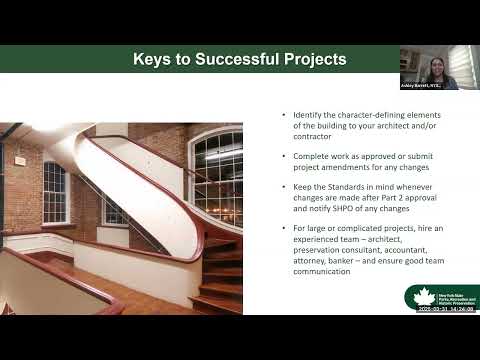
Barrett also reviewed the Secretary of the Interior's Standards for Rehabilitation, which the National Park Service interprets to judge whether proposed work preserves a property's historic character. "The standards are ultimately interpreted by the National Park Service, not by our office," she said. She advised applicants to identify character-defining features early, involve design and building professionals familiar with preservation, and consider hiring a preservation consultant to coordinate between contractors and SHPO staff.
Barrett pointed to local examples: the Ford Block at 186–212 Main Street received final certification in December of the prior year and is finished and open, and a building at 151–153 Main Street was awarded final certification in March 2020. She provided contact information for SHPO staff, including Kath Lafrank (who handles Part 1 submissions for Otsego County), and reiterated that the program issues tax credits rather than cash payments.
Questions from meeting hosts were brief and the presentation ended with organizers thanking Barrett and noting that Oneonta already has many commercial buildings listed on the National Register.
Barrett closed by urging careful, accurate completion of the Part 1/2/3 forms because those written descriptions are shared with the IRS and treated as tax documents.
Next steps for property owners Barrett identified included: checking CRIS for census-tract eligibility on or after April 1, consulting a tax professional to calculate adjusted basis and QREs, and contacting SHPO staff to begin Part 1 if a building is not yet certified.