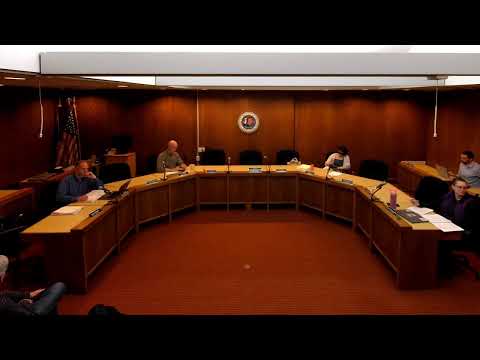
Oneonta budget subcommittee reviews police staffing, building and overtime pressures
Loading...
Summary
The Oneonta Common Council budget subcommittee heard Police Chief Chris Wittenberg outline staffing shortages, proposed operational changes, building needs and overtime costs. Committee members discussed volunteer options, outsourcing dispatch and a needs assessment for the police facility; no formal votes were taken.
The Oneonta Common Council budget subcommittee on police services heard from Police Chief Chris Wittenberg on staffing shortfalls, operational changes intended to reduce overtime and the police facility's long‑term needs.
Wittenberg told the committee that "we have 3 in the academy right now, which would put us at 24," but added that those officers "won't be ready for solo assignment until December." He said the department also has about "17 currently signed up for the test that's gonna be given in May," and that an upcoming retirement on June 28 will reduce staffing by one. Wittenberg described options for hiring and timing given academy schedules and training timelines.
The chief outlined operational changes intended to reduce attrition and overtime, including pairing officers on patrol and shifting one civilian dispatcher position to a sworn officer so more officers can be on the street. He said the change allowed the department to "establish 3 people on the road without filling that [dispatcher] position," and that the goal was to have "an officer backfill the dispatch position and have an officer sit at the desk" so the station can be closed and more officers put on patrol.
The committee heard preliminary cost and operational signs from those experiments: Wittenberg said the department has seen fuel savings and less wear on vehicles and fewer officer injuries. He summarized recent measures as "a 25% down on fuel costs" compared with two years earlier and a "27% decrease from August until April" compared with last year. He also reported fewer uses of force and fewer workers'‑compensation injuries anecdotally since implementing paired patrols.
Committee members pressed on overtime and budget effects. Members noted department overtime exceeded the prior budget by roughly six figures; one council member recalled overtime had gone over by "between a hundred and 12 and a hundred and 25,000," a range the group said Ginny (staff) would confirm with the 2024 actuals she completed and agreed to circulate. Wittenberg said a major objective of adding funded patrol positions is to reduce supervisor overtime and minimum‑shift coverage that currently requires sergeants to take patrol duties.
Facility needs and technical infrastructure were another focus. Members and Wittenberg discussed a building needs assessment budgeted at about $50,000 in the current year and noted long‑standing limitations in the dispatch area, raised flooring and radio tower infrastructure that "has not been anything but patched since 1979," in Wittenberg's words. He called the dispatch space "not conducive to human habitation" long‑term and said the department must weigh small‑term rehabilitation against multi‑decade planning for a replacement or major renovation.
The committee explored other options for cost control or service delivery changes. Members discussed outsourcing dispatch to the county, contracting or third‑party vendors for administrative tasks such as background checks (the department already uses a vendor called Guardian Alliance for some personal‑history work) and developing a volunteer or auxiliary program for large events. Wittenberg said the department has worked with the Department of Public Works and that volunteers or DPW support could reduce overtime for events such as July 4, where staff estimated public safety costs could run into the tens of thousands of dollars for a single day.
Wittenberg also told the committee the department's report management system is hard to use — "I can't even search people by phone number right now" — and that replacing it would help track calls, officer activity and overtime more precisely. He described ongoing work to identify administrative tasks that could be contracted out or streamlined, including fingerprinting and background checks where feasible.
Members and staff flagged follow‑ups: Ginny will provide the 2024 actuals broken down by department; the committee will invite the fire department to the next meeting to continue discussions about shared space and the community paramedicine/crisis intervention efforts that could link police, fire and social work supports. No formal motions or votes were recorded during the review.
The meeting also opened with one resident public commenter urging tighter limits on fund‑balance withdrawals and a requirement that new, unbudgeted projects be justified as emergencies before being funded; the commenter said those ideas would be provided to the council in writing.
The subcommittee scheduled follow‑up briefings and additional data requests to clarify how staffing changes, equipment purchases and building work would affect the department's budget and the city's overall financial position.