Get Full Government Meeting Transcripts, Videos, & Alerts Forever!
Get email alerts on the Convenience Centers Solid Waste Budget topic
No spam. Unsubscribe anytime.
Board weighs convenience-center changes and public-safety staffing as it advertises FY26 tax rates
Summary
Supervisors discussed convenience center operations, short-term fixes to Livingston and Chancellor sites and a plan to form a working group. During the FY26 budget work session, the Commonwealth's Attorney and Sheriff's Office outlined staffing and courtroom needs; the board voted to advertise the recommended tax rates 5-2.
The Spotsylvania County Board of Supervisors spent a significant portion of its March 11 meeting addressing operations at the county—s convenience centers and landfill, and heard department-level budget presentations that emphasized personnel needs in public safety and the courts. The board also voted to advertise the County Administrator—s recommended FY2026 tax rates, a procedural step needed before final tax-rate adoption.
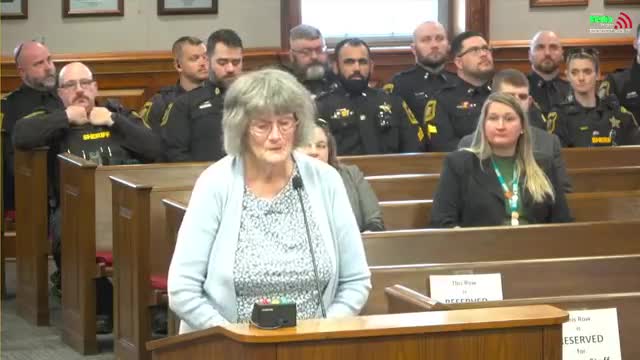
Multiple residents urged the board to address site conditions and customer-facing problems at convenience centers. Judith Rogers (Cortland District) described large potholes and muddy conditions at the Livingston Landfill dump area and asked the county to grade and add gravel to reduce safety risks. Marcus Garcia (Lee Hill District) asked for a short public presentation explaining how volunteer commission and board members are appointed and vetted; he said he had counted many advisory boards and wanted more public transparency in appointment processes.
Board discussion focused on short-term fixes and longer-term operational changes. County solid-waste staff said that Livingston—s pothole issue would be addressed promptly and that Livingston Landfill and convenience center hours had moved back to summer hours: most centers 8 a.m. to 6 p.m. and Livingston 7 a.m. to 5 p.m. Staff reiterated Chancellor Convenience Center was still not accepting brush while a limited plan to resume brush collection is developed; safety of citizens and employees was cited as the primary concern.
Supervisors agreed to concentrate initial work in small "2-by-2" contacts between board members and staff and then present a public briefing on solid-waste operations. Supervisors Childress and Lane offered to meet with staff and report back; the board later voted 7-0 on a motion to disband the previously created ad-hoc committee and direct staff to work with a small group of supervisors to address operational issues and short-term fixes.
Budget work session: public safety and courts The meeting moved into the FY2026 budget work session where Commonwealth's Attorney Mahaffey and sheriff's office officials described operational stresses.
Commonwealth's Attorney Mahaffey told the board his office is handling substantially more jury trials and court workload and requested additional staff support for trial preparation and victim services. He cited repeated weeks with multiple jury trials scheduled and said the office needs more prosecutors and victim-witness staff. Mahaffey said a full-time victim-witness advocate would cost about $50,000 and that even a part-time position would provide meaningful assistance while the office processes cases and supports victims during trials.
Sheriff's Office representatives, including Major Scott, reported 35 full-time deputy vacancies and warned that the department is "critically" short-staffed. The sheriff—s presentation outlined a two-pronged retention and recruitment strategy that County Administration has included in the recommended budget: a pay-scale update already funded in the recommended budget (about $1.3 million) and a proposed year-for-year credit for experienced certified officers so certified hires could be paid at their years-of-service level. Staff said the budget as recommended can implement a pay-scale change effective July 1 and a half-year of year-for-year credit effective January 1.
Sticker revenue and enterprise fund discussion Board members and staff discussed proposals to reinstate a vehicle decal (sticker) for convenience-center access and to move convenience-center revenues and tipping fees into a separate solid-waste enterprise fund. Staff and supervisors estimated decal revenue might be in the range of several hundred thousand dollars to more than $700,000 annually depending on price and uptake; several board members said they prefer a county sticker tied to registered vehicles rather than a general new fee. The board discussed using a dedicated revenue stream to support convenience-site operations and, in the longer term, financing options such as revenue bonds if solid waste were run from an enterprise fund rather than the general fund.
Tax-rate advertisement After discussion about the volatility in vehicle valuations and uncertainty in final vehicle value files from the Commissioner of the Revenue, the board voted to advertise the County Administrator—s recommended FY2026 tax rates. The vote to advertise passed, 5-2; Supervisors Yakubowski and Dr. Frazier voted no. Staff said the advertised rates set the maximum the board can later adopt and that the Commissioner of the Revenue will finalize vehicle values to inform the final tax-rate decision.
Why this matters: Convenience centers serve thousands of residents; changes to hours, access rules and decal policies directly affect residents without curbside service. The sheriff—s staffing shortages and the Commonwealth—s Attorney—s request for courtroom support highlight near-term public-safety and court-service risks that factored into the board—s FY2026 budget discussions.
Next steps: Staff will produce a public presentation on convenience-site operations and will meet with nominated supervisors to address short-term fixes (potholes, brush acceptance, signage). Finance and the Commissioner of the Revenue will finalize vehicle-value data and present updated revenue estimates before the board sets a final FY2026 tax rate.