Get Full Government Meeting Transcripts, Videos, & Alerts Forever!
Get email alerts on the Data Centers topic
No spam. Unsubscribe anytime.
Southampton County planners review data center impacts; staff asked to monitor infrastructure needs
Summary
Commissioners reviewed a JLARC report and local zoning rules, discussed water, power and permitting constraints for potential data centers, and asked staff to continue tracking developments and neighbor jurisdictions’ experiences.
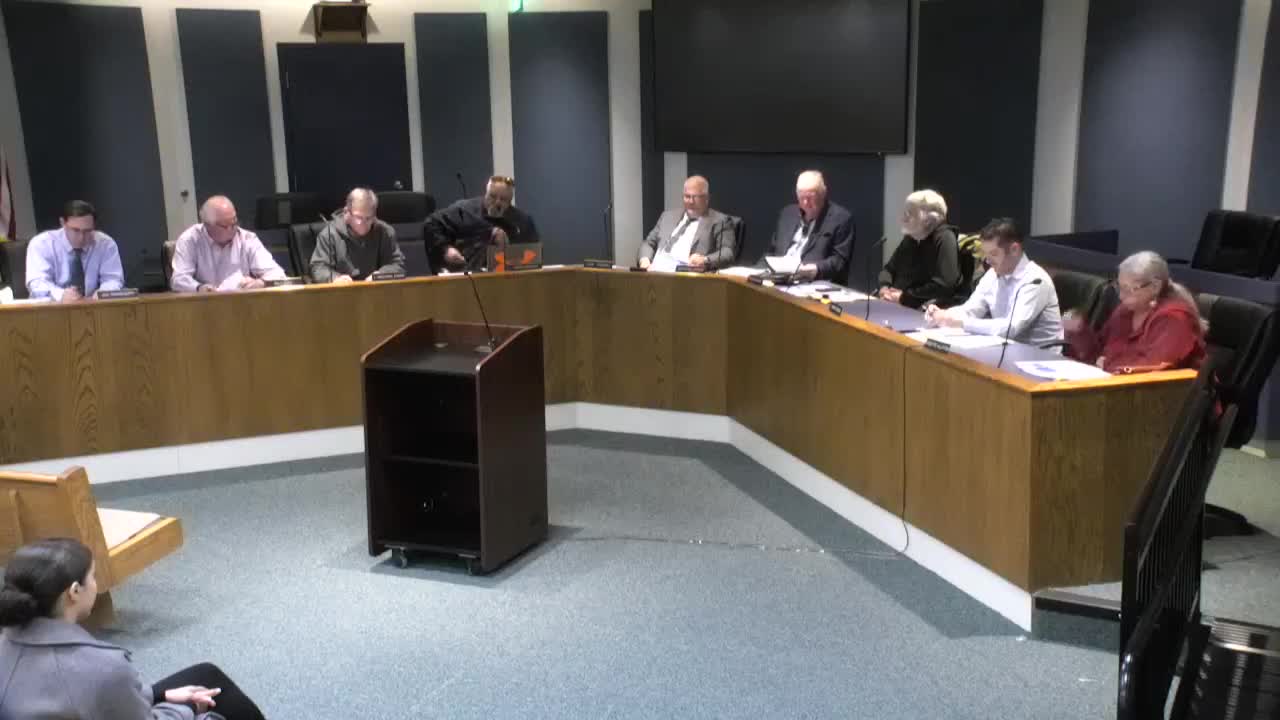
The Southampton County Planning Commission spent the bulk of its meeting discussing the potential local impacts of data center development and how the county’s zoning and infrastructure would accommodate such facilities.
Secretary Randolph, planning staff, told commissioners that “In 2023, the Joint Legislative Audit and Review Commission began to study and determine the impact of data center development in Virginia,” and that the JLARC study and an accompanying presentation were included in the commission’s meeting packet. Randolph also summarized how Southampton County’s zoning addresses data centers: data processing centers are a permitted use in the county’s M-1 industrial district but only when the M-1 district is at least 30 acres in size.
The commission’s review focused on utilities and siting constraints. Commissioners and staff flagged electricity and water availability, transmission-line capacity, and wastewater/cooling-discharge requirements as the most significant local considerations. Several speakers noted that large data centers require substantial, sustained power and often large water supplies for cooling; one commissioner summarized material in the packet by saying the study suggested grid upgrades could increase average customer bills by “anywhere from $75 to $100,” a cost that would depend on how local and regional utilities recover infrastructure investments.
Commissioners discussed county-owned land that could be marketed for industrial uses. Randolph said the county owns several hundred acres on Rose Valley Road (referred to in the packet as the Beale Farm property) and has sought state support to make the site more “shovel ready.” Randolph told the commission the county had received a roughly $200,000 state grant to start environmental assessments and to increase the property’s marketability.
Members compared Southampton’s position to other Virginia localities cited in the JLARC packet. Commissioners discussed projects elsewhere — including a large, multi-site proposal in Surry County that recently entered bankruptcy proceedings, and long-running proposals in Pittsylvania and Mecklenburg counties — and noted those cases illustrate long timelines, complex infrastructure needs and uncertain realization of projected tax revenues. Randolph warned that rezoning and site-development processes can allow for proffers and conditions but also that the county currently has few M-1 districts larger than 30 acres, meaning most large projects would require rezoning.
The commission emphasized process and caution. Commissioners asked staff to examine: (1) the county’s existing industrial and M-1 zoning acreage and whether thresholds or conditional review should be added for very large industrial projects; (2) current transmission-line capacity and likely lead times for upgrades with Dominion Energy and the local electric co-op; (3) water availability and treatment/cooling-discharge constraints; and (4) experiences and ordinance responses in nearby jurisdictions. Chairman, Southampton County Planning Commission, said the packet was “quite fitting, quite enlightening,” and asked Randolph to continue gathering information for future meetings.
No formal zoning changes, conditional permit standards, or site approvals were made during the meeting. Commissioners discussed timelines and concluded that, while interest exists, actual development in Southampton County — particularly for large campuses — would likely be a multi-year prospect and would require addressing utility, environmental and permitting challenges before moving forward.
Votes at a glance - Approval of minutes (with a correction from “Randall” to “Randolph”): motion made and approved by voice vote; no roll-call tally recorded. (Action recorded as approval of minutes.) - Motion to adjourn: motion made and approved by voice vote; meeting adjourned.
Ending Commissioners directed staff to continue monitoring data center trends, utility capacity and neighboring localities’ regulatory responses and to report back at a future meeting. The commission did not set a timeline for ordinance revisions; members described the discussion as an early-stage review to inform potential later action.