Get Full Government Meeting Transcripts, Videos, & Alerts Forever!
Get email alerts on the Emergency Management topic
No spam. Unsubscribe anytime.
Spotsylvania supervisors adopt revised Emergency Operations Plan, board hears details on public alerts and response gaps
Summary
The Spotsylvania County Board of Supervisors voted unanimously May 13 to adopt a revised Emergency Operations Plan. County emergency management staff described public alerting tools, confidentiality of core response elements, and equipment and staffing gaps for high-rise and data-center incidents.
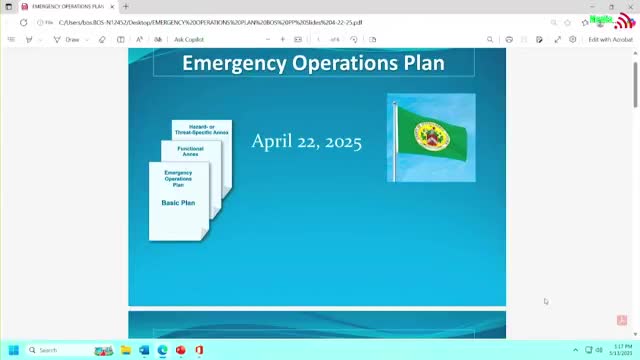
Spotsylvania County on Tuesday adopted a revised Emergency Operations Plan that county staff said provides the legal and organizational framework for responding to disasters and large-scale emergencies.
County Emergency Management Coordinator Don Willis told the Board of Supervisors the plan assigns responsibilities to county departments for mitigation, preparedness, response and recovery and "follows the Commonwealth of Virginia Emergency Services and Disaster Law," requiring annual updates and a formal review every four years.
The plan also describes public-notification tools and redundancies the county would use when a serious incident occurs, Willis said. "We integrated FEMA's integrated public alert warning system, which will touch any and all devices, with an emergency alert to include a wireless emergency alert if that's necessary," he said. He also described use of Everbridge, reverse 911, traditional media and door-to-door notifications where required.
Why it matters: the plan sets the county's formal approach should a major weather event, technological failure or radiological incident occur — and supervisors pressed staff about whether residents would receive timely warnings, especially in rural areas with weak cell coverage.
Supervisor Lang asked how the county would notify residents if North Anna Nuclear Station required local action, noting recent problems placing phone calls in rural areas. Willis said the county has redundancy built into its alerting approach, including wireless emergency alerts, the Emergency Alert System and possible landline notifications, and that door-to-door evacuation procedures are part of the plan if needed.
Board members also asked about operational gaps. Willis said Spotsylvania currently lacks permanently staffed aerial apparatus to reach the tops of very tall buildings and that staffing Station 12 (planned to open in a future budget cycle) is intended in part to address response capacity along the Route 1 corridor and to position critical equipment closer to new development. On fires or heavy smoke incidents at data centers, Willis said the county is considering regional options for specialized equipment such as truck-mounted positive-pressure fans and would rely on mutual aid where appropriate.
Board action: Supervisor Mullins moved to approve the plan as revised; the board then voted and the motion passed unanimously. Records in the meeting show a formal roll-call approval: "7 yes, motion passes." The board also held a closed session beforehand to discuss aspects of the county's emergency plans under cited Virginia statutes; staff returned to open session and certified the closed meeting before taking the vote to adopt the plan.
The plan's basic document will be public, Willis said, but he emphasized that the "core emergency operations plan remains confidential and exempt from Freedom of Information Act requests," language he attributed to the Commonwealth and the county's legal review.
The board and staff agreed to test county alerting and Willis said staff will schedule a publicized test of the wireless alert system so supervisors can notify residents in advance and assess message delivery.
Ending: With adoption complete, supervisors asked staff to follow up on exercise and testing schedules and on equipment needs tied to new development and fire-station staffing plans.