Get Full Government Meeting Transcripts, Videos, & Alerts Forever!
Get email alerts on the Solid Waste Management topic
No spam. Unsubscribe anytime.
Supervisors order committee after extended discussion of county trash sites and attendant safety
Summary
After months of complaints about overflowing dumpsters, out-of-county users, and hazardous conditions, the board directed the county administrator to convene a committee with site attendants and staff to develop fixes and return with recommendations.
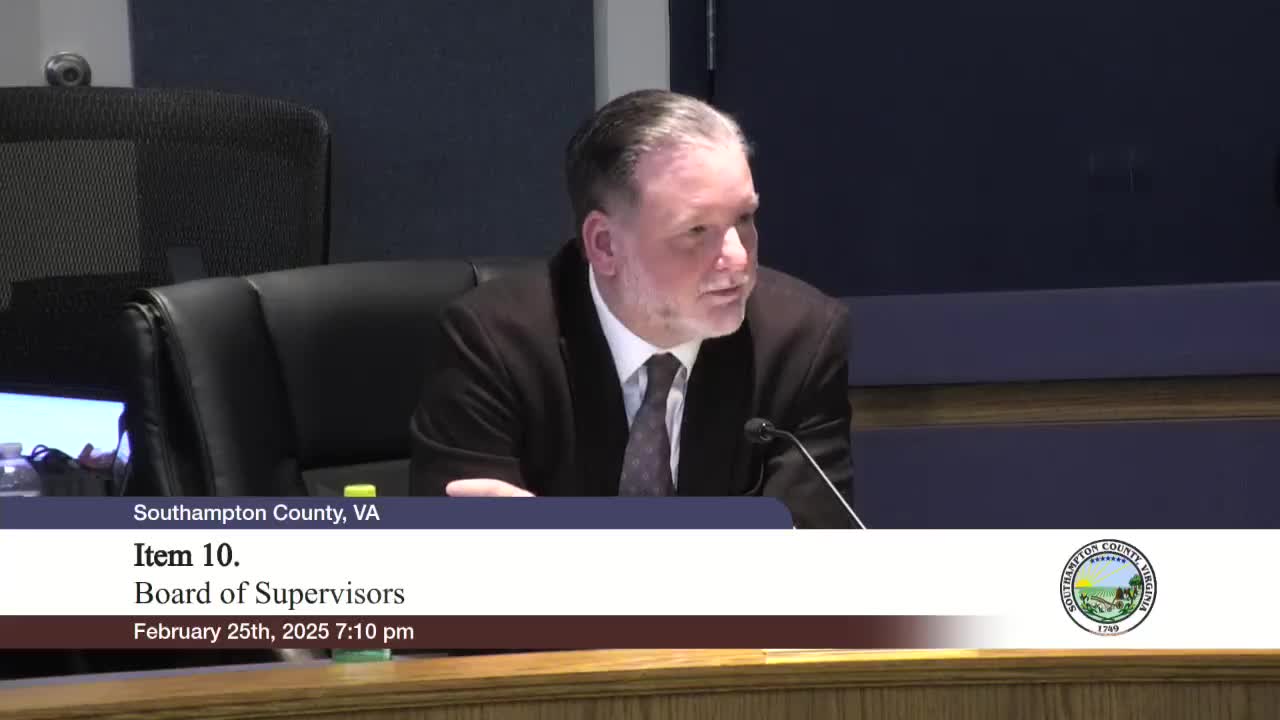
An extensive Feb. 25 discussion about Southampton County’s refuse collection sites ended with supervisors directing the county administrator to form a committee to develop recommendations on operations, attendant responsibilities and safety.
Issues raised by residents, supervisors and a longtime site attendant included overflowing dumpsters, out‑of‑county vehicles using the sites, inconsistent attendant duties, and hazardous conditions behind bins. Dave Cox, a site attendant at the Munro site for 19 years, told the board he has been asked repeatedly to pick up heavily soiled material and hazardous household items without personal protective equipment and expressed fear of exposure: “At this point in my life if I was to get some kind of bad disease or something it would probably kill me,” he said.
County staff described the existing practice: attendants should pick up small amounts of loose trash near bins, the county brings heavy equipment (bobcat) for larger bulk items, and attendants are covered by workers’ compensation. Staff also said scheduling and hauling are on a regular route but noted seasonal spikes around holidays.
Supervisors and staff discussed enforcement options for non-resident users (decals, ID checks) and the trade-offs of stricter policing: staff warned that checking IDs or decals at gates can create safety issues (traffic backups or confrontations) and may push illegal dumping to other locations.
Board members asked for clearer role definitions and better equipment and proposed an internal committee including the county manager, public works staff and site attendants to develop practical solutions. The board directed the county administrator to convene that committee, solicit site attendant input and return with recommended changes; supervisors asked for the group’s report at a future meeting.
The action is a direction to staff rather than a formal ordinance change; any recommended changes to job descriptions, enforcement practices or budgets would return to the board for approval.