Get Full Government Meeting Transcripts, Videos, & Alerts Forever!
Get email alerts on the Land Use Solar Farm topic
No spam. Unsubscribe anytime.
Ingleside council denies special-use permit for solar farm after drainage and wetlands concerns
Summary
The City Council voted to deny a port-backed special-use permit for a proposed solar farm, citing unresolved drainage easement language, potential wetland impacts and questions about long-term land use; several residents praised the vote during public comment.
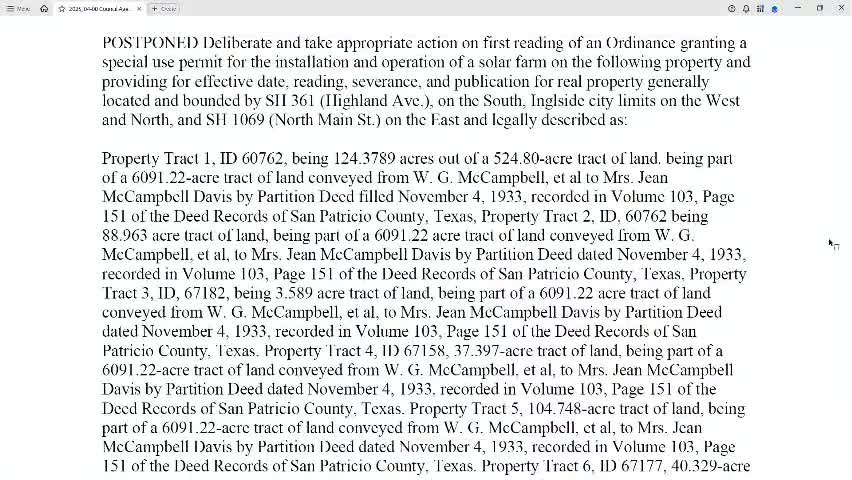
The Ingleside City Council voted 5-1-1 on first reading to deny a special-use permit for a proposed solar farm on land bounded roughly by SH 361/Highland Avenue and North Main Street, citing unresolved drainage easement language and lingering environmental concerns.
Council members raised repeated concerns that the draft ordinance required only a drainage plan tied to the project rather than a city drainage easement that would allow the city or drainage district to remedy runoff affecting a large portion of the city. “The whole point of getting the drainage easement as part of the condition of getting a special use permit was that…one fourth of this city goes through that deal,” Mayor Pro Tem Tim Long said during debate, urging an easement “regardless of whether the project goes forward.”
Councilman Deal made the motion to deny; Councilman Wilson seconded. The roll call was: Deal, Wilson, Pruitt, Mayor Pro Tem Long and Julio Salinas voted to deny; Council member John Salinas voted no; Mayor Adame abstained. The motion to deny therefore carried. The motion and vote record match the council’s formal action on the ordinance.
Several council members also questioned the project’s long-term economic benefit to Ingleside, potential effects on wetlands and whether mitigation proposals would move impacts to other jurisdictions. A port representative told the council that Port of Corpus Christi commissioners make final port decisions and earlier stated the port would comply with city zoning; council members sought clarity on how port-level approvals would interact with city requirements. Council debate also covered the expected 20–25-year life cycle of solar installations and the permanence of wetlands and flood-control functions.
During public comment, residents who had organized against the project thanked the council for the denial. Martha Hoplitzel, who circulated a petition related to the application, told councilors she appreciated the “good reasons for your decisions,” and others said the land contains wetlands and ranch features they want preserved.
The council’s denial was limited to the special-use permit on first reading; the transcript shows no follow-on amendment or conditional approval. Council members and staff discussed options for revisiting drainage easement language and for additional coordination with the drainage district and the Port of Corpus Christi before any future application would be accepted.
The council recorded no ordinance adoption accepting the permit; the formal action taken was a motion to deny on first reading.