Get Full Government Meeting Transcripts, Videos, & Alerts Forever!
Get email alerts on the Transportation Trails Master Plan topic
No spam. Unsubscribe anytime.
Tucker launches combined Transportation and Trails master plan; Lawrenceville Highway study highlights safety priorities
Summary
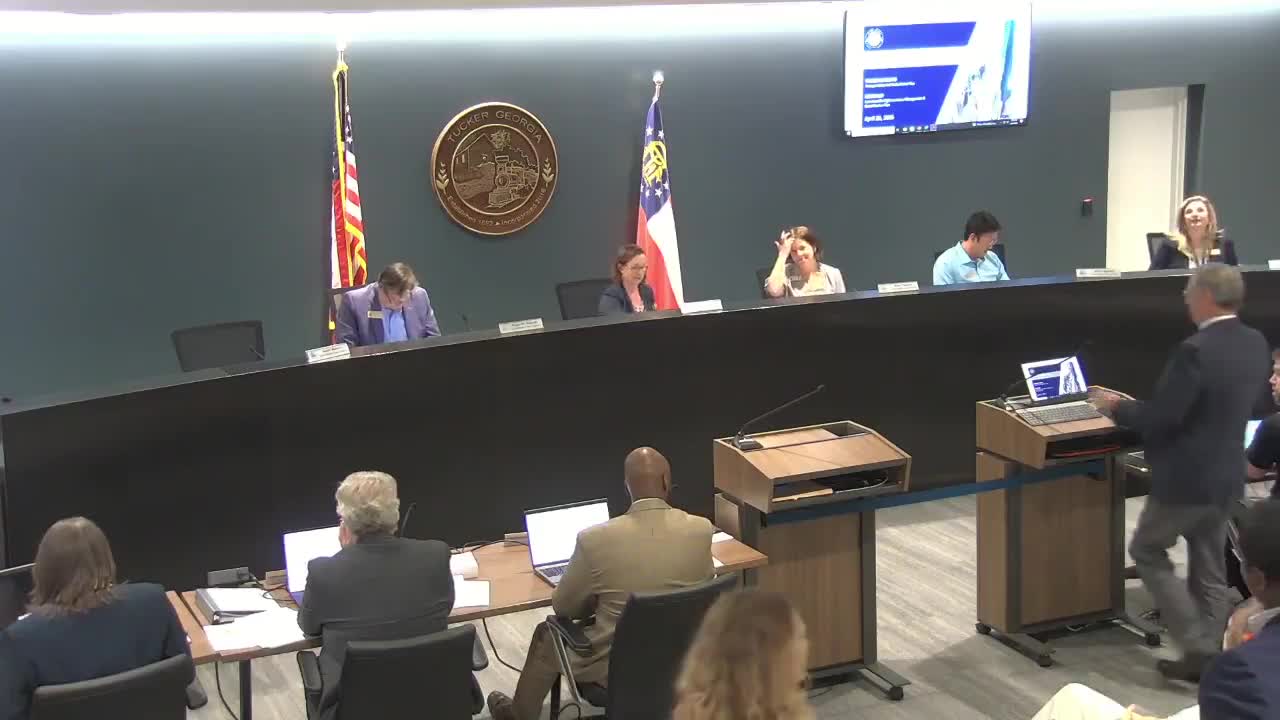
Consultants from Pond & Company presented the City of Tucker’s combined Transportation and Trails Master Plan — branded “Tucker Connects” — and an associated Lawrenceville Highway Access Management and Beautification Study at the council’s April 28, 2025 working session.
Consultants from Pond & Company presented the City of Tucker’s combined Transportation and Trails Master Plan — branded “Tucker Connects” — and an associated Lawrenceville Highway Access Management and Beautification Study at the council’s April 28, 2025 working session. The consultants outlined a public-engagement calendar through November, initial findings on collisions and user priorities, and next steps to position the city for federal safety implementation grants.
The presentation matters because the master plan will shape which safety and multimodal projects the city can prioritize and match to funding programs such as the Federal Highway Administration’s Safe Streets and Roads for All (SS4A) implementation grants. Pond representatives said the scope includes a safety action plan component required by SS4A and a Vision Zero leadership commitment the council would be asked to adopt later in the process.
Pond project lead Kat Anori (consultant, Pond & Company) said the combined plan carries a public-engagement timetable with multiple rounds of stakeholder and public meetings through the fall and an online survey already open. "We have our project website and our online survey are currently open," she told councilors, noting the team held the first round in March and plans additional meetings in June, August and September.
Consultants reported crash and injury totals drawn from five full years of GDOT data (2019–2023). According to the presentation, the dataset shows roughly 13,000 total crashes in Tucker over that span, including 38 fatalities and 157 serious injuries. Pond staff said those collisions help define a citywide “high-injury network” that will be the framework for prioritizing safety countermeasures.
Public priorities gathered so far emphasize off-street trails and bike lanes, safer continuous sidewalks, and traffic-calming or geometric speed-control measures. In community voting exercises presented by Pond, respondents ranked parks and downtown as the most important destinations to connect via new trail links. Consultants said many residents requested safer crossings and more trailheads with parking to make trail access practical.
Mitchell Lloyd (Pond & Company), who led the Lawrenceville Highway study presentation, described the corridor as a mixture of heavy commercial truck use on the western edge near I-285 and more residential areas to the east, with gaps in transit service and concentrations of older adults and residents without access to private vehicles. "There's a big commercial truck traffic on the corridor… and there is a gap in transit service on the eastern side of the corridor that do cause some connection issues," Lloyd said, summarizing early field observations and crash hotspot mapping.
Pond emphasized that adding a federally compliant safety action plan component is intended to make Tucker eligible for SS4A implementation funding. Anori described that requirement: "In order to be eligible for that implementation funding, you need to have the safety action plan under your belt… a detailed safety analysis, high injury network identification, Vision Zero network, and so forth." She said the plan will document countermeasures with evidence-based crash-reduction factors to support grant applications.
Councilors discussed the plan’s ability to prioritize vulnerable road users and to align local priorities with federal grant requirements. Pond staff said the city can choose local prioritization (for example prioritizing bicycle and pedestrian users) and then demonstrate how projects fit within the high-injury network and federal criteria for implementation funds.
Consultants also outlined possible mobility options beyond conventional bus service. Anori pointed to demand-responsive microtransit models that operate like app-driven shuttles or trunk-and-feeder services and recommended that the city consider transit-supportive zoning and street design so future high-capacity transit or BRT would be viable. "Through the Lawrenceville Highway study, you can start to look at specific design recommendations or design guidelines even that would work for BRT buses in the future," she said.
Pond will return to council with alternatives and draft recommendations later in the year. The consultants said they expect to complete the planning effort by the end of 2025 and that a council resolution to adopt a Vision Zero commitment could appear during the adoption process if members choose to pursue it.
The presentation concluded with an invitation to continue public outreach; councilors asked for continued emphasis on transit connections, pocket-park siting along corridors where space is available, and how the plan’s priorities would be programmed into the city’s capital budget once finished.
Ending: Pond said the next public outreach phase will occur in June, with additional stakeholder meetings planned through November and a final plan anticipated before year end. Council members did not vote on policy during the presentation; it was an informational briefing and planning update.