Get Full Government Meeting Transcripts, Videos, & Alerts Forever!
Get email alerts on the Land Use topic
No spam. Unsubscribe anytime.
Gainesville annexes landfill parcels and rezones city land; council bars household garbage after residents complain of persistent odors
Summary
After extended public comment about odors and health concerns, the council voted 4‑1 to annex and rezone parcels tied to the GWR/Gainesville construction and demolition landfill and to rezone adjacent city‑owned land for possible composting, adding a condition that the properties not accept municipal solid waste for household garbage.
The Gainesville City Council on May 6 voted 4‑1 to annex and rezone properties associated with the GWR/Gainesville landfill and to rezone adjacent city‑owned tracts for heavy industrial special use to allow construction‑and‑demolition (C&D) landfill and composting activities, and added a condition that the sites not be permitted to accept municipal solid waste for household garbage.
Beau Weber, an attorney representing GWR/Gainesville Landfill LLC, told the council the application seeks annexation of an existing C&D landfill and the addition of roughly 20 acres for a composting area; he emphasized the proposal does not seek approval to accept municipal solid waste (household garbage) and that all landfill and composting activities remain subject to Georgia Environmental Protection Division (EPD) permitting and oversight.
“First of all, this is a request to annex an existing approved construction and demolition landfill, C and D. The only materials that are received in a constructiondemolition landfill are, as the name suggests, construction and demolition materials,” Weber said. He described plans for a more modern composting method, the aerated static pile method, which he said reduces the need to turn windrow piles and can mitigate odors.
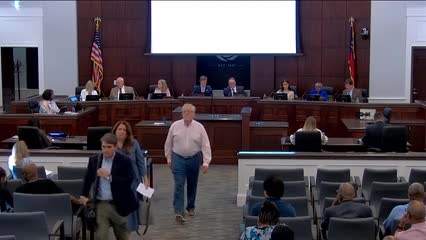
Residents and neighborhood representatives spoke for nearly an hour and a half, detailing long‑running odor problems they attribute to the landfill and raising environmental‑justice concerns about locating waste facilities near predominantly Black and historically underserved neighborhoods. Several speakers said smells made them physically ill and affected outdoor activities.
“We object because of the terrible, horrible odors that we experience almost every day, regardless of what the gentleman just said about the turning over and it it's it's horrible. You have to live it to know,” said Belinda Dickey, a city resident, during public comment. Tracy Randolph, who lives near the site, described nasal and throat irritation after exposure: she told the council the odor “burned the left nostril in my nose and the left side of my throat.” Others cited property‑value losses and asked the council to delay or deny rezoning.
Councilmembers said annexation would give the city more leverage to require odor mitigation measures and physical controls that are not part of county oversight. The council amended zoning conditions to add a sentence — citing Georgia administrative rules — that the property “shall not be permitted as a municipal solid waste landfill for the purpose of accepting household waste” (referencing Georgia Comprehensive Rules and Regulations 391‑4‑0.01 in the motion record) and approved the annexation and rezoning measures by 4‑1 votes.
Planning staff told the council the existing landfill site has operated under Hall County approvals and an EPD permit since 2012, currently operates Monday through Friday from 7 a.m. to 4 p.m. with 14 full‑time employees, and would maintain a minimum 200‑foot natural buffer around the perimeter, free of waste disposal activities and used only for landscaping, monitoring and access roads. Weber said any expansion for composting would likely be limited to roughly 20 acres of the larger parcels, and that EPD approval for new operations would not be expected sooner than July 2026.
Council action included approval of an annexation ordinance and three rezoning/zoning resolution items tied to both the GWR property and a 134‑acre city tract; each passed by 4‑1. Council members also discussed a separate intergovernmental agreement with the Gainesville Redevelopment Authority that outlines odor control and other requirements for any future composting operations. Several council members said voting to annex and rezone would enable the city to require a concrete pad and a three‑wall enclosure where incoming waste is handled; if the council rejected annexation, planning staff said existing county and EPD oversight would remain unchanged.
The vote does not, by itself, change current on‑site operations; planning and staff repeatedly told the room that EPD retains permitting authority over landfill operations and that current operations will continue under that state oversight regardless of the council's zoning decision.