Get Full Government Meeting Transcripts, Videos, & Alerts Forever!
Get email alerts on the Public Pensions topic
No spam. Unsubscribe anytime.
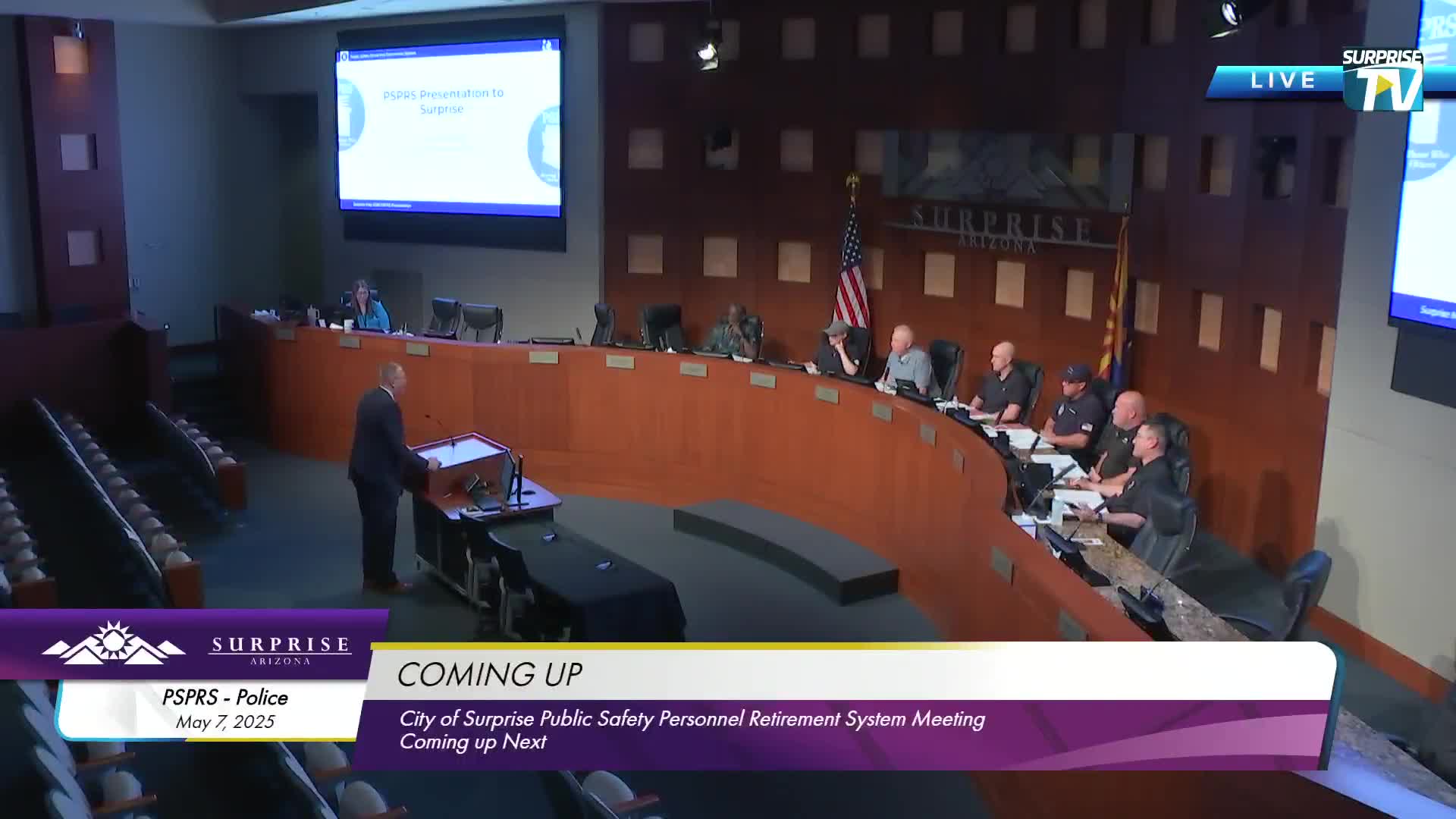
PSPRS official tells Surprise commission funded ratios improved but gap remains
Summary
Clark Partridge of PSPRS briefed the Surprise Public Safety Retirement Commission on actuarial methods, recent valuation results and contribution implications, saying benefits are constitutionally protected and current funded ratios require continued contributions to amortize unfunded liabilities.
Clark Partridge, senior executive with the Public Safety Personnel Retirement System (PSPRS), told the Surprise Public Safety Retirement Commission that recent actuarial valuations show some improvement in funded status but a remaining funding gap that the city must address through contributions and long-term planning.
Partridge said the PSPRS actuarial process discounts projected benefit cash flows at the plan—s assumed investment return and splits liabilities between what has already been earned and what remains to be funded. "These benefits are a key part of the compensation for those who serve us so well," he said. "The benefit shall not be diminished nor impaired."
The presentation showed the police example at a 68.5% actuarial funded ratio, up from 66.8% the prior year, and the fire example at 77.9%, down from 80.8% the prior year. Partridge described drivers of year-to-year changes: higher-than-assumed pensionable salaries (including pay increases and overtime), demographic experience and asset returns. He said the plan—s assumed rate of return is 7.2% and that investment performance varies year to year.
Partridge explained amortization mechanics for Surprise—s unfunded liability: the plan had an actuarial valuation of assets around $80.1 million and an unfunded actuarial liability of about $37.2 million; prior payments had amortized roughly $22.7 million of that remaining layer over 12 years, while a new liability layer of about $3.8 million created the prior year will be amortized over 15 years. He noted the annual amortization expressed as a percentage of payroll contributed substantially to the employer contribution rate (example figures cited included a total employer contribution approaching the low- to mid-20 percent range when combining normal cost and amortization).
Partridge gave concrete illustrations: an additional $1 million deposited as of the valuation date would have moved the police funded status from 68.5% to about 69.3%; $10 million would have moved it to about 76.9%. He also said the underlying payroll used in the valuation was roughly $12.6 million and gave examples of plan-level figures for other PSPRS cohorts (not including CORP or EORP).
During Q&A board members pressed on the effect of local pay increases on pension liabilities. Partridge said salary increases raise average pensionable pay and therefore increase liabilities; he recommended that jurisdictions consider budgeting for the pension cost impact when approving across-the-board raises or market adjustments. He advised cities can make additional contributions beyond required amounts to reduce the unfunded liability and change the contribution trajectory.
The presentation included discussion of experience studies that review assumptions roughly every five years and of how portfolio construction aims to capture upside while protecting downside. Partridge emphasized that actuarial assumptions are estimates and that PSPRS reviews and adjusts assumptions as experience warrants.
Less critical details from the presentation included comparative employer funding bands across PSPRS employers, historical return examples (including a very strong 2021 return and some negative years), and an explanation of how transfers into the plan and large single-year pay adjustments can affect a single employer more than a larger agency.
Partridge and the board did not take any formal action during the presentation; staff and the commission indicated they would follow up with questions and could request more granular, city-specific projections if desired.