Get Full Government Meeting Transcripts, Videos, & Alerts Forever!
Get email alerts on the Winter Maintenance Parking topic
No spam. Unsubscribe anytime.
Bozeman staff seek new winter parking rules after motor-grader pilot showed limits
Summary
City transportation director Nick Ross presented results from an odd‑even alternate‑side pilot and laid out options — permanent one‑side restrictions, seasonal alternate‑side rules, expanded overnight bans and increased enforcement — to improve motor‑grader winter maintenance and emergency access downtown.
Bozeman’s transportation and engineering department told neighborhood representatives that the city needs new on‑street parking rules to maintain local streets during heavy snow and keep routes passable for emergency vehicles.
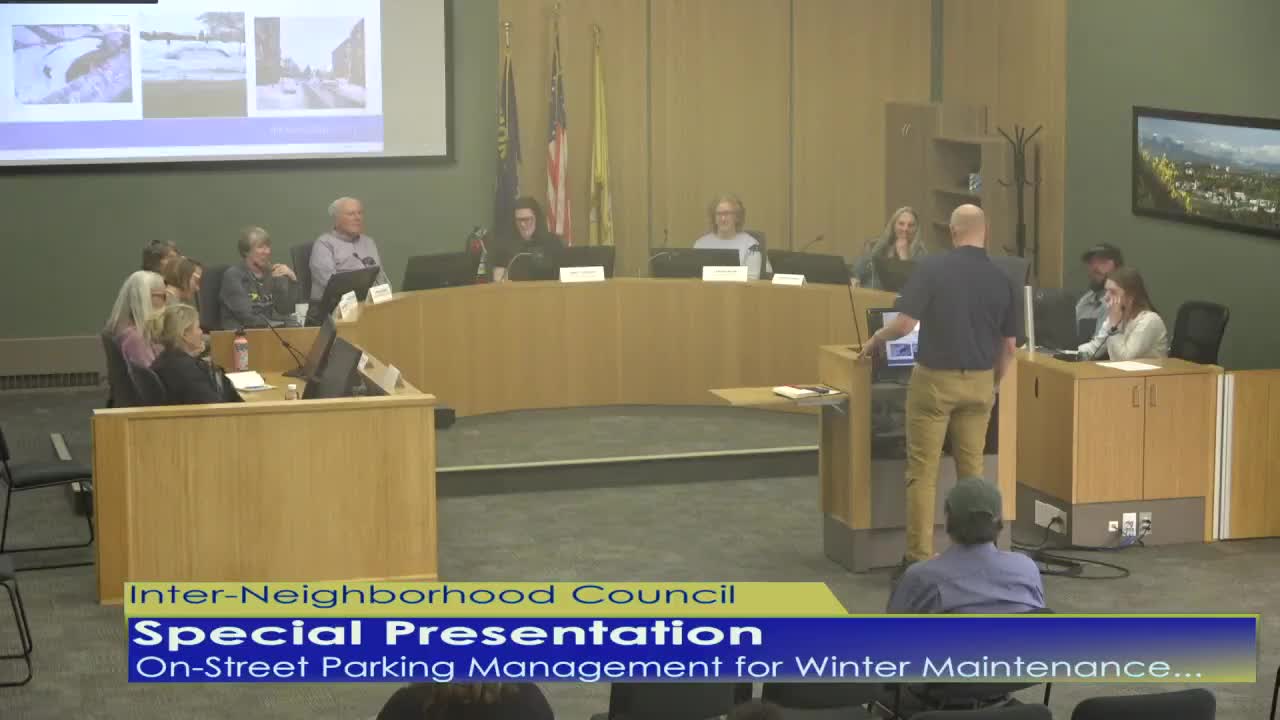
Nick Ross, the city’s director of transportation and engineering, told the InterNeighborhood Council that “this direction comes directly from city management, and is with the support of our fire chief, community development director, neighborhood services manager, and economic development director.” Ross presented operational data from a winter pilot of an odd/even alternate‑side parking program and said the pilot showed clear trade‑offs between parking supply and the city’s ability to clear snow efficiently.
Nut graf: Staff urged that without clearer curb access, the motor‑grader fleet’s production rate falls dramatically — from a target of roughly 4 miles per hour per grader on clear blocks to about 1 mile per hour when cars block curbs — and that reduced production either forces more service failures or requires substantially more equipment and overtime to meet current service goals.
Ross summarized lessons from the pilot: compliance rose on blocks with available curb space and fell on high‑utilization blocks; signage and enforcement were essential to compliance; and low fines for existing 72‑hour and “snow lump” parking violations (the current penalty is $23.50) do not deter some long‑term parkers. He warned that “appropriate level and amount of fine for enforcement is gonna have to be required for any parking regulation of this to have teeth.”
Staff framed four policy alternatives for neighborhood feedback: 1) permanent one‑side parking restrictions on streets narrower than the city standard (35 feet curb‑to‑curb), which would increase maintenance performance but reduce on‑street capacity; 2) seasonal alternate‑side (odd/even) rules like the pilot, made permanent, with a higher enforcement cadence; 3) expansion of overnight (2 a.m. to 7 a.m.) parking bans across a larger downtown footprint to allow early‑morning clearing shifts to work without parked vehicles; and 4) no action (maintain the status quo), which staff said would likely continue service failures on local streets. Ross noted signage installation costs and phased rollouts would be required for permanent rules.
Ross also cited equipment and safety impacts: motor graders operate with a roughly 13‑foot envelope once the blade is attached and need clear curb access to drop snow gates and store snow in the boulevard. He referenced the International Fire Code’s 20‑foot minimum clear width requirement for fire apparatus and said narrower legacy streets under about 35 feet make it difficult to maintain space for emergency access when cars park on both sides.
Neighborhood representatives asked about alternative enforcement and mitigation ideas such as designated overflow lots (senior center, fairgrounds), weekly fixed‑day alternate‑side rules instead of odd/even calendar days, better advance signage and outreach, heat‑map identification of high‑utilization blocks, and use of the city’s mailer/water bill to notify residents. Ross offered to share the presentation and asked neighborhood groups to return written feedback before the City Commission work session.
Ending: Staff will present the proposal to the City Commission at a work session scheduled for April 22; neighborhoods are encouraged to review Ross’s presentation materials and send comments to Nick Ross at nross@bozeman.net or through Emily Toledo for inclusion in staff’s report.