Get Full Government Meeting Transcripts, Videos, & Alerts Forever!
Get email alerts on the Tenant Right To Counsel topic
No spam. Unsubscribe anytime.
Bozeman begins design work on tenant right-to-counsel; commission seeks scope and funding options
Summary
The Bozeman City Commission on May 13 directed staff to develop tenant-assistance and ‘right-to-counsel’ program options and to begin outreach with justice-court judges, legal providers and community stakeholders.
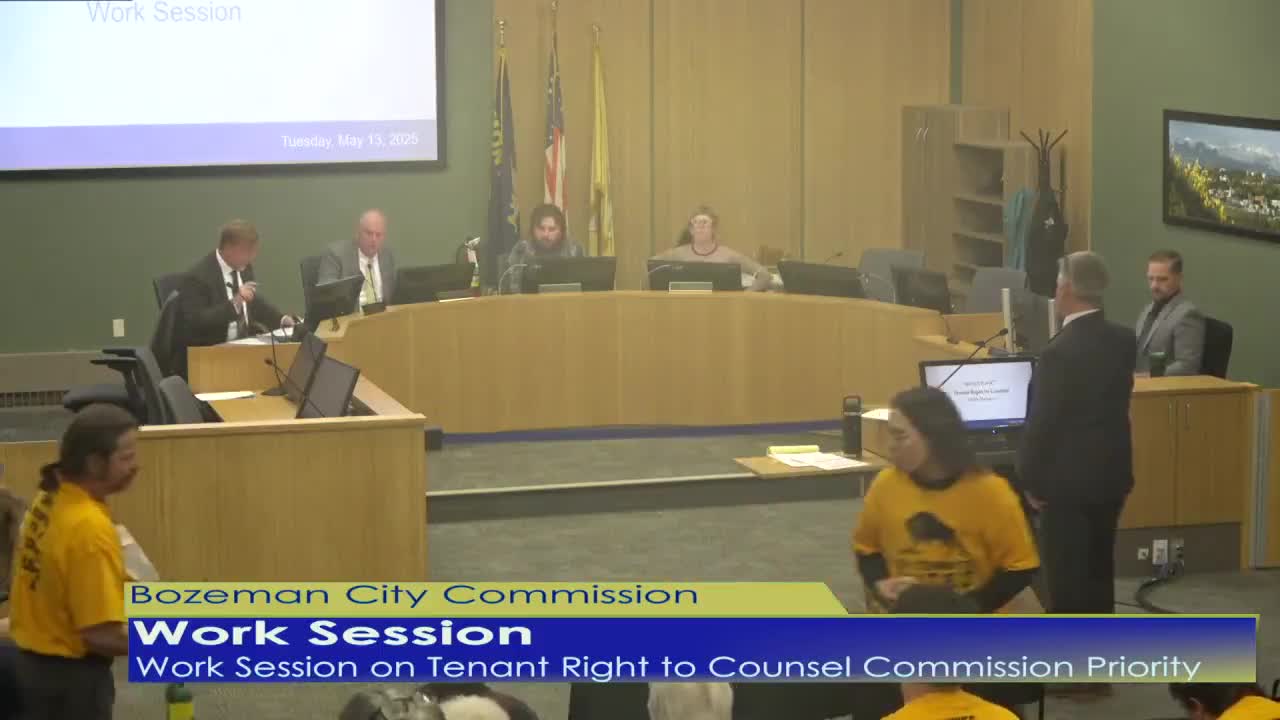
The Bozeman City Commission on May 13 held a work session on a city-level tenant’s right to counsel priority and asked staff to develop options for the commission to consider this fall.
City Attorney Greg Sullivan and senior city attorney Anna Saverud briefed the commission on legal limits and the range of program models used elsewhere. Sullivan said Montana law does not currently establish a constitutional or statutory right to counsel for tenants in possession or eviction proceedings and that a municipal program would have to be crafted so it does not improperly interfere with state statutory procedures. He told commissioners the city can create a voluntary program that provides counsel or services to eligible tenants but should clearly state the public purpose behind any expenditure of public funds.
Anna Saverud summarized national practice and program design: "A tenant's right to counsel" as enacted in some U.S. jurisdictions codifies a government's obligation to provide tenants free legal representation; other cities have chosen non‑codified access, mediation, rental-assistance or eviction‑prevention programs. Saverud told the commission that many U.S. jurisdictions that have adopted a formal right are in home-rule states; Montana's statutory structure requires careful legal design but does not bar a municipal access program.
Why it matters: Eviction filings and tenant displacement are associated with homelessness, child- and family‑level harm and downstream public costs. Commissioners framed the item as an eviction-prevention and housing‑stability tool rather than a program to increase litigation.
What the city presented: staff reviewed Gallatin County justice-court filings for 2023–24. In 2023 there were 91 landlord–tenant actions in Gallatin County; 15 of those named properties in Bozeman. In 2024 Gallatin County recorded 198 landlord–tenant filings; 123 involved Bozeman properties. In 2023 the county data showed roughly 95 landlords were represented by counsel while only 3 tenants had counsel; the dataset and 2024 numbers produced an approximate pattern in which landlords had representation in roughly 80–87% of cases while tenant representation was below 1% in the years reviewed. Nonpayment of rent was the most frequent basis for filings; staff reported an average arrearage of about $4,800 on cases reviewed.
Policy options: staff laid out a menu of approaches and tradeoffs: (1) codify a tenant ‘‘right to counsel’’ in municipal code and finance it with general‑fund or other revenue, creating an enforceable municipal right (subject to annual appropriation language); (2) create an access‑to‑counsel program or pilot (uncodified) that funds non‑profit or contract attorneys to represent eligible tenants; (3) establish eviction‑prevention packages that combine short‑term rental assistance, mediation and legal advice; or (4) use mediation and education plus referrals without full representation. Boulder (Colorado) was cited as an example that funded its program with a voter‑approved rental excise; many larger cities use general fund appropriations.
Commission direction and next steps: commissioners agreed on a shared goal—eviction prevention and housing stability—and asked staff to return with program options, cost estimates and funding possibilities. Several commissioners favored beginning with a targeted, surgically‑focused program (for example, prioritizing tenants with dependents) rather than an unrestricted universal entitlement. Staff was asked to consult judges (Justices of the Peace), Montana Legal Services Association, MSU legal clinic providers and existing community providers; to collect typical performance metrics; and to return in the fall with RFP templates, pricing tiers (pilot/limited/full representation) and likely demand estimates.
Public comment: more than 100 people registered comments for the session. Tenants, tenant organizers and nonprofit leaders described housing instability, argued the program saves public money downstream and urged broad eligibility with full representation. Several landlords and landlord‑association representatives warned of cost pass‑through to tenants and urged safeguards for small, local landlords; a few suggested alternatives such as stronger rental‑assistance funding or an independent housing authority.
Staff will proceed with stakeholder outreach and produce budgeted program options and recommended eligibility tiers, with performance measures (dismissal rate, cases diverted from eviction, dollars of rental assistance provided, public-cost savings) for commission review.