Lifetime Citizen Portal Access — AI Briefings, Alerts & Unlimited Follows
Bozeman HR presents 2024 equal pay report; board urges deeper role-level and retention analysis
Loading...
Summary
Jamie Norvey of the City of Bozeman HR department presented the city's 2024 equal pay report, citing progress on transparency and pay processes but showing persistent gender gaps in some education bands. Board members asked for role‑level comparisons, retention data, regression analysis and clearer year‑over‑year outcomes.
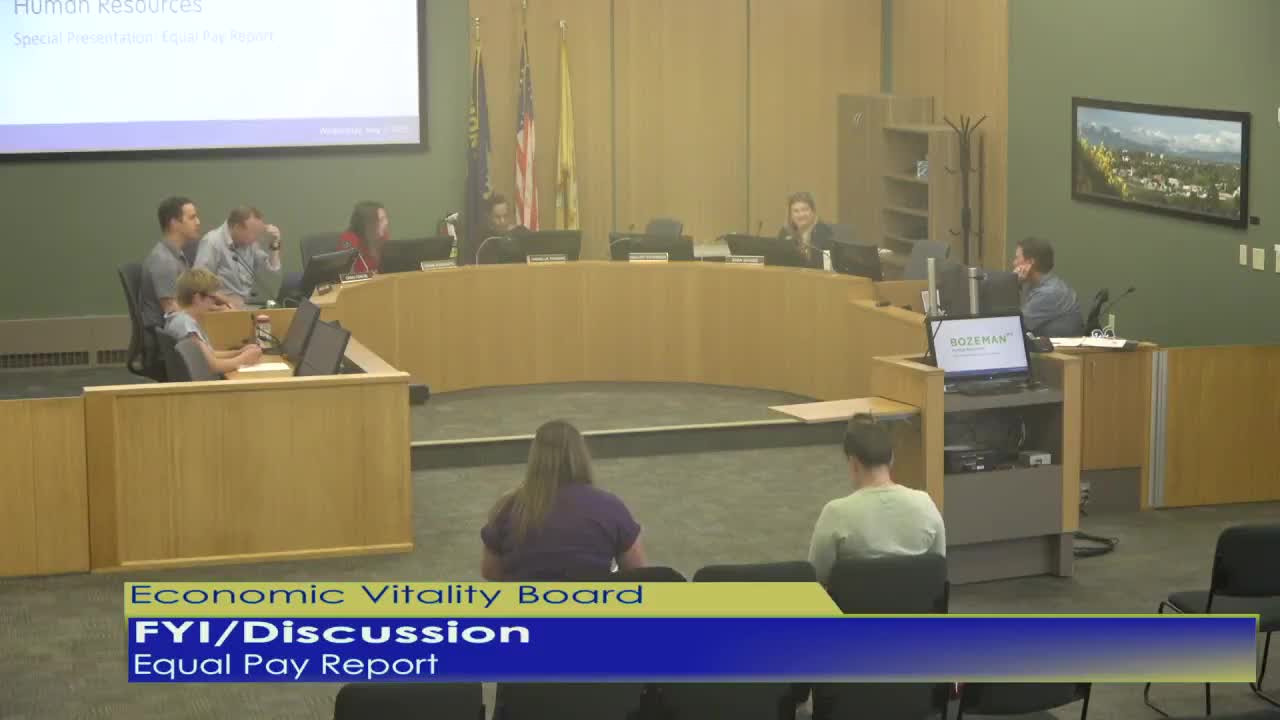
Jamie Norvey, a human resources professional for the City of Bozeman, presented the city’s 2024 equal pay analysis and outlined actions the city has taken since the City Commission adopted Resolution 4,601 (2015) and Resolution 5,169 (2020) on gender pay equity.
Norvey said the city’s workforce composition at year‑end 2024 was 70.2% male and 29.8% female and described steps the city has taken to promote pay equity, including posting positions and wages publicly, removing the salary question from applications and using objective compensable factors (education, experience, responsibility and working conditions) to set pay. She said the city uses collective bargaining and a pay committee (HR director, assistant city manager, city manager) to establish pay and that the city reports and analyzes data each year as of Dec. 31.
Norvey showed narrower gaps in some categories, noted that females with graduate degrees earned 103% of their male counterparts in the 2024 snapshot, and said the city’s median earnings for women were roughly 50% higher than national estimates. She also highlighted the paid parental leave policy — eight weeks of paid leave — and said uptake rose 128% from 2023 to 2024.
Board members pressed for deeper analysis after Norvey’s presentation. Al Jones asked about an appendix question on part‑time hours; Norvey confirmed the city tracks full‑time‑equivalent status and provides regular hours to part‑time employees. Several members, including Craig and other board participants, recommended regression analysis to test whether observed gaps are explained by years of experience, education, job class or other compensable factors. Members also urged the city to produce gender‑differentiated retention data and to compare pay within the same job classifications or role types (for example, within police, fire, Teamsters, MFPE, and non‑represented groups).
Norvey said the HR function already uses the annual process to look for underlying explanations and welcomed suggestions for additional analyses. She noted the city’s pay setting is tied to collective bargaining for represented groups (police, fire, Teamsters, MFPE) and that entry‑level pay is set by experience and qualifications so, for example, two police officer candidates with the same years of law enforcement experience would be offered the same initial pay.
Several board members suggested partnering with local university statistics classes or interns to perform focused analyses on subsets of data (recent hires, retention history, role‑level comparisons) to test hypotheses about causes of gaps. Members also asked the city to make more of its progress visible to the public and to return with specific, actionable comparisons — such as gendered retention rates and licensed vs. unlicensed occupation outcomes — in future reports.
Norvey and board members agreed to continue the annual reporting process and to consider the recommended analyses for the next iteration of the equal pay report.