Get Full Government Meeting Transcripts, Videos, & Alerts Forever!
Get email alerts on the Zoning Districts topic
No spam. Unsubscribe anytime.
Planning Commission proposes five new zoning districts; board raises questions and requests boardwide feedback
Summary
Planning Commission chairman Mister Capel presented draft proposals for five zoning districts — A1, A2, Rural Residential, Rural Service and Technology — plus optional overlay districts, and the Board asked for written comments and more detail before mapping or adoption.
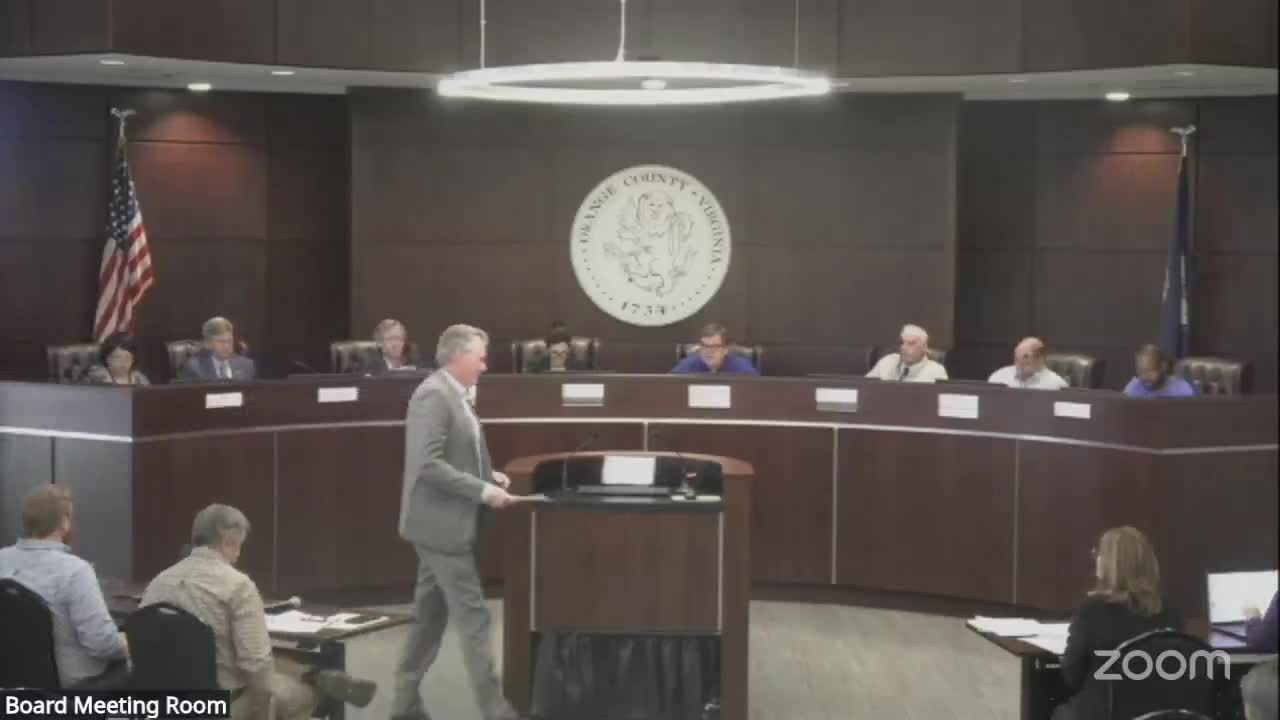
Planning Commission chairman Mister Capel presented the commission’s draft zoning-district concepts at the Orange County Board of Supervisors work session, describing five proposed base districts and optional overlay districts intended to align the zoning ordinance with the county comprehensive plan.
Capel said the commission assigned two commissioners to each district and used existing ordinance language plus comparisons to other localities to draft proposed intents, permitted uses and special-use lists. “For us, this began roughly last summer,” Capel said, summarizing the multi-month process and noting the drafts are the commission’s starting point for board and staff comment.
The five district concepts Capel described were: A1 (conservation agricultural), A2 (less restrictive agricultural), Rural Residential (to capture existing small-lot neighborhoods currently zoned agricultural), Rural Service (to regularize small businesses and legacy nonconforming uses such as gas stations), and Technology (to cover data centers, distribution centers and utilities). Capel said the Technology district would exist in ordinance text but not be mapped until a rezoning application prompted review.
Capel also described overlay districts as optional tools to apply different performance standards within particular settlements (for example, different standards for Unionville versus Somerset).
Board members thanked the commission for producing a draft but raised substantive concerns. One member urged against leaving use classification to loose interpretation and suggested more exhaustive use definitions rather than broad “light/ heavy industrial” categories. Several board members urged caution about increasing nonconformity (for example, setting a Rural Residential minimum lot size at 3 acres could make many existing 2-acre lots nonconforming) and asked staff to provide concrete examples of the practical effects of nonconforming designations.
On the Rural Service district, members noted the potential for a broad by-right allowance to be exploited; they asked the commission and staff to tighten which businesses would be permitted without a special-use permit and to attach clear performance standards. On the Technology district, board members agreed the Louisa County technology ordinance is a useful model but asked staff and the commission to think more broadly about types of technology uses (data centers, AI labs, warehouses/distribution) and whether distribution should be allowed as a technology use.
Following discussion, the board agreed on a process to advance drafting: board members will submit individual, written comments on district intent, lot sizes and setbacks by April 4; staff will collate comments and forward them to the Berkeley Group. The Berkeley Group will use that input to prepare materials for a May work session that will review primary and overlay districts; uses and use performance standards are scheduled for July; community design and administration in September; a compiled draft will be presented in November. The board also agreed to hold a focused work session at 3:30 p.m. on the 20th (date as discussed in the meeting) to review materials when they are available.
Capel closed by thanking commissioners and staff and reminding the board that the drafts reflect planning commission recommendations, not final ordinance text, and that the documents will be revised after board, staff and public comment.