Get Full Government Meeting Transcripts, Videos, & Alerts Forever!
Get email alerts on the Zoning Ordinance Update topic
No spam. Unsubscribe anytime.
Orange County consultant summarizes engagement findings, outlines zoning ordinance drafting schedule
Summary
Consultants for Orange County presented an engagement summary from two focus groups and proposed a bimonthly drafting schedule that will produce a compiled proposed zoning ordinance by November; the Board and staff discussed how drafts will be circulated and asked for written feedback by April 4.
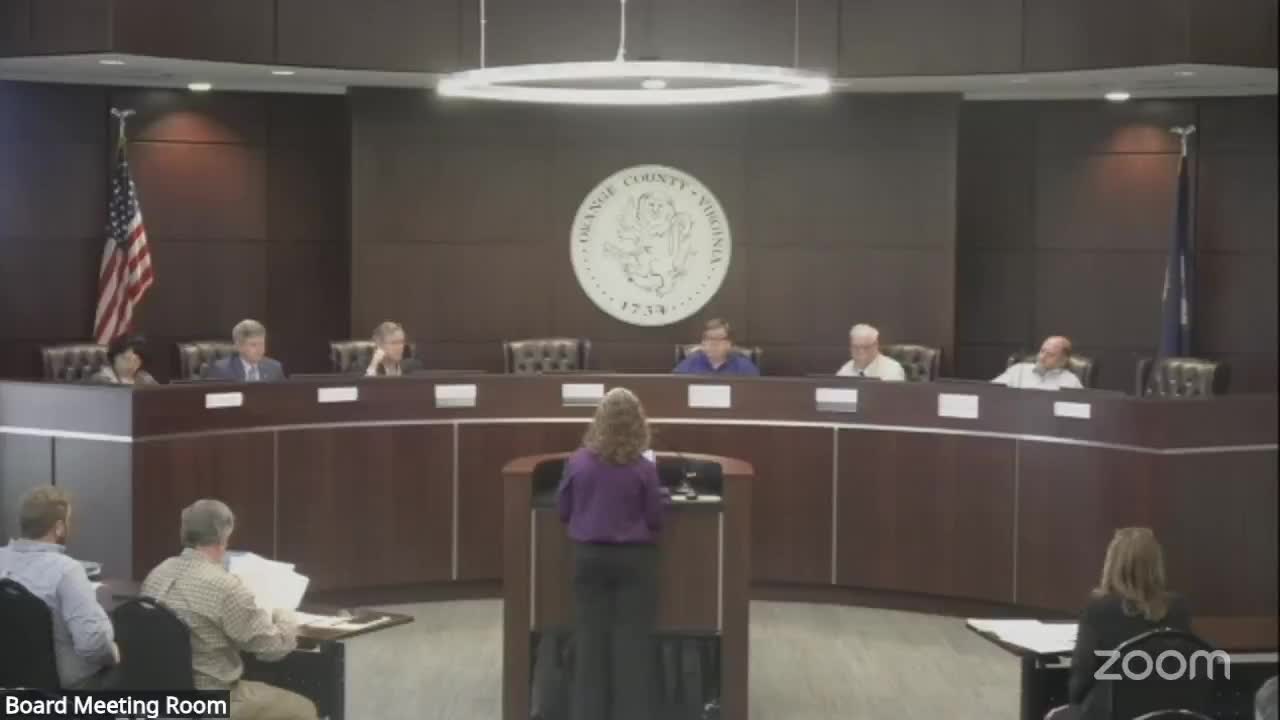
Consultant Michelle of the Berkeley Group told the Orange County Board of Supervisors during a March work session that consultants met with two focus groups — a development group and an agricultural group — and distilled key themes for the county's zoning ordinance rewrite.
Michelle said the groups raised “frustration with the inconsistent interpretation of the ordinance,” a desire for clearer, step-by-step permitting processes, and a request for more flexibility in use standards. She summarized other common items: preserving prime agricultural soils while allowing development in poorer-soil areas, interest in agritourism and short-term rentals with performance standards for noise and setbacks, and cautious openness to data centers and solar when they are “sized and located appropriately.”
The Berkeley Group proposed a bimonthly work-session schedule. Michelle said the March meeting would cover the engagement summary and table of contents; May will address primary zoning districts and overlay districts; July will review permitted uses and use performance standards; September will cover community design standards (landscaping, signs, lighting) and administration; and November will present a compiled proposed zoning ordinance for review before the adoption phase.
On drafting technique, Michelle said the new ordinance is intended to be more user-friendly by using tables and matrices. She described a use matrix that lists allowed uses down the left column and zoning districts across the top so users can find where a use is allowed and any linked performance standards.
The consultant also addressed specific issues raised in engagement: cluster-development rules that require large amounts of open space and can make clustering cost-prohibitive; concerns that some setback requirements from highways are overly restrictive; and requests to allow alternative septic systems in areas with poor soils to enable development.
The Board discussed how drafts will be circulated. Michelle and staff said internal working papers typically remain internal until posted with a public meeting packet. Board members said they favor “openness and transparency” once drafts are used in a public meeting. Staff and the county attorney cautioned that documents circulated internally to the board or planning commission typically become public unless exempt under FOIA.
As a scheduling action, the board requested written feedback on the draft district materials and related intent/lot-size/setback comments by April 4; staff will collect those comments and forward them to the Berkeley Group for incorporation into drafting. Michelle asked for that feedback to speed drafting so her team can prepare materials for the May session.
The presentation and discussion closed with staff and the consultant reiterating the staged approach: district intents and dimensional standards in May, uses and use performance standards in July, design and administration in September, then a compiled draft in November for review prior to public hearings.