Get Full Government Meeting Transcripts, Videos, & Alerts Forever!
Get email alerts on the Budget Tax Rate topic
No spam. Unsubscribe anytime.
Mathews County sets real estate tax at 60¢ per $100, adopts FY26 budget with narrow cushion
Summary
The Mathews County Board of Supervisors voted to raise the real estate tax rate 4 cents to 60¢ per $100 of assessed value and adopted the fiscal 2026 general fund budget after debate over contingency levels, library cuts and school spending.
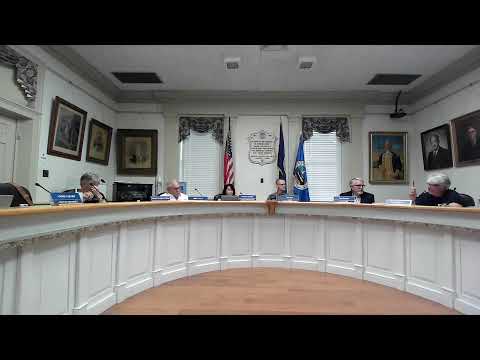
The Mathews County Board of Supervisors voted May 1 to set the real estate tax rate at 60 cents per $100 of assessed value — a 4-cent increase — and to adopt the county—s fiscal year 2026 general fund budget.
The change implements Ordinance No. 25-03, the advertised tax-rate ordinance, and follows a public hearing held at the start of the meeting. Miss Wilson said the tax rate decision needed to be made by May 1 to allow the treasurer time to generate bills. "This is the public hearing, to decide what the tax rate will be for this year," she said.
The board adopted the ordinance and corrections to the draft and then took a roll-call vote. Roll-call responses recorded during the meeting were recorded as aye from Mister Golan, Mister Walls, Miss Phillips, Mister Jones and Mister Dobbs; the motion carried.
Why it matters: the board—s vote closes the county—s legally required budget-setting window and provides revenue to cover a projected shortfall in the general fund. Miss Wilson displayed draft 5 of the budget and told the board the total general fund budget excluding capital projects stood at $14,000,229.02 and produced a deficit of $834,137.40, which the staff said equates to a 3.96-cent shortfall on the tax rate.
Board debate focused on how much room the adopted 4-cent increase (rounded in action to 4¢) gives the county for unexpected costs. Mister Brown said the budget is "so tight" and that contingency has been reduced to near zero; he said the county—s minimum unassigned fund balance target is about $5.7 million and urged that any additional revenue be placed in contingency under board control. "I have looked at this budget, and as Mister Wallace has said, we have combed every line multiple times... We have taken every revenue line and pushed it to its limit," Brown said.
Mister Walls said he had opposed a larger (10-cent) increase at an earlier hearing and reaffirmed his reluctance to raise taxes without extensive scrutiny; he said the board had "done our due diligence" this year and that he was "not in favor of [a] 10¢ tax increase." He said public concerns about schools and library content have shaped his thinking.
Miss Wilson and staff described specific expenditure adjustments from draft 4 to draft 5. Library cuts were a notable portion of the adjustments: professional services for training was reduced to $0 from $5,000; computer installation and maintenance to $10,000 from $15,000; repairs and maintenance to $450 from $1,000; HVAC and controls contracts to $9,600 from $15,000; advertising to $500 from $55,000; Virginia database user fees to $17,000 from $21,000; lease/rent of equipment (MiFi) to $25,000 from $28,000; books and subscriptions to $32,000 from $45,000; and several other line items trimmed. After the revisions staff said the library department total would be $526,766; staff also said those cuts equated to a $24,637 reduction from the library's current fiscal year budget.
Members pressed for clarity about contingency and revenue risk. Brown said a 1-cent tax change would provide a modest cushion and argued for allowing any extra dollars to remain in contingency unless the board voted otherwise. Mister Wallace and others warned that a 4¢ increase leaves "no room whatsoever for any unexpected expense" and suggested 5¢ would be safer; others said 4¢ was the working compromise the board had negotiated.
The board also discussed related fiscal items during the meeting: staff said capital projects for FY26 are proposed to be financed with interim financing rather than drawing on fund balance, and staff said they did not propose to pull fund balance into FY26 operating needs.
Ending: With the tax rate set and the budget adopted, supervisors directed staff to finalize revenue-line adjustments to balance the budget under the adopted rate. The meeting continued with other agenda items, including separate discussions on surplus property, municipal water planning and an unrelated procurement matter on IT services.