Get Full Government Meeting Transcripts, Videos, & Alerts Forever!
Get email alerts on the Municipal Budget topic
No spam. Unsubscribe anytime.
Plattsburgh council hears five-year budget forecast showing deficit beginning 2026
Summary
City finance staff presented conservative five-year revenue and expense projections showing a projected general-fund deficit beginning in 2026 and a shrinking fund balance if assumptions hold; councilors discussed tax-rate choices, capital spending and next steps for updated project costs.
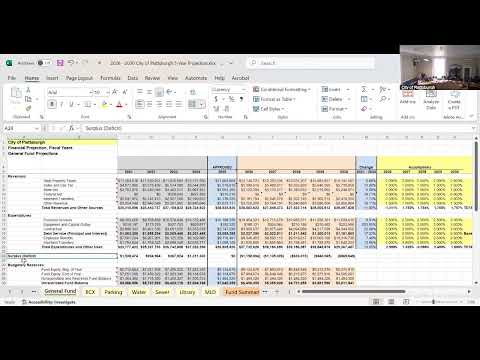
Plattsburgh Common Council members reviewed a five-year budget forecast that projects the city’s general fund will move into a deficit starting in 2026 if current revenue and spending assumptions hold.
Finance staff presented projections that assume about 2.6–3% inflation and modest growth in sales and use taxes; under those assumptions the general-fund unassigned fund balance would fall from roughly $7.6 million to about $3.0 million over the five-year horizon. The staff presentation showed a deficit “in parenthesis” beginning in 2026 of about $1 million or more based on those conservative estimates.
Council members pressed staff on the key assumptions behind the forecast: projected inflation tied to the Consumer Price Index, reduced sales tax receipts tied in part to cross-border (Canadian) traffic declines, lower state aid compared with 2024 and modest growth rates applied to sales-tax estimates. Staff said they used conservative growth assumptions (for example, about 1.5% growth on sales/use tax receipts in future years) and that special one‑time items in 2024 such as grant receipts had inflated last year’s figures.
The council discussed options that affect the revenue side of the ledger: keeping the tax rate lower to help homeowners, raising the levy to capture increased assessed value, or using fund balance to cover capital needs. Staff noted the budget currently assumes leaving the tax rate roughly unchanged, which reduces levy revenue compared with raising the rate to match assessment increases; that choice helps keep the rate lower but shifts more of the tax burden to those whose assessments rose.
Councilors also reviewed planned capital spending and debt-service timing. Staff said most existing debt will roll off by 2027, but some projects planned for 2025–2029 could require borrowing and would affect future debt service and the city’s debt-to-income trajectory. The presentation identified several lines in the proposed budget that would be affected if council adds capital projects funded from the general fund rather than from enterprise reserves or grants.
Next steps: staff committed to update capital-project cost inputs with department project leads and to produce updated projections for council review, with a target of having revised figures ready for the next regular council meeting. Councilors asked for ledger-size printed fund‑summary and levy sheets for review.
The council moved and seconded a motion to adjourn at the close of the work session; the motion passed.