Get Full Government Meeting Transcripts, Videos, & Alerts Forever!
Get email alerts on the Workforce Housing Sales Tax topic
No spam. Unsubscribe anytime.
Commission reviews two private projects seeking workforce-housing sales tax support and an IRB abatement
Summary
City staff presented two applications for the workforce-housing sales tax program — a townhome project on Morrow Street and Morrow Flats — and commissioners discussed caps, scoring criteria and accountability before directing staff to prepare formal agreements for June consideration.
Manhattan city staff on Tuesday presented two private development applications seeking assistance under the city’s workforce-housing sales tax policy and an associated IRB sales-tax exemption; one of the projects is also seeking a property-tax abatement tied to a performance agreement.
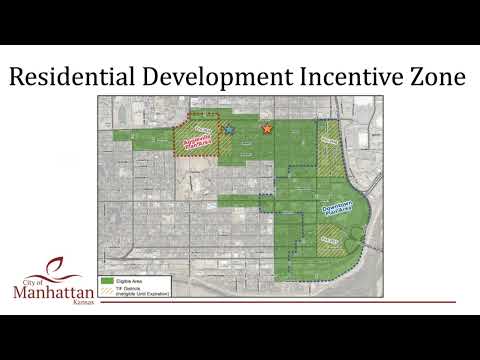
The applications, both sited on or near Morrow Street east of Aggieville, together request $295,000 from the workforce-housing sales tax account, city planner Stephanie Peterson told the commission. Peterson said the program has multiple limits written into the policy — per-unit and dollar caps, and a 10% cap that prevents more than 10% of a project’s total cost coming from workforce-housing funds — and that the 10% cap is the limiting constraint for both proposals this round.
The discussion matters because the workforce-housing sales tax fund is finite and the commission has debated how to use it to shape infill redevelopment. Peterson reported $1.5 million in receipts to date and said, after pending commitments, roughly $712,000 would remain available if the commission funds the two applications now before it.
Peterson described the two projects in staff materials: one is a townhome development composed primarily of one-bedroom units; the other, Morrow Flats, is seeking a performance-based property-tax abatement administered through the city’s IRB process. For the townhome project, Peterson said current property tax on the parcels is approximately $6,000 and would rise to about $36,000 under the proposed redevelopment; for Morrow Flats she said current property tax is about $2,400 and the proposed project would generate about $13,000 in property tax. Peterson also presented a methodology for calculating the performance-based abatement for Morrow Flats that ties annual abatement to the developer’s documented investment and the share of units leased to households in the workforce range.
Commissioners pressed staff and the applicants on the policy’s scoring matrix, accountability measures and product mix. Several commissioners said the scoring rubric should move away from “all-or-none” checklist items in favor of a sliding scale so the commission can compare unlike proposals more fairly. Commissioner comments also noted that many of the units proposed were one-bedroom units and asked whether the incentives could be structured to encourage a greater mix of unit sizes for families.
Tyler Holloman of Frontier Development Group, representing Morrow Flats, and another developer, Zach, described why their projects were sited where they are and why the product types pencil given current zoning and construction costs. Holloman and Zach said one-bedroom units are in strong market demand and that infill zoning changes enabled these projects. Zach added that prior projects with incentives had leased quickly and argued the applications were viable under current market conditions.
On accountability, staff recommended a three-year performance period and repayment provisions for the townhome grant if units do not remain within the workforce-rent range; for Morrow Flats the proposed abatement is already tied to annual performance review of leases, Peterson said. She warned that more prescriptive monitoring would increase city staff workload.
No formal final vote was taken Tuesday. The commission gave staff direction to prepare IRB documents and grant agreements and return the items for formal consideration at the June 17 meeting; Peterson said the abatement would require a public hearing if the commission wishes to move forward. Commissioners also encouraged staff to convene developers before the October application round to refine the scoring matrix and to consider revisiting the 10% cap and other policy parameters.
Public comment at the meeting included residents urging the commission to track how awards change the profile of affordability over time and to consider additional mechanisms such as down-payment assistance and co-op models that could promote homeownership and wealth-building.
Next steps: staff will prepare IRB/grant agreement drafts and advertise any required public hearing for the June 17 meeting. If the commission approves the abatement, staff will implement the performance monitoring described in the proposal.