
WJCC proposes nearly $13.9 million local increase for FY26, prioritizes teacher pay and mandated EL/special‑ed staffing
Get AI-powered insights, summaries, and transcripts
Subscribe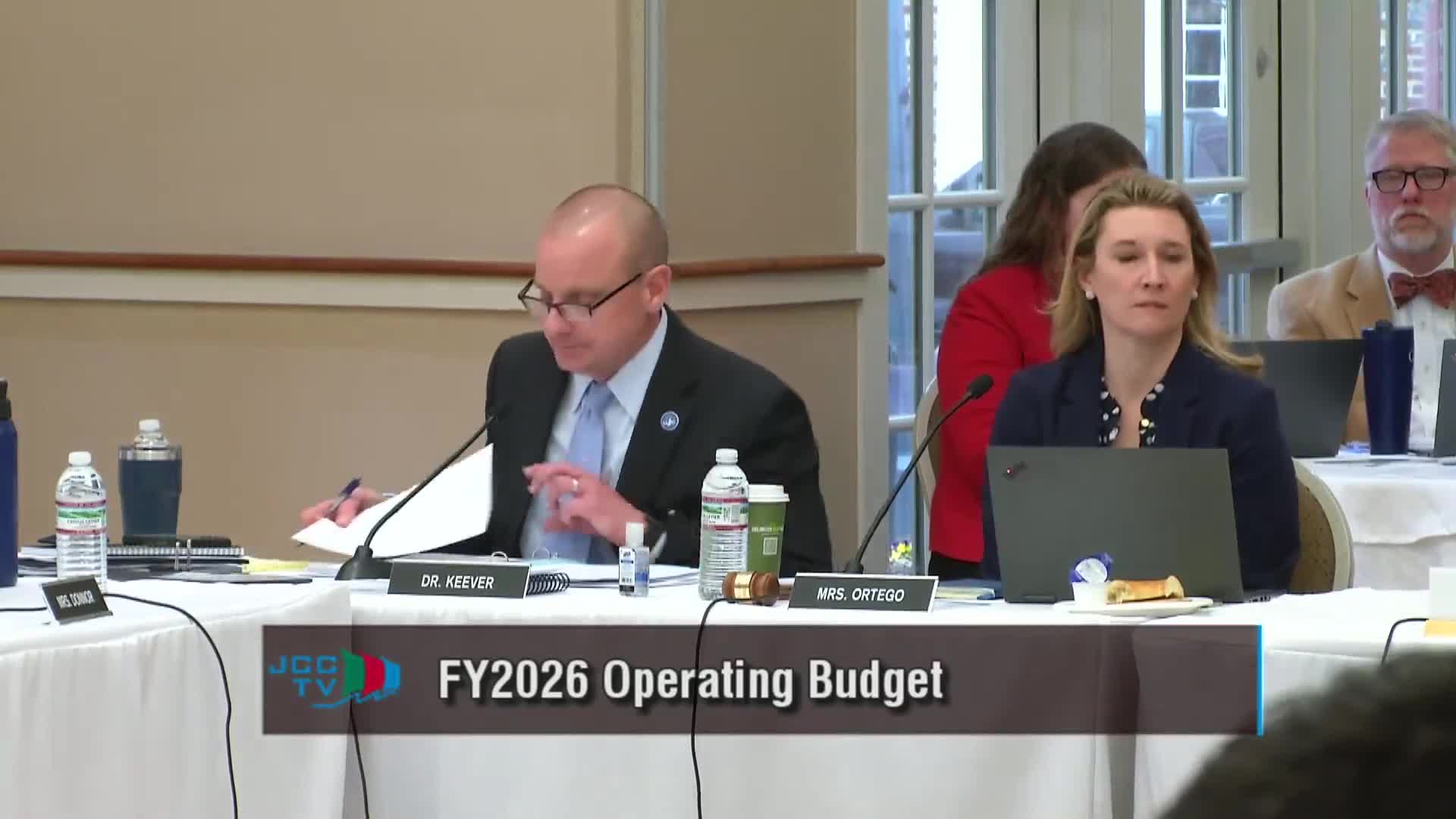
Summary
Superintendent and finance staff presented a FY26 operating request that emphasizes compensation changes from a Bolton study, mandated LEAP staffing increases for English learners, expanded special‑education and behavioral supports, and carries federal‑funding exposure for later years.
At a joint meeting of the Williamsburg City Council and the James City County Board of Supervisors, district leaders presented the superintendent’s proposed fiscal year 2026 operating budget, outlining new staffing requests, compensation changes and assumptions about state and federal funding.
Renee Ewing introduced the proposal, saying it is based on Governor Youngkin’s amendments to the 2024–26 state budget and the General Assembly’s pending figures. Ewing and Doctor Keever (district leadership) said the superintendent’s request to local funding partners is nearly $13,900,000 above last year’s budget; they also said the full “needs” list would total about $21,000,000 above last year but that administrators had trimmed the request for the initial proposal.
The budget presentation emphasized that people are the bulk of the cost: about 87% of the operating budget is compensation and benefits. Key components of the proposal include a 3% salary increase for all staff, a 70/30 employer/employee split on an estimated 15% increase in health‑care costs, and $2.5 million to begin implementing recommendations from a Bolton compensation study. Ewing said the district recommends a multiyear implementation and included a year‑one package of roughly $1.9 million targeted to raise the beginning teacher salary (Bolton’s recommended new starting bachelor’s salary cited as $55,003.11) plus $600,000 to move support and administrative pay toward a unified scale; the proposal would raise the unified‑scale minimum to $15.50 per hour and ensure at least a 3% raise for staff on the unified scale.
Presenters identified mandatory and enrollment‑driven staffing needs. The Virginia General Assembly’s new LEAP staffing model (for English learners) will require WJCC to increase LEAP teacher allocations from 22 to about 32 teachers; Walker said the state is providing support for that mandated staffing change. Special education expenditures and caseloads were described as growing: district staff said the K–12 special education rate is about 16.4% of enrollment, local funding covers roughly 70% of special education spending, state funding about 21% and federal about 9% for the FY24 sample year cited in the slides.
The proposed operating budget also contains school‑based position requests including: additional elementary and high‑school teachers to maintain class‑size ratios (estimated 3 elementary and 4 high‑school teachers), one additional K–5 counselor allocation, two additional gifted resource teachers for K–2 at two elementary schools, six additional paraprofessionals for self‑contained special education classrooms, nine elementary teacher assistant positions (one per elementary school) to strengthen early‑grade behavioral supports, and sustained positions for a secondary “reset” restorative center. Central office requests include two finance positions, one human resources position and two maintenance assistant positions in operations.
The presentation included an itemized list of compensation costs from the Bolton study: a one‑year, full implementation estimate of about $7.6 million for scale changes (teacher and support/administrative combinations), rising to about $9.6 million after estimated benefit costs. District staff proposed a three‑year phased implementation and included $2.5 million in FY26 to start the process.
Ewing and Keever also described budget items that were considered but not included in the initial request, such as added middle‑school assistant principals, additional elementary instructional coaches, expanded stipends for certifications and doctoral degrees, and selected contractual day‑length changes. The proposal spotlights bus driver pay adjustments made midyear and notes continued recruitment challenges: the district said it has had persistent vacancies and that human resources and payroll workload have grown substantially.
Several members asked questions about AP exam funding, federal grants exposure and benefit comparisons. On AP exams, district staff said the new accountability model awards points if students sit for AP exams (0.5 point per exam regardless of score) and that the district proposes embedding AP exam costs in the operating budget (budget slide listed approximately $720,000 for AP participation and $340,000 for exam costs in related slides). Presenters clarified that families currently pay exam fees and fee‑waiver rules remain available for eligible students; the district framed paying for AP exams as an accreditation strategy rather than a direct state reimbursement.
On federal funding, presenters said the grants fund budget for FY26 shows about $5,125,000 in federal allocations; they cautioned that federal grants are reimbursement‑based and that FY27 would be the year most at risk if federal funding levels changed. Board and council members asked about contingency planning if federal support is reduced.
Votes at a glance: the meeting closed with routine adjournment motions for both bodies. The school board recorded a roll call with affirmative responses from “Mister Dimple,” “Miss Dawson,” “Mister Woodland” and “Mister Carson.” The city council adjournment roll call recorded “Miss Williams,” “Miss Ramsey,” “Miss Herndscher,” the vice mayor and Mayor Ponds voting Aye.
Why it matters: the FY26 proposal targets teacher competitiveness, mandated EL staffing, growing special‑education caseloads and behavioral supports at the earliest grades. Local funding partner decisions this spring will determine which requested positions and compensation changes are adopted.