
WJCC reports midyear academic gains and outlines impact of new Virginia accountability framework
Get AI-powered insights, summaries, and transcripts
Subscribe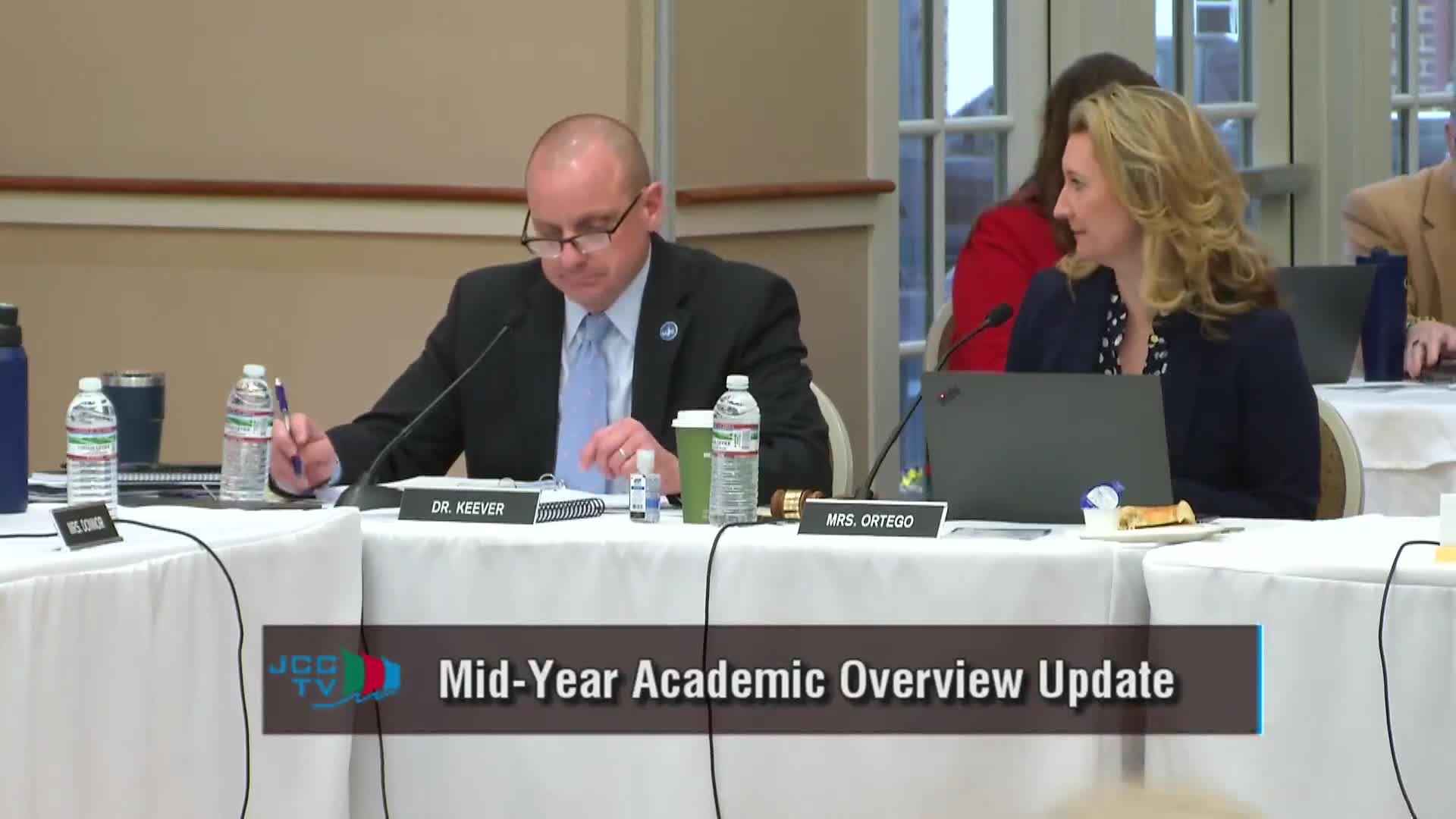
Summary
District leaders told the Williamsburg City Council and James City County School Board that midyear diagnostics show student growth, a drop in early-grade literacy risk, and reduced chronic absenteeism while explaining how Virginia’s new four-tier accountability system will change school ratings and reporting.
At a joint meeting of the Williamsburg City Council and the James City County School Board, district leaders presented a midyear academic update and explained how the state’s new accountability model will affect school ratings and local planning.
Acting Superintendent Doctor Cooper said he has visited schools across the division in the past six weeks and described “phenomenal” work by teachers and staff while previewing four briefing topics: the Virginia accountability changes, the district’s Elevate to ’28 strategic plan, school improvement planning, and midyear assessment results.
The update matters because the Virginia Department of Education’s new School Performance and Support Framework replaces the prior accreditation labels with four performance levels — distinguished, on track, off track and needs intensive support — and reduces the student subgroup reporting threshold (the “n-size”) from 30 students to 15. Sean Walker, assistant superintendent for elementary schools, said the framework is a 100-point model that weights mastery (SOL results and English learner progress), growth/readiness and, at the high school level, graduation and a “ready for life” indicator based on enrollment, employment and enlistment (the “3 E” indicator).
Walker told the bodies that applying last year’s SOL results to the new model would drop the statewide share of schools in the top two categories from about 88% under the old model to roughly 65% under the new model; using the same modeling, 13 of WJCC’s 16 schools — about 81% — would be in the on track or distinguished categories. Walker said the high school “ready for life” indicator awards points for students who take AP exams, enroll in dual-credit courses or earn industry-recognized CTE credentials; the enlistment portion uses ASVAB results. He warned that students enrolled in AP courses who do not sit for the AP exam are “leaving accountability points on the table.”
The presentation included division demographics and midyear diagnostic data. The slide deck, distributed to both bodies, said WJCC serves more than 11,000 students in 16 schools; it lists roughly 4,000 students as economically disadvantaged, more than 1,000 English learners, about 1,700 students in gifted programs and about 1,800 in special education services.
On early literacy, presenters said the statewide literacy screener has been redesigned and renamed the Virginia Language and Literacy Screener (VALS). The district reported that the fall VALS screening identified 28% (651 students) of kindergarten–2 students as high risk; the midyear rescreening showed a reduction of 159 students and an overall lower rate reported as 21.7 percent. The presentation said individualized reading plans were developed for students identified as needing intervention.
Walker and Kathy Worley, assistant superintendent for secondary schools, described use of the state‑approved diagnostic assessments (IXL this year) for grades 1–8 and said every grade showed growth from fall to midyear. The presenters reported intervention counts: 1,706 elementary students (22% of elementary enrollment) received additional literacy intervention in semester 1 and 767 elementary students (16%) received additional math intervention; at middle school, 623 (23%) received literacy intervention and 369 (20.5%) received math intervention, with 84 students enrolled in after‑school tutoring.
The update also covered graduation cohort and attendance data. The slide deck listed a 2025 graduation cohort of 975 students and noted categories for diploma pathways and students on the dropout list; it also noted efforts to recover credits and support retests or alternatives for verified credit. On attendance, the division reported a semester‑1 chronic absenteeism rate of 12.2% (1,389 students), down from 15.3% in semester 1 of 2023–24. District staff described ongoing attendance work including parent notifications, attendance meetings, home visits and coordinated supports with city and county partners.
Board and council members asked several procedural and technical questions about the new framework. When asked whether the label “off track” corresponds to the old “accredited with conditions,” Walker responded, “If we had to try to pair that, yes.” Council and board members pressed on implementation details — for example, how ASVAB enlistment scores will be reported to the division — and presenters said the state and local recruiting partners are working to improve data flows.
Why it matters: the framework change alters public reporting methods and introduces new readiness indicators that can affect a school’s reported performance even where local leaders say instruction is improving. The district said it will publish a public dashboard (a QR code was provided on the information card) and return to both bodies this fall with subgroup and school‑level results using the new model.