Get Full Government Meeting Transcripts, Videos, & Alerts Forever!
Get email alerts on the School Budget topic
No spam. Unsubscribe anytime.
Isle of Wight schools present $6.6 million request to supervisors; highlight $4M bus‑garage option, 11 new positions and health‑insurance pressures
Summary
School division leaders told the Board of Supervisors they face fading federal COVID funding, a projected $673,000 revenue decline, and a request they described as roughly $6.6 million in increased needs for FY2026 that would fund capital priorities, new staff and higher benefits costs.
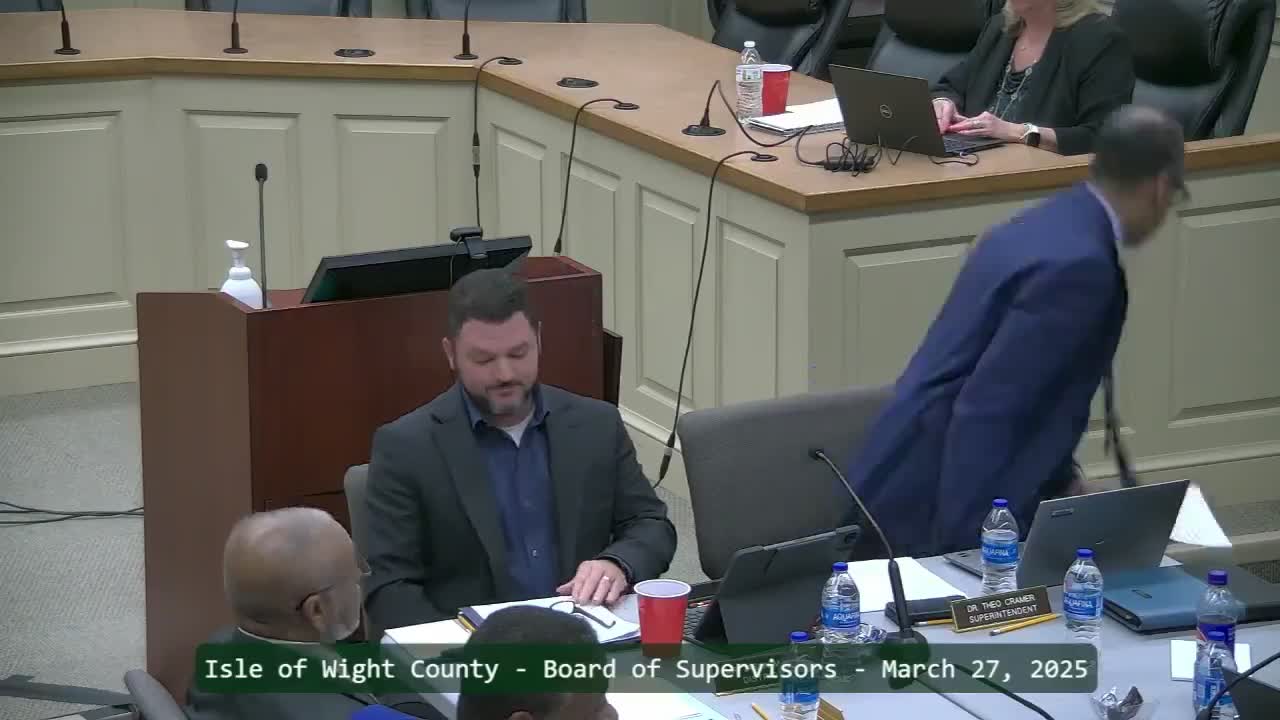
School division leaders presented the Isle of Wight County Board of Supervisors with an overview of the school division’s FY2026 budget request and capital improvement priorities during a joint meeting, saying federal COVID-era funding has ended and the division is projecting revenue declines while asking supervisors to consider several large capital projects and new staff positions.
The presentation, delivered by school division staff, listed a total requested increase of about $6,600,000 and called out specific drivers including a projected $673,000 drop in revenue, a health‑insurance fund increase the presenters said is about $2,400,000, and a set of discretionary and staffing requests. The school division also said it received a $2,700,000 award under the governor’s lab‑school initiative that will be implemented next year.
The request matters because, as presenters reminded the meeting, state law (Code of Virginia § 22.1‑92) gives the division superintendent responsibility to submit an estimate of funds needed for the next fiscal year and the county board must appropriate funds before money becomes available. School staff said they had already approved a budget at their March 18 meeting and were making the presentation so supervisors could ask questions before appropriation decisions.
Most prominent among capital items was a proposed replacement or renovation of the transportation facility. Presenters described three options studied last year: a full new joint facility estimated at about $10,300,000 (no longer recommended), a $7,500,000 standalone bus garage, and a $4,000,000 phased option the school staff said would provide three heavy‑duty working stalls and allow future expansion. Transportation staff said much of the early cost in the $4,000,000 option would go to site infrastructure (demolition, pavement, storm piping, utilities) and that a required stormwater best‑management practice (BMP) pond for the site is currently estimated at about $400,000. Speakers noted state and federal stormwater rules now treat some surface treatments (milling, crush and run) as permanent cover above certain square‑foot thresholds, which affects site costs and options.
School staff also described ongoing bus‑replacement plans and a multiyear approach: the division buys five buses a year under its current replacement rotation but said even with that pace the fleet will remain older than ideal for many years. The division said it seeks 77‑passenger buses in rural routes to maximize capacity and that new buses typically arrive 12–18 months after order.
Capital priorities the school board ranked for FY2026 included: the transportation/bus garage project; replacement buses; weapons‑detection systems already planned for the high schools; a proposed band‑room renovation at Smithfield High School; and ADA bleachers. The school’s band‑room proposal would convert an old boiler room into roughly 2,437 square feet of new band and instructional space; the renovation estimate presented was about $1,400,000 and proponents said the new location would offer direct access to the fields and relieve congested spaces in the current band room.
On staffing, presenters asked for a package of new or reclassified positions. After discussion and a small revision during the meeting, staff said the net request stands at 11 new positions to be added to the operating budget (some positions currently funded with federal Title I or other restricted funds were described as being moved to the operating budget where federal allocations have declined). Key personnel requests emphasized by presenters included: CTE (career and technical education) staff to support an Isle Maritime Trades Academy partnership with Camp Community College and Newport News Shipbuilding; additional clinic assistant time for school health clinics; a registered behavior technician to expand behavior supports across the division; additional SSOs (school security officers) tied to weapons‑detection operations at the high schools; and additional HR support to handle hiring, licensure and retention workload for more than 800 employees.
Presenters said the division’s special‑education preschool population has grown and that 23 preschool students will transition to kindergarten next year, with 17 of those expected to need self‑contained settings; staff said that increase supports a request for three additional self‑contained special‑education teachers for elementary grades. For CTE, the school noted both current employer demand and a planned expansion of welding and ship‑yard–related programs, and said a CTE director position is needed to coordinate grants, partnerships and program growth.
School finance staff described larger cost pressures in benefits and compensation: the budget presentation used a planning assumption of a 3% pay increase and showed the health‑insurance fund rising sharply (presenters used figures that place the healthcare fund increase in the millions). Finance staff said the division’s self‑insured health fund has been underfunded in recent years and that claims have trended up; they reported a working estimate of a roughly 14% increase in rates this year and said the overall health‑insurance fund displays a larger effective increase because of past underfunding.
Several supervisors asked for additional detail: board members requested a formal business case for the bus‑garage project (detailed throughput, bays, mechanic staffing and phasing) and asked for a multiyear capital plan or memorandum of understanding that would track ongoing bus purchases so future boards understand the commitment. School staff said they would prepare the requested business case and noted the capital improvement plan (CIP) is the appropriate place to show multiyear bus replacement plans while reminding supervisors that annual appropriation decisions remain discretionary.
Supervisors probed budget execution and year‑to‑date spending. School finance staff said that prior years’ accounting and an across‑the‑board spending curtailment in FY2024 make single‑line year‑to‑date comparisons difficult, and that in some cases line‑level underspending in one org offset overages elsewhere. School staff also described a planned increase in substitute pay to make the district competitive with neighboring localities and to reduce unfilled long‑term substitute assignments; presenters said substitute pay rates have been low relative to nearby jurisdictions and argued that increasing sub pay should reduce teacher workload disruption and burnout.
The meeting closed with supervisors and board members asking staff for follow‑up documents: a bus‑garage business case, a technology plan and schedules for expected encumbrances and the division’s projected year‑end surplus. School staff and supervisors agreed to continue communication while the supervisors deliberate on appropriation and reserves.
Ending: School leaders and supervisors said follow‑up materials will be provided before final appropriation decisions and that the CIP and operating budget conversations will continue in coming county budget sessions.