Get Full Government Meeting Transcripts, Videos, & Alerts Forever!
Get email alerts on the Behavioral Health topic
No spam. Unsubscribe anytime.
Western Tidewater CSB director outlines same‑day access, school programs and crisis capacity for Isle of Wight
Summary
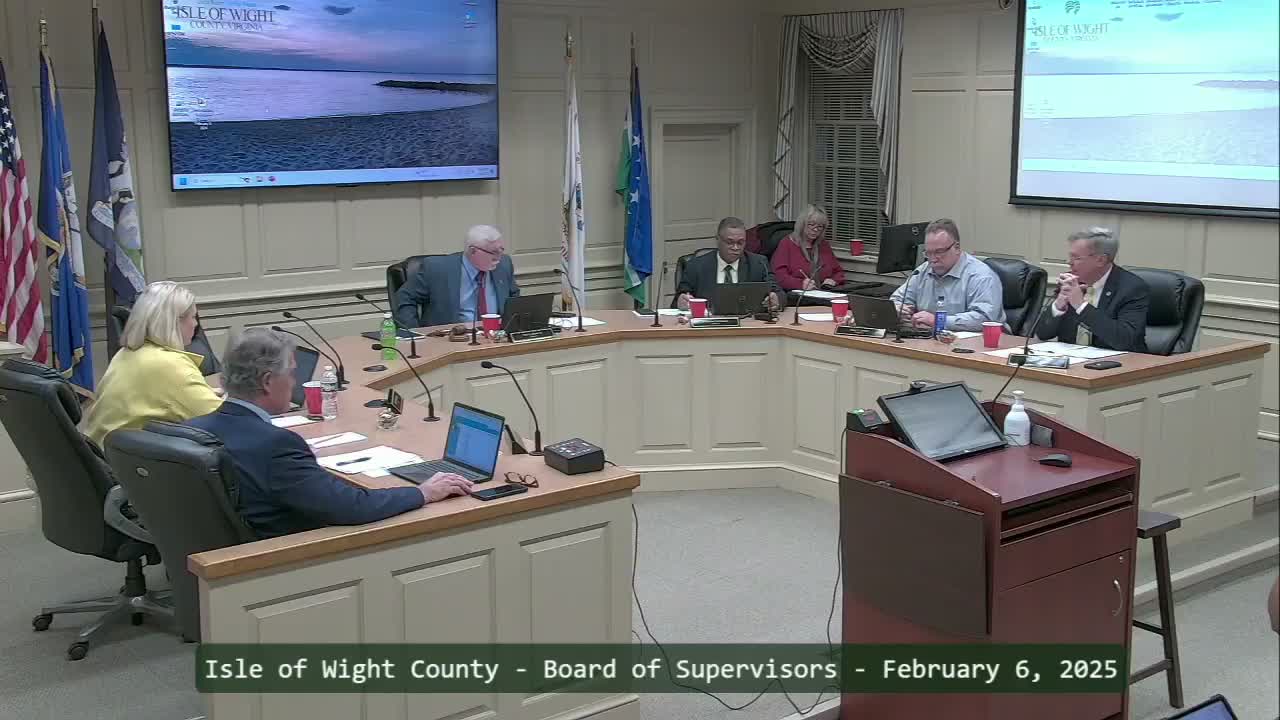
Brandon Rogers, executive director of the Western Tidewater Community Services Board, told the Isle of Wight County Board of Supervisors on Feb. 6 that the agency has opened a larger Isle of Wight clinic offering same‑day access and expanded school‑based and crisis services.
Brandon Rogers, executive director of the Western Tidewater Community Services Board, told the Isle of Wight County Board of Supervisors on Feb. 6 that the agency has opened a new, larger Isle of Wight clinic offering same‑day access and expanded services to residents.
Rogers said the clinic — moved to the Food Lion Plaza in Smithfield — now accepts walk‑ins on Wednesdays with same‑day access between about 8:30 a.m. and 2 p.m. and includes group‑therapy and classroom space, a sensory room for children with developmental needs and a monthly “coffee with a clinician” drop‑in offering. “When they walk in the door, [they] don't need to know what services they qualify for,” Rogers said. “We'll work out a treatment plan with them.”
The nut of Rogers’s message to the board was that the Community Services Board (CSB) is the local public safety net for mental health, developmental and substance‑use services, and that local investment is required: “There's a state mandate that local funds make up 10% of our budget,” he said, and the CSB also bills Medicaid and insurance and uses state and federal funds and grants.
Rogers described core clinical programs now operating in Isle of Wight: outpatient therapy (including CBT, DBT and EMDR), psychiatric medication management with nursing support, case management to coordinate primary care and benefits, and a school counseling intervention program that places case managers and outpatient therapists in four local schools to reduce barriers to care. He said clinical staff are trained to treat trauma in school settings and to work with teachers on behavior and resilience. “One of the best ways to engage [families] is to go to them,” Rogers said.
Rogers also described crisis and stabilization resources. The CSB operates a crisis receiving center in Suffolk that he characterized as a voluntary, 23‑hour program open 24 hours a day where individuals can be assessed and receive nursing, licensed therapy and peer support; the site also provides 24‑hour transportation when needed. He said the CSB operates a children’s crisis stabilization unit in Isle of Wight County that serves children for up to two weeks in a home‑like setting and that the agency plans to add 16 adult crisis stabilization beds to the regional capacity, more than doubling available adult beds in the Southeast Region from the 10 currently available.
Rogers described operational pressures: about $5,000,000 in federal funds support the agency and roughly 3% of that (about $46,470) was temporarily frozen because it was a state pass‑through targeted for diversity, equity and inclusion work. He said the CSB has contingency plans and that staffing and recruitment — especially for specialized therapists such as play and art therapists — is a continuing challenge.
Rogers listed free community trainings the CSB provides, including Mental Health First Aid for adults and youth, SafeTALK (suicide alertness), naloxone education (Revive) and an Adverse Childhood Experiences (ACEs) training he urged the board to promote. He also invited board members and local organizations to request on‑site training; “We will come to you,” he said.
Board members asked about crisis responses when the sheriff's office encounters people in crisis and after‑hours care. Rogers said the agency can pick up voluntary clients at any hour, and that law enforcement sometimes executes emergency custody orders that require hospital evaluations; he said law enforcement staffing, bed shortages at hospitals and the need for dedicated off‑duty officers to staff custody transfers remain obstacles. He identified legislative work under way to allow special conservators of the peace to assist with custody and transport.
Rogers closed by asking supervisors for local input as the CSB develops its strategic plan, and thanked Isle of Wight staff and supervisors for local funding and partnership.
The presentation was informational; the board did not take formal action during the report.