Get Full Government Meeting Transcripts, Videos, & Alerts Forever!
Get email alerts on the County Budget Utilities topic
No spam. Unsubscribe anytime.
Supervisors probe water, sewer and stormwater rate changes as tax-relief costs and public-safety staffing drive budget debate
Summary
County staff presented proposed utility rate increases, a cut to the stormwater fee, rising costs for the county tax-relief program, and capital and staffing priorities. Supervisors discussed alternatives including higher tap fees, use of solar-farm funds for apparatus, and possible additional deputies tied to a new hospital.
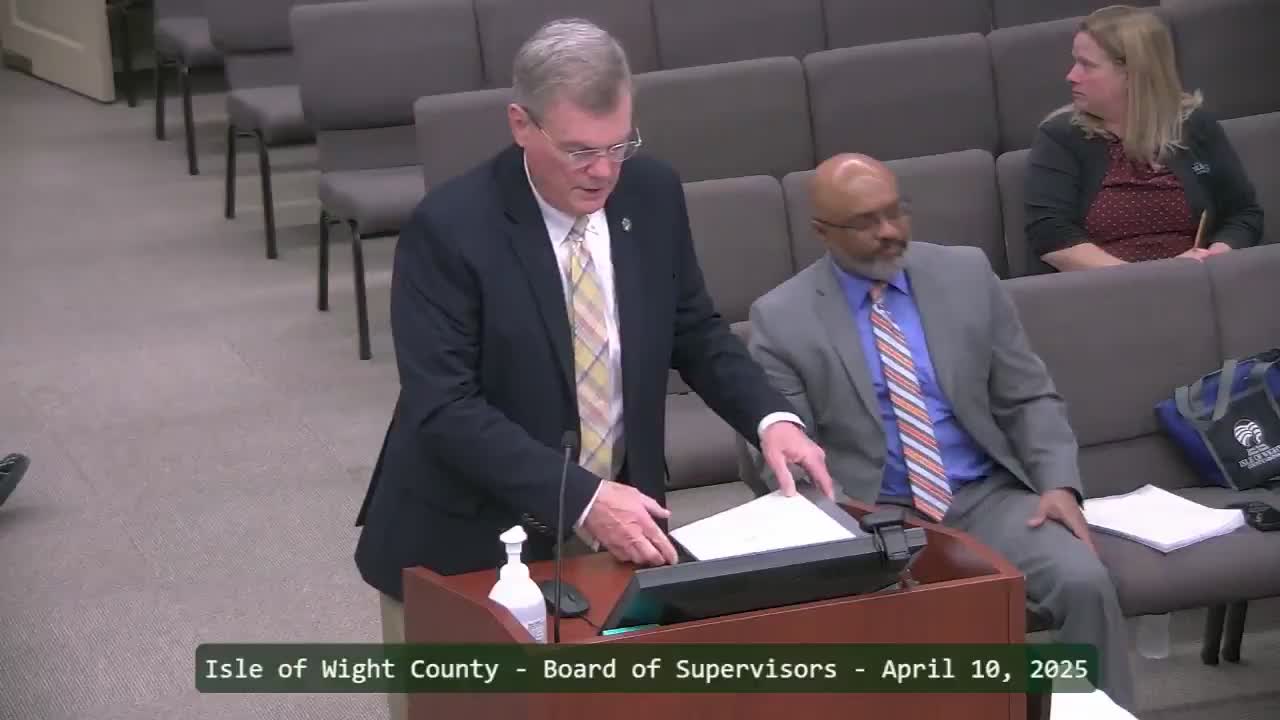
Isle of Wight County staff presented a proposed FY 2026 budget that would raise several utility rates, reduce the annual stormwater fee, and shift capital funding while supervisors pressed for detail on program costs, staffing needs and options to avoid large tax increases.
In the utilities presentation, staff proposed a water rate increase of 66 cents per 1,000 gallons, taking the rate from $13.15 to $13.81 per 1,000 gallons; a monthly base meter fee that would rise about 43 cents to make the meter fee $17 per month; and an estimate that a household using the county average of 5,000 gallons would see roughly a $4 monthly bill increase. Staff said the county budgets about $4.4 million in water sales revenue and currently subsidizes utilities from the general fund by roughly $4.3 million; eliminating the general fund subsidy would require roughly doubling water rates, staff said.
On sewer, staff proposed raising the collection charge from $7 to $9 per 1,000 gallons. Staff noted that treatment of wastewater is performed by Hampton Roads Sanitation District (HRSD), and residents receive separate collection and treatment bills depending on where they live. The county also proposed increasing new-connection (tap) fees: sewer tap fees from $4,000 to $4,500 and water from $4,500 to $5,000. Staff estimated roughly 100 new homes would connect to county water or sewer systems in the coming year (they stressed this excludes homes built outside county systems).
Staff described the county’s purchase agreements for wholesale water: the largest supplier is Western Tidewater (Suffolk) and the county also buys water from the towns of Smithfield and Windsor and the city of Franklin. A Norfolk contract was cited as roughly $1.6 million for reservation and actual use of additional million-gallon-per-day capacity.
On capital, staff proposed transferring $2 million from the general fund balance into the utilities capital program for a multi-item slate of water and sewer projects; staff said there is an additional $1.5 million budgeted for capital repairs, for a potential utilities capital spending total near $3.5 million in the coming year. Several supervisors asked for a prioritized list so the board could see which projects would be done with the available funds and the risks from delay.
Stormwater: staff proposed reducing the annual stormwater fee from $54 to $41 per parcel because the state has taken over permitting for larger development projects and the county no longer bears those engineering and permitting costs. The proposed reduction would lower stormwater fund revenue by about $310,000 (county staff estimated roughly 25,000 equivalent residential units across the county are used to calculate fees). Staff said the stormwater fund remains self-supporting and can be used for matching grants and local projects addressing failing septic systems, such as targeted sewer extensions.
Tax-relief program: staff reported the county’s veterans/elderly/disabled tax-relief expenditures have accelerated. FY 2025 was budgeted at $2.5 million for the full year; through March staff said the program was already approaching $3.0 million with three months to go. Initial FY 2026 planning numbers had $3.1 million budgeted, and staff recommended increasing that line further, noting a potential need to budget roughly $3.6 million to avoid an in-year shortfall. Staff cited rapid take-up of the veterans’ exemption: applications grew from an initial expectation of about 41 to roughly 750 approved veterans with 11 pending at the time of the meeting.
Staffing and FTEs: supervisors and department leaders discussed a set of roughly a dozen new FTE requests countywide that the county administrator did not recommend for funding in the proposed “maintenance” budget. Supervisors asked staff to produce an analysis of vacancies, length of time positions have been posted, and cost-per-FTE so the board could consider tradeoffs (for example shifting savings from unfunded, persistently vacant positions to high-priority public-safety hires). The board discussed public-safety staffing in light of Riverside’s forthcoming emergency department and the potential increased demand on sheriff and EMS resources. The sheriff and the county’s public-safety leaders explained differences between school resource officers (sworn SROs) and school security officers (SSOs) and emphasized training and response roles.
Capital priorities and funding: supervisors examined the draft capital improvement plan and discussed options to avoid additional borrowing. County staff proposed using $2 million in solar-farm funds to preorder fire/rescue apparatus and to allocate funds for several prioritized projects. Board members suggested reducing the scale of a proposed $4 million bus garage to a $775,000 maintenance/extension project to limit borrowing; they also discussed advancing design money for a Carrollton volunteer fire department renovation (design-only estimate discussed at $300,000) and assessing Windsor library and parks requests later in the process.
Nonprofit and service contributions: staff presented the list of discretionary and committed contributions to regional bodies and local nonprofits. The Western Tidewater Free Clinic request accounted for a notable part of the year-over-year increase among discretionary recipients, as the clinic said prescription and dental services have expanded.
Next steps: staff agreed to produce a prioritized capital list, clarify which utilities projects would be included in the $2 million capital transfer, provide comparative tap-fee and rate data from neighboring localities, produce an itemized list of FTE vacancies and durations, and supply the board a calendar of employee-recognition weeks. The board scheduled further budget work sessions and a public hearing on the proposed FY 2026 budget.