Get Full Government Meeting Transcripts, Videos, & Alerts Forever!
Get email alerts on the Noise Ordinance topic
No spam. Unsubscribe anytime.
Supervisors reopen discussion on county noise ordinance, deputies seek objective standard
Summary
Supervisors discussed a redlined draft of the county’s noise ordinance focused on avoiding subjective standards and decibel requirements; county attorney and sheriff’s staff said an objective, easily enforceable rule is preferred, and the item will return for public hearing and further study.
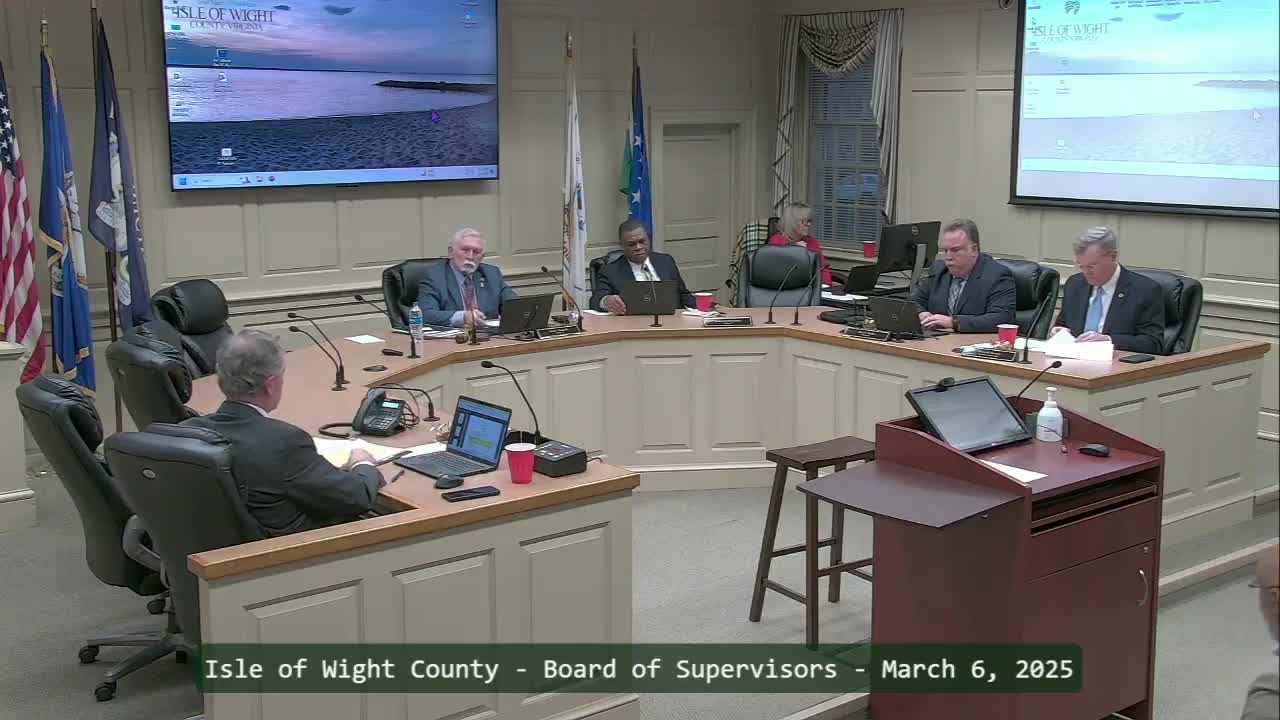
Members of the Isle of Wight County Board of Supervisors reopened discussion on a redlined draft of the county’s noise ordinance, with supervisors, the county attorney and sheriff’s deputies debating how to create an objective, enforceable rule that works across dense and rural areas of the county.
Supervisor Rountree introduced the item and said she had received complaints from residents in higher-density developments. County Attorney Jones said the draft deliberately avoids decibel thresholds and distance-based rules because deputies do not routinely carry calibrated meters and property-line measures can be difficult to apply in practice. “If you’re inside your home … and a police officer can hear the music inside your home, that music’s too loud from your neighbor,” Jones said, describing the goal of an objective standard the sheriff’s office could enforce.
Captain Potter of the Sheriff’s Office confirmed deputies reviewed the draft and said removing requirements that depend on a meter or exact distance would make enforcement more practical. He noted one recurring issue: by the time deputies arrive at a reported noise complaint the noise has sometimes stopped, making enforcement difficult.
Board members discussed tailoring hours or standards for higher-density growth areas (DSDs) and whether to set an earlier quiet-hour in those zones—Supervisor Rountree suggested 10 p.m. in zoned higher-density areas instead of midnight. The group also discussed exemptions for contractors and differences between residential and commercial operations.
Members agreed the draft should be refined with input from the Sheriff’s Office, legal staff and community stakeholders and returned as a work-session item before any public hearing. The board directed staff to gather complaint statistics by geography and to consider whether zoning-based rules or other targeted approaches would avoid unintended consequences for industrial or agricultural uses.