Get Full Government Meeting Transcripts, Videos, & Alerts Forever!
Get email alerts on the Transportation Safety topic
No spam. Unsubscribe anytime.
Isle of Wight begins countywide Safe Streets for All planning with federal grant
Summary
County staff and consultant Wallace Montgomery outlined a USDOT-funded Safe Streets for All action plan to map high-injury corridors, gather public input and produce an implementation-oriented safety plan by spring 2026.
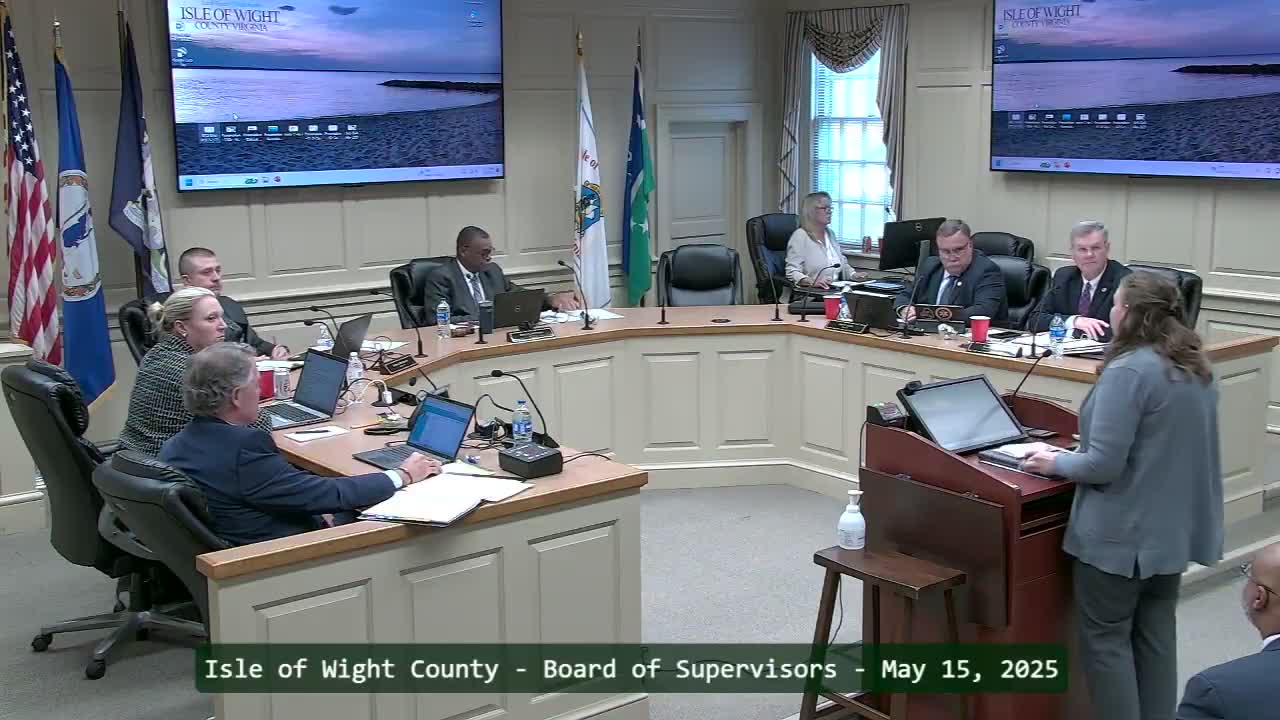
Isle of Wight County officials on Tuesday introduced a federally funded Safe Streets for All (SS4A) action plan to identify dangerous locations and prioritize pedestrian and bicycle safety projects countywide.
The program, led by Transportation Administrator Jamie Oliver and consultant Larry Marcus of Wallace Montgomery, will combine crash-data mapping with pop-up and online public engagement to produce an action plan the county aims to complete in spring 2026. Oliver said the county “was awarded a federal grants” for the program and expects the plan to be countywide.
The plan will create a high-injury network—an interactive map that staff and the public can filter for severe injuries and fatalities, vulnerable road users and crash types. Marcus told the board SS4A follows a federal “safe system” approach and stressed that “deaths, the severe injuries and fatalities are unacceptable,” adding the effort focuses on where severe outcomes occur rather than only counting crashes.
Officials described outreach that pairs public events—farmers markets, Springfest pop-ups—and an online map where residents can mark locations where they feel unsafe. Marcus said the project will “listen to the residents and identify the safety concerns” and then overlay public input with crash data to prioritize locations that appear in both data streams.
Planning staff emphasized the SS4A action plan will produce tools the county can use after the grant ends, including a GIS-based prioritization tool and an equity analysis to focus resources on communities that rely more on walking and biking. The consultants and staff said the plan is intended to feed into small-area plans and county capital programming, and to support later grant applications for implementation funding.
Board members asked about implementation examples from other localities and about the availability of federal implementation grants. Marcus and Oliver said planning grants have been common and that a smaller number of implementation grants have been awarded; Marcus said the implementation pot exists but that jurisdictions must complete a plan before applying.
Oliver and Marcus asked the public to use the project website and the online survey to mark problem locations; Marcus said a community “catch-all” meeting will be scheduled in areas underrepresented in early outreach.
The board received the presentation and engaged staff on coordination with law enforcement, emergency services and schools. No votes were required at the meeting; staff said they will return with ongoing engagement dates and a timeline for the draft action plan.
Why it matters: The plan aims to direct scarce engineering and enforcement resources to locations where severe injuries and fatalities are most likely to occur and to produce a prioritized list that can be used to seek federal and state implementation funding.