Get Full Government Meeting Transcripts, Videos, & Alerts Forever!
Get email alerts on the Utilities Payment Policy topic
No spam. Unsubscribe anytime.
County utilities present formal payment-arrangement policy to standardize assistance for residential customers
Summary
The Department of Public Utilities briefed the board on a formal payment-arrangement policy and agreement for residential water/wastewater customers, standardizing eligibility, an initial payment requirement and maximum terms while allowing flexibility for extenuating circumstances.
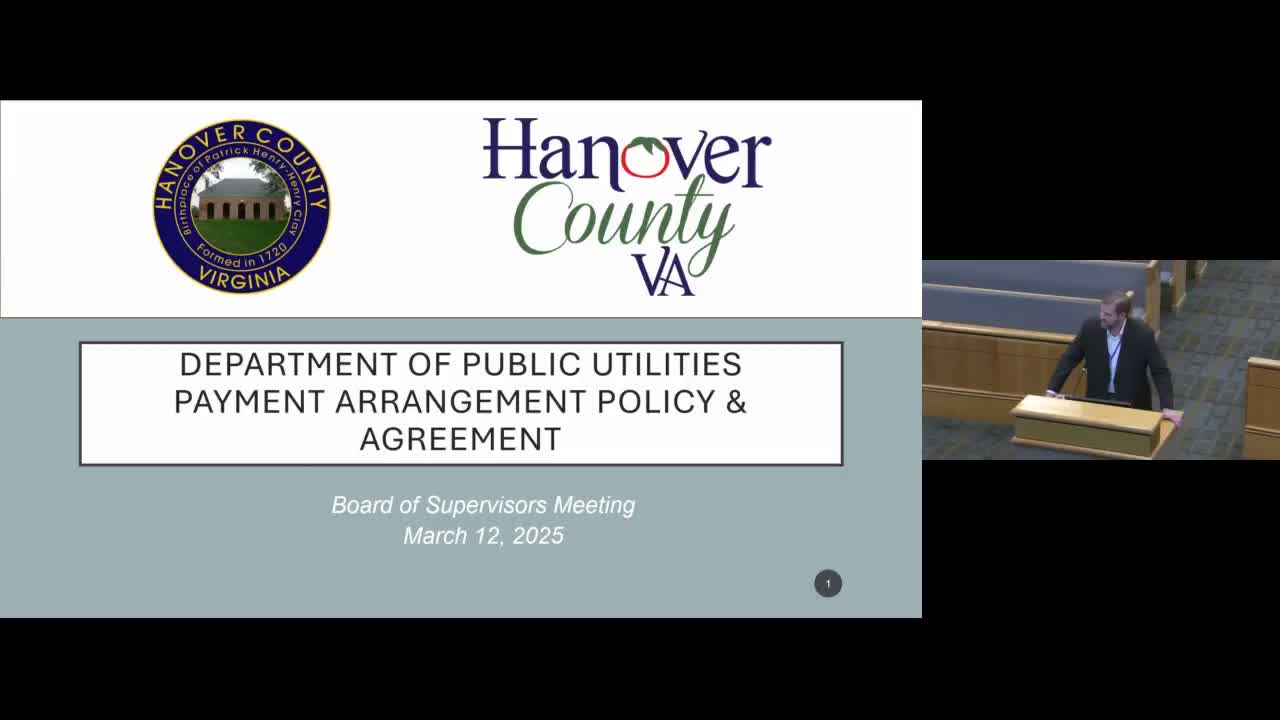
Hanover County Department of Public Utilities presented a new payment-arrangement policy and customer agreement to the Board of Supervisors on March 12, describing how staff plan to manage delinquent residential water and wastewater accounts consistently while providing access to third-party assistance and limited grace periods.
Scott Longshore (presenting) told the board that payment arrangements expanded statewide during the COVID-19 moratorium on utility disconnections and that the county’s draft policy formalizes eligibility criteria, required initial payment and term limits. The policy as presented applies to residential, active accounts and requires an initial payment equal to 20% of the account balance (or the customer may opt instead to make the monthly payment amount). The policy caps most arrangements at a 12-month term but allows longer terms for extenuating circumstances such as recent unemployment or health conditions.
Longshore said the agreement requires a signed document by both the customer and the county and that county staff will return a signed copy and a tangible payment schedule showing monthly amounts. The policy also directs customer-service staff to present third-party payment assistance options and to provide up to a one-week disconnection grace period for customers actively pursuing third-party help. The county attorney reviewed the agreement and the finance committee previously discussed and supported the draft policy, the presenter said.
Why it matters: Formalizing payment arrangements aims to ensure equitable, consistent treatment of customers while preserving a path to avoid disconnection for vulnerable households. The policy clarifies eligibility, payment expectations and default definitions.
Next steps: Presenters said an electronic version of the agreement is being developed for quick delivery to at-risk customers; no board action was required on March 12 because the presentation was informational following finance-committee review.