Get Full Government Meeting Transcripts, Videos, & Alerts Forever!
Get email alerts on the Schools Budget And Capital topic
No spam. Unsubscribe anytime.
Schools ask Frederick County to restore $1.2M of a $4.5M proposed cut as county staff outline capital and debt scenarios
Summary
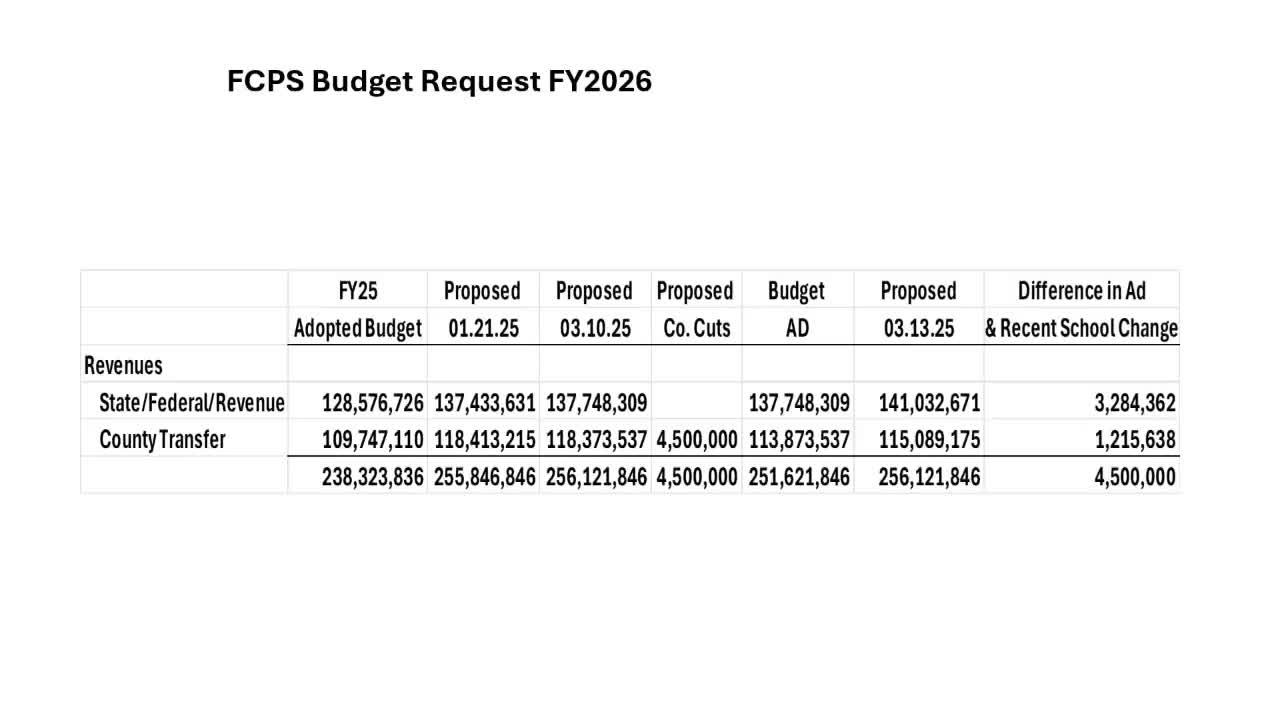
School leaders asked the Board of Supervisors on the 19th to reduce a proposed $4.5 million cut in the county contribution by $1.2 million so the schools can reach their original FY26 request; county staff presented multiple budget pro formas and capital scenarios for board consideration.
School leaders asked the Frederick County Board of Supervisors on the 19th to reduce a county-proposed $4.5 million cut to the school operating transfer by $1.2 million, which the schools say would bring their total county-plus-state budget request back to the amount they originally sought for fiscal year 2026.
Dr. Hummer, representing the schools, told the board the request is separate from a state one-time bonus for school staff and relates to the FY26 needs-based budget. He said the schools expect an additional $3.2 million in state funding for FY26 and that the $1.2 million sought from the county would restore their request to their original $256 million total. "We are asking the county to reduce its reduction of $4,500,000 by the $1,200,000," Dr. Hummer said.
County staff presented a detailed budget model showing adjusted operating expenses, proposed transfers and several capital and fund-balance pro formas under different real property tax-rate assumptions. Mr. Bolhofer, county finance staff, said the administration modeled five scenarios ranging from the revenue-neutral rate to the current 51¢ rate and used a 48¢ target in one scenario to test balance. To get to a balanced number at that rate staff moved transportation costs to the capital fund and identified $500,000 in miscellaneous cuts, software-license savings under review, and a approximately $400,000 estimated sales-tax increase to narrow a gap.
Why it matters: the combination of operating budget decisions, capital needs and projected school debt from approved projects affects the county’s long-term fund balance, the capital fund, and pressure on the real property tax rate. Staff warned that approved school construction projects will raise debt service in coming years and that continued use of the capital fund to balance operating budgets will erode reserves.
School officials outlined enrollment and staffing context. Dr. Hummer said the division currently has more than 14,600 students — about 300 above initial projections this year — and expects continued growth. He described the schools’ needs-based budgeting approach, noting that different categories of students (students with disabilities, English learners, gifted students) carry different per-student cost implications.
On personnel and compensation, the schools described a multi-part approach that started with a 2.5% cost-of-living adjustment, increased to 3% to meet a state funding threshold, and added further adjustments and "declustering" of pay scales and incentives. The division presented group-specific averages: teachers about 4.9%, classified staff about 5.6%, other professionals about 4.4%, and administrators about 3.4%; division-wide average was presented at about 5%.
The schools also described built-in vacancy savings: the division commonly has 40 to 70 unfilled positions during the year and currently budgets roughly $3.0 million as a rolling savings estimate that reduces the county transfer request.
County capital and fire/rescue funding: staff put forward ordinary capital needs for schools and the county (the schools’ preventive-maintenance request was about $14 million this year) and discussed a separate fire/rescue proposal presented by the fire chief to shift equipment and capital costs under a 60/40 cost-sharing model with volunteer companies. Staff and several supervisors stressed that the fire/rescue plan was being included for financial modeling only and would return for public workshops, legal review and memoranda of understanding; no purchase authorization or appropriation was requested at this meeting.
Board discussion emphasized choices the board will face: whether to use unreserved fund balance or the quasi-capital fund to cover large near-term expenses, whether to alter the advertised real property tax rate, and where to prioritize capital requests (transportation, school preventive maintenance, fire/rescue). One supervisor urged an outside, independent review of the volunteer/county fire-rescue financing model before large purchases.
What was not decided: the board did not adopt changes to the advertised FY26 tax rate or finalize any appropriation for the schools’ $1.2 million request. Staff said the board will address adjustments after the public hearing next week and during the following meeting when the board considers the budget resolution.
Ending: County staff recommended further review and workshops on capital priorities, fire/rescue financing, and school funding assumptions before the board adopts a final FY26 budget and any related tax-rate changes.