Get Full Government Meeting Transcripts, Videos, & Alerts Forever!
Get email alerts on the Personal Property Taxes topic
No spam. Unsubscribe anytime.
Frederick County staff report modest uptick in personal property estimates after abatements adjusted
Summary
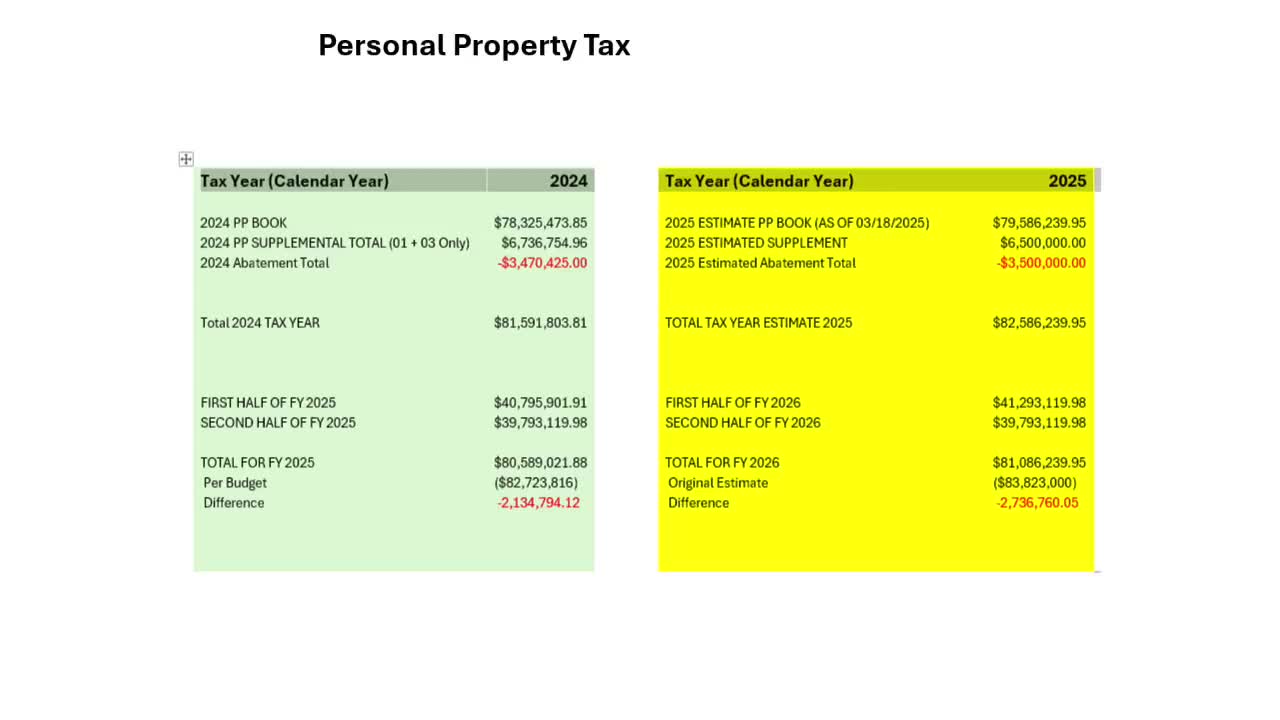
County staff told the Board of Supervisors the county’s conservative personal property (vehicle) tax estimate is $80.5 million for 2025 and $81.0 million for 2026, and that updated abatement and supplement counts reduced a previously reported net negative adjustment from about $3.4 million to $2.7 million.
County finance and revenue staff told the Frederick County Board of Supervisors on the 19th that updated calculations put the county’s conservative personal property tax (vehicle) estimate at $80.5 million for 2025 and $81.0 million for 2026.
The figures were presented by Bonnie, county staff responsible for personal property records, who said, “Our conservative numbers, we now have at 8, 80,500,000. And for, 2026, we have 81,000,000.” She told the board the numbers remain provisional while weekly Department of Motor Vehicles downloads continue and the official tax book is set to close in mid-April.
Why it matters: personal property collections are a material revenue source for county budgets and help set how much the county needs to raise from real estate and other taxes. Small shifts—driven by vehicle supplements (added assessments) and abatements (removed assessments)—change projected revenue and pressure decisions on the county’s fiscal year 2026 budget.
Bonnie said staff expect further small changes as remaining supplements and abatements post and that recent recalculations reduced the projected net abatement (a negative adjustment) from about $3.4 million to about $2.7 million. Mr. Bolhofer, county finance staff, told supervisors the worksheet some members received earlier reflected an estimate run the day before; staff reran the books and updated abatements and supplements, producing the lower net negative figure.
Board members pressed staff on methodology, timing and confidence. One supervisor noted the numbers remain a “moving target” because fiscal and calendar year timing differ—collections for parts of a fiscal year occur in different calendar months—and because JD Power vehicle-value estimates, which staff use, update seasonally. Bonnie and others said jurisdictions across the state have reported reductions in vehicle values since the COVID-related highs and that the county is using JD Power because it provides consistent breakdowns by vehicle type.
Several supervisors asked for a workshop so the board could better understand how personal property estimates are calculated and how supplements and abatements are counted. Bonnie said staff would return for a dedicated workshop that would explain timing, the role of annual data sources such as JD Power, and how the county moves from calendar-year vehicle values to fiscal-year budget estimates.
What was not decided: the discussion was informational. No formal change to the tax rate or final revenue numbers occurred at the meeting; staff said they will continue weekly updates until the book closes and will present the material again in a workshop.
Ending: County staff recommended the board schedule a follow-up workshop on personal property estimation; several supervisors supported that plan so members can see the underlying data and assumptions before finalizing budget decisions.