Get Full Government Meeting Transcripts, Videos, & Alerts Forever!
Get email alerts on the Rest Act Rent Stabilization topic
No spam. Unsubscribe anytime.
Kingston committee endorses REST Act to ease municipal opt‑in to rent stabilization
Summary
The City of Kingston Community Development and Housing Committee voted in April to forward a memorializing resolution urging the New York State Legislature and the governor to pass the Rent Emergency Stabilization for Tenants Act (REST Act, S.4659/A.48877).
The City of Kingston Community Development and Housing Committee voted in April to forward a memorializing resolution to the full Common Council asking the New York State Legislature and governor to pass the Rent Emergency Stabilization for Tenants Act (REST Act, S.4659/A.48877), legislation supporters say would make it easier for municipalities outside New York City to adopt rent stabilization measures.
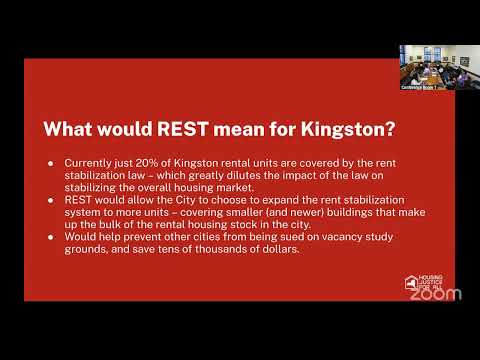
Robin, a representative of Housing Justice for All, told the committee the REST Act would let local elected officials declare a housing emergency and opt into rent stabilization without conducting expensive vacancy studies. “It allows municipalities to declare a housing emergency, and opt in to rent stabilization without having to do a costly vacancy study,” Robin said during the presentation.
Presenters and advocates said vacancy studies — which can cost tens of thousands of dollars and rely on landlord reporting — have blocked opt‑in efforts in several upstate cities; they cited Poughkeepsie and Newburgh as examples where local ordinances were later struck down after legal challenges focused on vacancy study findings. Supporters said the REST Act would let municipalities use publicly available metrics such as homelessness data and housing stock to show local need, and would include a rolling expansion to bring units built up to 15 years before the current date into coverage on an ongoing basis.
The bill, advocates said, would also let municipalities choose whether to cover smaller buildings (under the current statewide standard of six or more units), which could be relevant in Kingston where many rental units are in two‑ or three‑unit houses. The presenter told the committee that in Kingston roughly 20% of the rental stock is currently covered by local rent stabilization and that expanding coverage could protect more long‑term tenants, including seniors on fixed incomes.
Committee members asked about potential unintended effects on small landlords, administrative capacity, and enforcement. One member warned that smaller landlords facing rising maintenance and utility costs might sell to larger corporate owners if they could not absorb expenses; another asked whether the state Division of Housing and Community Renewal (DHCR) has sufficient resources to administer expansion. Advocates said they support increased resources for DHCR and noted that the REST Act is an opt‑in tool that leaves municipal discretion over which unit sizes to include.
Residents and service providers who spoke during the discussion described housing shortages and shelter use in Kingston. Jeannie, a local service provider, said the warming center housed about 60 people during the winter and that staff were able to find housing for only about 10 of them. Another speaker described recent rental listings that were unaffordable for clients of local shelters.
The committee read the memorializing resolution calling on the state to pass S.4659/A.48877 and voted to forward it to the full Common Council. The transcript records members saying “Aye” and that the motion carried; the record does not include a named roll‑call tally.
Presenters asked the council to send the resolution and to signal local support to state lawmakers working on the bill; advocates said state legislators have told them they want to see local elected officials’ backing before moving ahead. Committee members requested follow‑up information on vacancy‑study replacement metrics and potential administrative resources for DHCR.