Get Full Government Meeting Transcripts, Videos, & Alerts Forever!
Get email alerts on the Climate Planning topic
No spam. Unsubscribe anytime.
Climate Smart Kingston assigns leads and homework for 2025 goals
Summary
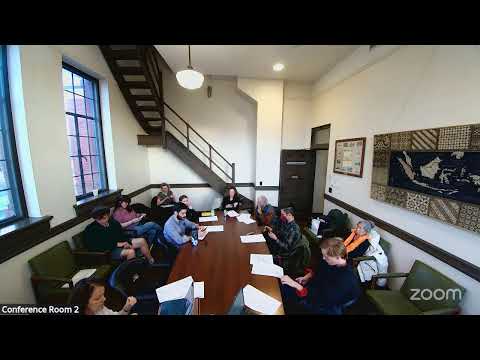
At its Feb. 26 meeting, Climate Smart Kingston reviewed a proposed list of 2025 goals and assigned commissioners and staff to research specific initiatives, including building performance standards, solar readiness, ED (electrification-ready) codes, financing mechanisms and clean mobility.
Climate Smart Kingston members reviewed a circulated list of proposed 2025 initiatives on Feb. 26 and assigned commissioners and staff to research next steps and return with proposals at the April meeting.
The discussion, led by Julie Noble, chair of Climate Smart Kingston and a Parks Department staffer, focused on eight new initiatives the commission had previously identified: benchmarking/building performance standards, solar readiness for new construction, ED (electrification-ready) building codes, PACE and other financing mechanisms, community gardens/local food support, battery storage, clean mobility (bike/e-bike programs) and municipal building electrification. Commissioners discussed whether items should be pursued directly by the commission, supported as a partner to city departments, or referred to other county or regional bodies for action.
The commission’s agenda item began with a staff-prepared spreadsheet mapping each initiative to the city’s Climate Action Plan and to Climate Smart Communities program elements. Noble said she populated roles and actions only for items discussed at the meeting and wanted the group to fill in the “action” column and identify who would do the follow-up work. The group agreed to a phased approach: quick “1” easy wins, “2” medium effort, and “3” heavy lifts.
Key assignments and near-term tasks - Building performance standards and benchmarking: Commissioners agreed this is a heavy lift; the commission will consult Hudson Valley partners and NYSERDA contacts to review model policies and earlier local efforts. A commissioner reported planning to include this work in a work plan beginning in June and will return with a progress update. - Solar readiness and solar permitting: The commission identified an intermediate step before any mandate — requiring that new construction be solar-ready (for example conduit/roof access) — and tasked members to check whether the city’s code already includes readiness language and to compile sample language from peer municipalities. - ED-ready building codes: Commissioners volunteered to review stretch codes and model language to determine a feasible phased approach toward electrification readiness through 2030. - Financing (PACE and other mechanisms): The group agreed to examine both PACE and alternative financing mechanisms tied to building performance work; commissioners will produce a short memo or rationale if they recommend deprioritizing PACE. - Ulster County IDA and developer incentives: The commission discussed limits of its jurisdiction. Members agreed the commission could advise the city council or planning board, but direct action on the county IDA would be out of the city commission’s jurisdiction; the commission may refer the matter to the Ulster County Climate Smart Committee or send a communication to the mayor if appropriate. - Battery storage, municipal fleet and CCA: Members will scope battery storage and municipal fleet implications, and will reach out to Hudson Energy Transition and other partners about community choice aggregation (CCA) and municipal readiness. - Clean mobility (bike share / e-bike rebates): The commission identified a possible role in outreach and consultation for a clean mobility grant being pursued by city staff.
Process and next steps Noble proposed assigning two people to each initiative to research what it would take and return with concrete proposals at the April 23 meeting. Commissioners agreed to that approach: volunteers were named for several items at the meeting, and staff will circulate an updated actions table. The commission planned a one-hour focused follow-up on the initiative list in April and asked members to report back with findings rather than exhaustive research so the group can prioritize which items to carry forward.
Why it matters The commission framed these initiatives as a mix of city-led policy changes and supportive roles the advisory body can play. Several items — especially building performance standards and mandatory solar installation — would require substantial legal or zoning changes and coordination with the Common Council, planning board or county entities, so the commission focused on preparatory analyses and short-term, feasible actions (for example, recommending solar-readiness code changes) as an initial pathway.
Ending: The commission scheduled a progress report for the April meeting and asked members to coordinate with assigned partners (NYSERDA contacts, Hudson Valley regional partners, city departments) to prepare short memos with recommended next steps.