Get Full Government Meeting Transcripts, Videos, & Alerts Forever!
Get email alerts on the Municipal Budgeting Tax Cap topic
No spam. Unsubscribe anytime.
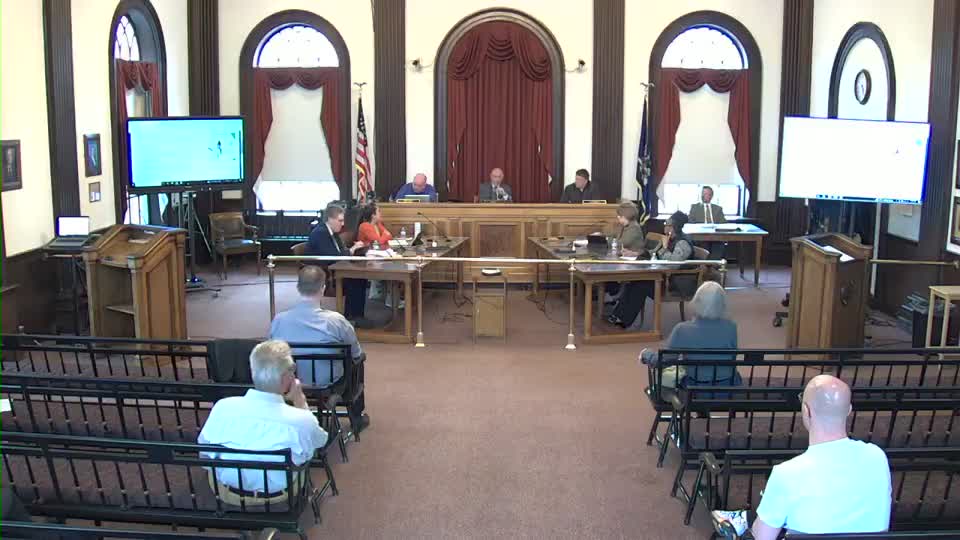
Auburn council opens first reading of local law to exceed state tax cap as budget gap persists
Summary
The Auburn City Council on Thursday held a first reading of a local law that would let the city adopt a 2025'1,026 budget with a property tax levy above New York State's statutory cap and set a May 22 public hearing.
The Auburn City Council on Thursday held a first reading of Local Law No. 1 of 2025, which would allow the city to adopt a 2025–26 budget with a real property tax levy above the limit set in New York State General Municipal Law, chapter 24, article 2, section 3-c, and authorized a public hearing for May 22.
The proposal matters because the council said it may be necessary to bridge an ongoing budget gap caused by flat state aid and rising costs. City officials discussed options including updates to enterprise fund charges, departmental spending reductions and closer scrutiny of retiree health coverage.
Mayor James N. Genentino introduced the reading and, after the presentation of the law'which states it would allow the city to exceed the statutory tax levy limit'the council voted to advertise and hold a public hearing. "As was stated, this is a first reading. It's a required step in a multistep process," Genentino said during the meeting.
Councilors and staff spent much of the meeting on budget topics. Councilor Kent asked for more granular disclosures and line-item detail for the 204 lines in the budget, saying residents and staff deserve clarity before possible tax increases or position cuts. "We owe it not only to the people of Auburn but to the employees of this organization to put in that extra time and just detail the 204 lines of the budget with what the exact expenses are," Kent said.
City Manager (Mr.) Geiger described several technical budget adjustments under consideration. He told the council the city re-evaluated its calculation of a return-on-investment (ROI) charge that enterprise funds pay to the general fund: "That has historically been at 10%. We adjusted that to 15% this year." Geiger also described an administrative charge based on shared services and said the sewer fund absorbed an increased charge because of an upcoming large capital project.
Councilors raised spending-control ideas including a 10% reduction target in energy budgets, centralizing supply purchases, and reexamining refuse collection frequency and commercial-account billing. Councilor Cuddy urged the council to consider predictable, sustainable funding and highlighted efforts to press the state to make temporary AIM (Aid and Incentives to Municipalities) increases permanent.
No tax increase is approved by the reading alone. The local law must be publicly heard and then adopted by the council; the law notes a 60% council vote is required under state law to override the tax levy limit. The council scheduled the public hearing for May 22, and Genentino said the city will continue to pursue other revenue and cost-saving measures while the state budget process unfolds.
For now the action on May 1 was procedural: the first reading occurred and the council authorized the public hearing. The council voted to advance the local law and the public hearing by roll call during the meeting.