Get Full Government Meeting Transcripts, Videos, & Alerts Forever!
Get email alerts on the Water Quality Owasco Lake topic
No spam. Unsubscribe anytime.
Owasco Lake inspectors report 47 sites of concern; council hears update on monitoring, grants and staffing
Summary
The Owasco Lake Watershed Management Council told the Auburn City Council the watershed saw increased reporting and identified 47 sites of concern in 2024, urged continued monitoring and sought city support for updated stream maps and potential staffing increases tied to municipal funding.
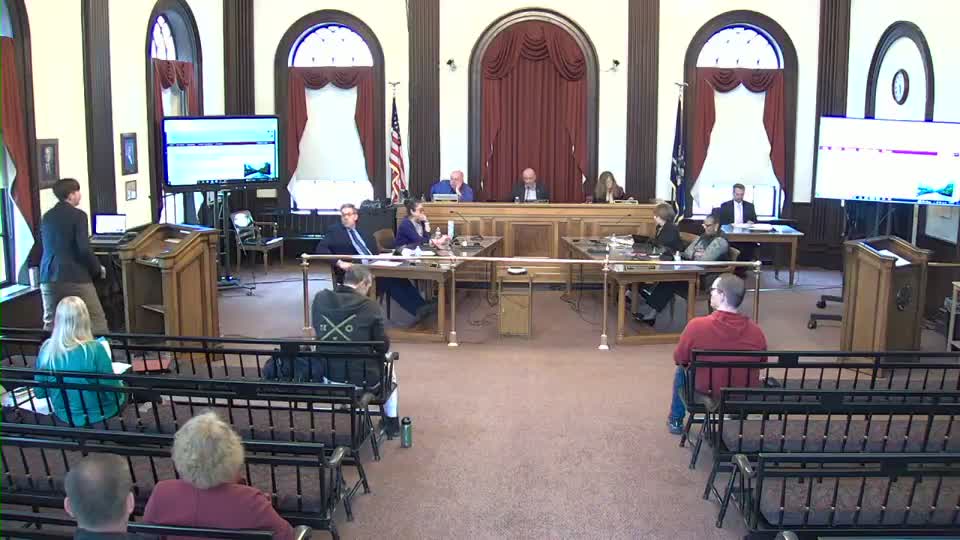
Adam Efler, executive director of the Owasco Lake Watershed Management Council, told the Auburn City Council on May 8 that the council is expanding inspections, grants and on-the-ground projects aimed at reducing phosphorus and limiting harmful algal blooms in Owasco Lake.
The update outlined the watershed council’s recent work, funding status and a 2024 inspection summary that the council’s lead inspector said identified 47 sites of concern across the watershed. "Inspections are based on regulatory parameters with guidance from the Watershed Inspection Committee," Jesse Lloyd, lead watershed inspector for the Owasco Lake Watershed Inspection and Protection Division, told the council. "Watershed inspectors identified 47 sites of concern in 2024."
Why it matters: Owasco Lake supplies drinking water for roughly 45,000 people in the city and Cayuga County, and the council and city described harmful algal blooms as a continuing public‑health and recreation risk. The management council said monitoring, agricultural best management practices and stream stabilization are central to its 9‑element watershed plan and long‑term water quality goals.
Key facts and recent developments presented to council members included: Efler said the council has secured 100% financial buy‑in from its board of directors for 2025 and reported a current committed annual total of $53,750 from participating municipalities; the council also noted that the City of Auburn previously budgeted a larger commitment (the presentation referenced a city commitment figure budgeted at $275,000 for 2025 and earlier annual commitments cited in the presentation). Efler told the council the model used in the 9‑element plan estimates roughly 90% of phosphorus loading to the lake originates from agriculture, and that implementing four primary agricultural practices could, in the model, reduce phosphorus loading by about 30 percent.
Lloyd described enforcement and voluntary compliance work in 2024, including cases elevated to the Cayuga County Department of Health and the New York State Department of Environmental Conservation (DEC). He gave examples of sites where inspectors documented severe erosion, stormwater and construction concerns, agricultural operations without required protections, and an illegal waste‑oil site that the DEC has characterized as nonhazardous waste but that remains in legal limbo. "This is an orphan site," Lloyd said, describing difficulties resolving ownership and cleanup responsibilities.
The council highlighted several grant‑funded and partner projects: a National Fish and Wildlife Foundation award for Owasco Inlet stream restoration and stream‑bank stabilization projects; a $138,750 Great Lakes Restoration Initiative grant for hemlock woolly adelgid suppression; the Finger Lakes Land Trust’s $1.24 million award for conservation easements and acquisitions; and participation with Ducks Unlimited on a wetland restoration award. The Fillmore Nature Preserve, a 61‑acre parcel the council now stewards, was cited as a priority conservation site with recent public‑education improvements.
Monitoring and metrics were a major focus. Efler said state guidance uses summer‑average chlorophyll a of 4 micrograms per liter as a benchmark for the 9‑element plan, but he warned that metric alone may not capture harmful algal bloom risk. Lloyd described a program of tributary and storm‑event sampling and noted Hobart and William Smith Colleges’ buoy remains deployed and that data are now digitized for public access.
Councilors pressed for clearer enforcement tools and mapping. Efler and Lloyd asked the city for help endorsing an updated, more usable protected‑streams map developed with Cayuga County planning staff; Efler said the management council needs an endorsed base map (the regional planning board’s approval) to replace an older, less clear map that the current 1984 rules and regulations still reference. Councilors indicated they would explore a resolution or other support to aid that endorsement effort.
No formal council vote or appropriation occurred; the presentation was informational. Efler said the council has budgeted for potential staff additions (an additional inspector was mentioned as part of the 2025 budget plans) but that hiring depends on municipal contributions.
Looking ahead: Efler noted pending state actions and legislation, including DEC and EPA activity and a recently reintroduced Harmful Algal Bloom Monitoring and Protection Act scheduled for a Senate hearing May 21; he urged continued municipal support for funding, monitoring and regulatory clarity. Lloyd said the inspection program will continue monthly reporting to the management council and will pursue voluntary compliance, with escalation to county or state authorities where warranted.