Get Full Government Meeting Transcripts, Videos, & Alerts Forever!
Get email alerts on the Municipal Utilities Budget topic
No spam. Unsubscribe anytime.
Auburn municipal utilities director outlines budget, recommends small rate increases and highlights biosolids, lead-service work
Summary
Director of Municipal Utilities Seth Jensen presented the department's fiscal 2025'26 budget picture to the Auburn City Council, recommending a 2% annual increase to water and sewer retail rates, reporting progress on a biosolids project and a lead service line inventory funded by a nearly $1 million grant.
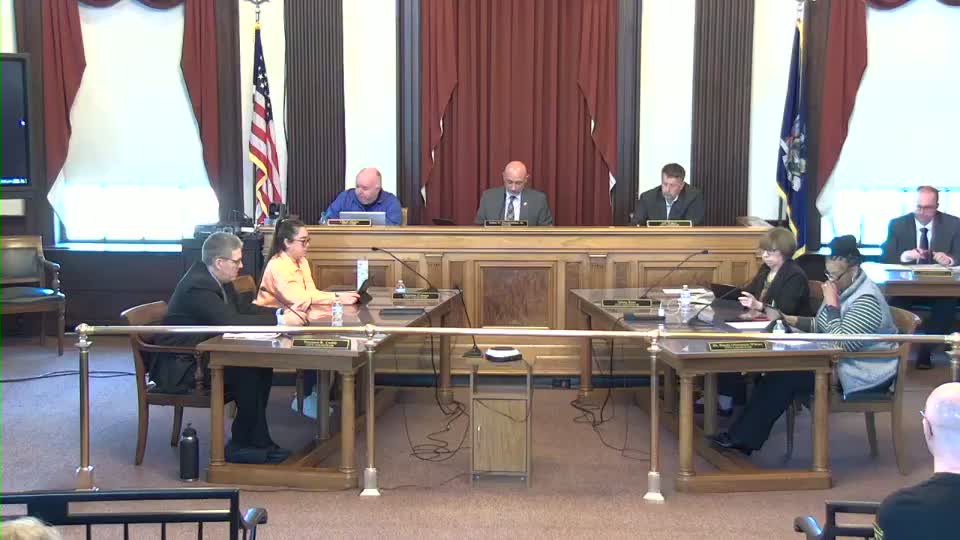
Director of Municipal Utilities Seth Jensen presented the municipal utilities department's proposed fiscal 2026 operating and capital budgets to the Auburn City Council on Thursday, April 17, outlining water, sewer and power funds, near-term projects and staffing risks.
Jensen told the council that "Our primary function at this point is to manage our water fund, sewer fund, and power utility fund." He recommended a modest, phased approach to rates: "A 2% small increase in our water and sewer rate, each year over the next 5 years," to stabilize revenue and protect fund balances.
Why it matters: municipal utilities supply drinking water and sewer service directly to city residents and to multiple wholesale customers in Cayuga County, and decisions about rates and capital projects affect both household bills and the utilities' ability to maintain aging infrastructure.
Jensen said the water fund treats about 4'4.5 million gallons per day on average, has nine water-treatment employees and roughly 14 million gallons per day of treatment capacity; the system serves Auburn plus 12 other municipal wholesale customers. The sewer fund treated about 6.7 million gallons per day last year (base flow nearer 3'4 MGD), has about 14.5 full-time-equivalent positions and 12.4 MGD capacity, Jensen said.
A major near-term change is the biosolids project at the wastewater treatment plant. Jensen said partial commissioning will yield operating savings this fiscal year and larger savings next year: the presentation estimated a reduction in operating biosolids costs from roughly $1.4'1.5 million last year to about $1.1 million for fiscal 2026, a roughly $200,000'$400,000 midyear impact tied to digestion startup. He said digesters should be running and the dryer installed within the calendar year if commissioning proceeds on schedule.
Jensen also described the lead service line inventory effort supported by "nearly a million dollar grant," and a new GIS-based application that staff will use to identify service-line materials and publish an outward-facing map so residents can check the material serving their property. He said about half of the city's ~4,000 services remain classified as "unknown" and that reducing that unknown class will limit unnecessary public notifications.
On the power side, Jensen said the city's two hydroelectric facilities are operating and provide remote net-metering credits, but the power fund carries significant debt service: roughly $1 million in debt, with about $290,000 tied to the cogen facility annual payments for the next 12 years. He said staff are working to operate the hydros at a profit to repay the general fund over time.
Councilors pressed Jensen on staffing and long-term projects. Jensen warned of upcoming retirements, noting some utility employees have 30 years of institutional knowledge. He listed risks including wholesale agreement negotiations with towns, potential intake-extension work to avoid harmful algal bloom impacts, and continued work on the watershed rules and regulations.
Councilors asked for clarification on specific items: Councilor Kent asked whether intake-extension design work will proceed this year; Jensen replied that the recently adopted capital plan includes funding to begin design work so the city can pursue state grant funding. Councilor Robert Street Wilson pressed Jensen on staff development and career ladders; Jensen said the department is working to define milestones, compensation steps and clearer career tracks to retain and promote internal candidates.
The presentation also summarized multi-year goals: fully implementing biosolids beneficial reuse to reach Class A biosolids, completing the lead-service-line inventory, developing an asset-management system, and continuing funding for watershed management.
Ending: The council did not take final action on rates during the presentation; Jensen's recommendations will feed into the formal budget adoption process later in the spring.