Get Full Government Meeting Transcripts, Videos, & Alerts Forever!
Get email alerts on the Commission Governance Values topic
No spam. Unsubscribe anytime.
Columbia River Gorge Commission holds workshop to draft shared values after year of internal review
Summary
Commissioners and consultants from the Avarna Group spent a public meeting workshop identifying challenges, opportunities and six draft values — transparency, sustainability, respect, equity/fairness, access and community — as the commission considers how to integrate “DEI”-related aims into its dual mandate.
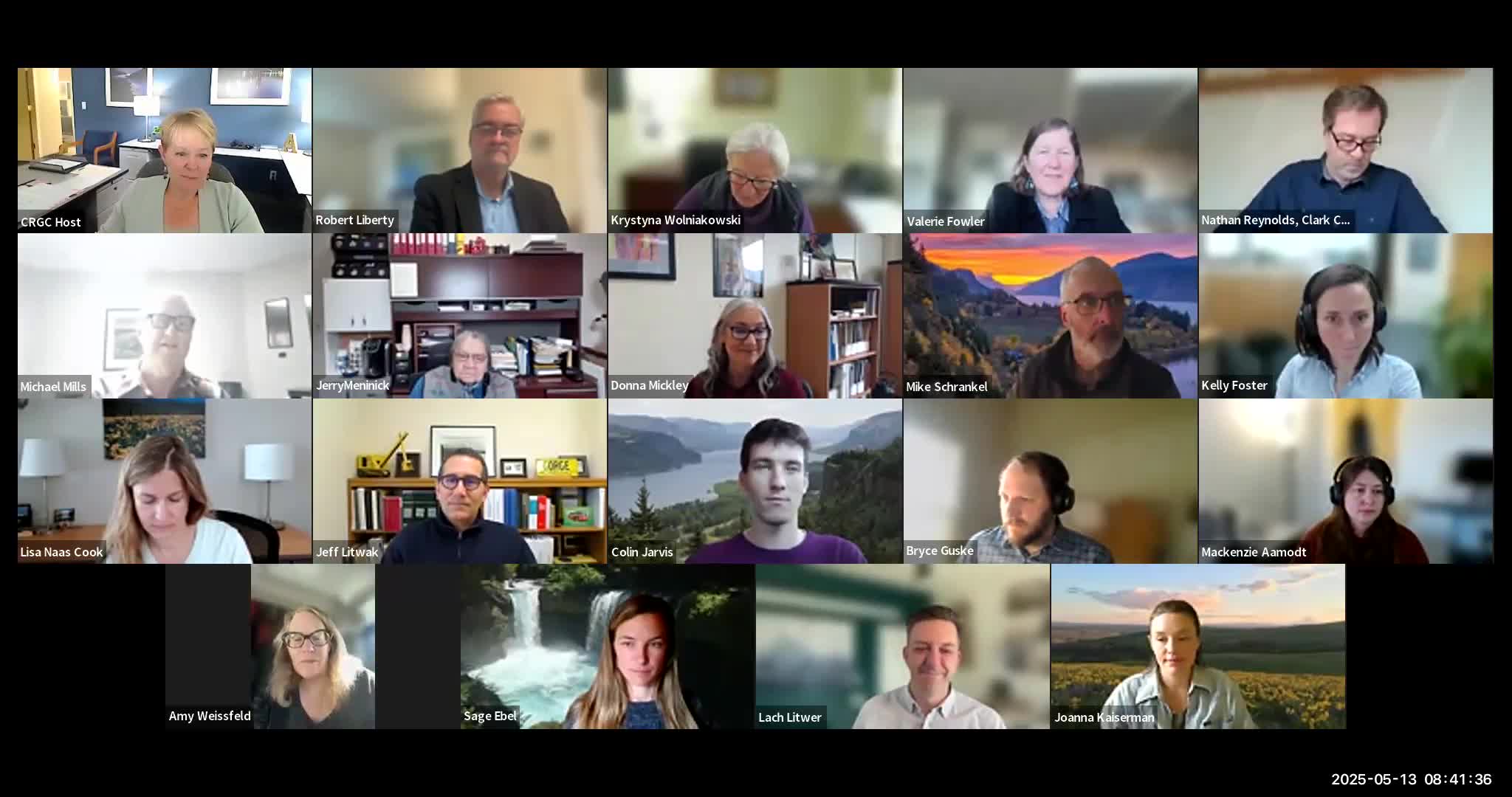
Commissioners of the Columbia River Gorge Commission and consultants from the Avarna Group spent a May 13 workshop identifying shared values and the next steps for integrating those values into commission work.
The session, led by Aparna of the Avarna Group and facilitator Sianna Carrillo Walker Flom, reviewed themes from one-on-one interviews with eight commissioners and then used an interactive poll to surface the six values participants ranked most important: transparency, sustainability, respect (or respectful), equity/fairness, access and community.
Aparna said the session was meant to “reimagine how you can all work together to achieve your common goals” and clarified the workshop was a conversation starter, not a training: “This is why today is not a DEI training, but it is the beginning of a conversation,” she told commissioners.
Why it matters: Commissioners are charged by the Columbia River Gorge National Scenic Area Act with a dual mandate to protect scenic, natural, recreational and cultural resources while supporting economic vitality. Several commissioners and the consultants said the commission’s reputation and historical focus has emphasized scenic preservation over economic and community needs; the workshop intended to begin resolving that tension by producing shared principles that can guide future policy, communications and the management plan.
Most commissioners who spoke during the public workshop described the same tension the consultants reported from interviews — that the commission’s work has often been seen as narrowly preserving aesthetics and enforcing rules rather than as also supporting local economies, infrastructure and community resilience. The Avarna Group summarized the interview themes as: 1) a historically myopic focus favoring scenic preservation over broader ecological or community resilience goals; 2) an imbalanced distribution of benefits that favors tourists, landowners and second homeowners over renters, working families and agricultural workers; 3) public perception issues, including confusion between the commission and nonprofit partners such as Friends of the Gorge; and 4) governance and funding strains, including commissioner-staff tensions and volatile state appropriations.
Discussion highlights: Commissioners and staff elaborated how those themes show up in practice. Commissioner Valerie Fowler urged clearer, plain-language communications to improve “transparency with our partners, the 4 Columbia River treaty tribes, and the 6 counties with whom we work.” Commissioner Laura Brennan Bissell and others pressed for definitions of equity and access that reflect local circumstances, including housing and the practical barriers ordinary residents face when navigating land-use rules.
Commissioner Alex Johnson and others raised sustainability as broader than environmental protection, urging inclusion of a sustainable funding model for the commission itself and economic stability for local businesses. Commissioner Corina Miller highlighted the need to center tribal sovereignty and move beyond land acknowledgments to co-created programs and treaty-rights issues. Commissioner Nathan Reynolds emphasized adapting the commission’s planning tools to produce measurable effects on justice and community health rather than treating equity as an abstract principle.
Outcomes and next steps: The group did not vote or adopt formal policy. The consultants said they will draft definitions of the six candidate values and return them for further refinement; they also plan a future workshop focused on historical context and how intersecting histories have shaped the Gorge and commission governance. Staff and consultants said drafted language and raw notes will be circulated for commissioner review and that any operational changes would be considered in formal agenda items or management-plan updates.
Context and caveats: The consultants told commissioners they interviewed eight members in confidential one-on-one sessions; the interactive poll that produced the six leading values was completed by most commissioners (about 11 participants were recorded in the Mentimeter exercise). Participants repeatedly distinguished between discussion (this workshop) and formal action: commissioners did not take formal votes, nor did the session change statute or commission policy.
The session repeatedly returned to funding and governance: presenters noted recent volatility in state appropriations and recommended that the commission integrate values into communications, vital-sign indicators, and program work so the public understands the commission’s role in both protection and economic vitality.
The workshop will be followed by a future session on history; the consultants encouraged commissioners to continue refining draft value definitions before deciding whether to adopt them or to use them for management-plan updates.